Calculate machining taper angle, included angle, ratio, taper per foot, slant, and apex geometry, or reverse-solve diameter and length in metric or imperial units.
Taper Calculator Formulas and Usage
The taper calculator finds the missing value in a straight taper when any four of the five main variables are known: larger diameter, smaller diameter, taper length, taper rate, and taper angle. This is useful in machining, turning, tool design, pipe transitions, reducers, cones, shafts, and any part where the diameter changes uniformly over a measured axial length.
In practical terms, taper describes how quickly a diameter increases or decreases over distance. A larger taper means a faster change in size over a shorter length, while a smaller taper means a gentler transition.
Core Taper Equations
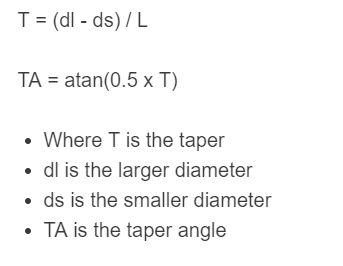
For a straight taper, the diameter change is spread evenly across the total axial length.
Here, α is the taper half-angle measured from the centerline to one side of the taper, and θ is the included angle measured across the full cone. If you are comparing the result to a drawing, make sure the drawing specifies whether it uses half-angle or included angle.
Variable Definitions
| Symbol | Meaning | Notes |
|---|---|---|
| D | Larger diameter | The diameter at the wide end of the taper |
| d | Smaller diameter | The diameter at the narrow end of the taper |
| L | Taper length | Measured along the axis, not along the sloped surface |
| T | Taper rate | Change in diameter per unit of length |
| α | Taper angle | Half-angle from the centerline to the surface |
| θ | Included angle | Full angle from one side of the taper to the other |
Rearranged Formulas
If you already know the taper rate, the calculator can solve for either diameter or the required length directly.
| Find | Formula |
|---|---|
| Larger diameter | D = d + TL |
| Smaller diameter | d = D - TL |
| Length | L = (D - d) / (T) |
| Taper ratio | n = (L) / (D - d) = (1) / (T) |
The taper ratio is often written as 1:n. A taper of 1:20 means the diameter changes by 1 unit for every 20 units of axial length.
How to Use the Calculator
- Enter the larger diameter.
- Enter the smaller diameter.
- Enter the axial length of the taper.
- Select the desired taper unit, such as per inch, per foot, per centimeter, or per meter.
- Select the angle unit if you need the taper angle in degrees or radians.
- If one value is unknown, enter the other four values and let the calculator solve for the missing one.
For accurate results, the large and small diameters must refer to the same feature type. For example, use outside diameters together or inside diameters together, and measure the taper length along the centerline of the part.
Important Interpretation Notes
- Taper is not the same as angle. Taper is a rate of diameter change, while angle describes the slope of the side wall.
- The angle shown by these formulas is the half-angle. If your print calls for the full included angle, double the result.
- Consistent units matter. Diameters and length should be entered in compatible length units before interpreting the taper rate.
- A zero taper means no change in diameter. In that case, the part is cylindrical rather than tapered.
- A negative taper usually means the diameters were reversed. The larger diameter should be greater than the smaller diameter.
Examples
If the larger diameter is 10 in, the smaller diameter is 5 in, and the taper length is 3 in, the taper rate is:
The taper half-angle is:
The included angle is:
If a part must go from 2.50 in to 2.00 in with a taper of 0.125 per inch, the required taper length is:
So the taper must extend over 4 inches of axial length.
Where Taper Calculations Are Commonly Used
- Lathe turning and CNC machining
- Tool holders and machine tapers
- Pipe reducers and nozzles
- Shaft transitions and mechanical fits
- Molded parts and conical components
- Structural or fabrication transitions between two diameters
Frequently Asked Questions
Is taper measured on the diameter or the radius?
In these formulas, taper is based on the change in diameter. That is why the angle equation uses 2L in the denominator. Each side of the taper changes by half of the total diameter difference.
What is the difference between taper and taper angle?
Taper is the amount of diameter change per unit length. Taper angle is the geometric slope of the side wall. Two tapers with different units can describe the same physical shape, but the angle stays tied to the actual geometry.
Why does the calculator need the larger and smaller diameters?
The total diameter reduction is the starting point for all taper calculations. Once that change is known, the taper rate and angle can be determined from the length.
Can I use the calculator for inside tapers?
Yes. The same equations apply as long as both diameters are internal diameters and the length is measured along the axis of the tapered section.
What if I only know the angle and one diameter?
You still need enough information to define the full geometry. In most cases that means knowing one more independent value, such as the second diameter or the taper length.