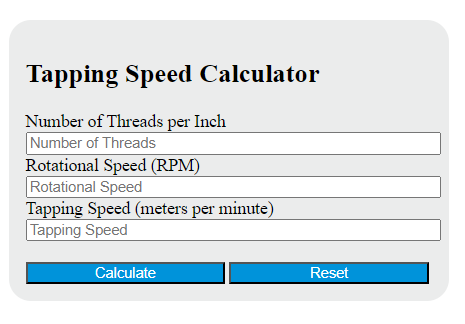
Calculate tapping RPM and pitch-synchronized feed from tap diameter, cutting speed, and TPI or metric pitch, with drill-size and cycle-time checks.
- Every Day Life And Education Calculators
- Threading Rpm Calculator
- Internal Thread Calculator
- Spindle Spacing Calculator
Tapping Speed Formula
For this calculator, tapping speed refers to the axial feed rate required for a tap to move forward exactly one thread pitch for every spindle revolution. In rigid tapping, the spindle speed and feed rate must stay synchronized so the tap does not push too hard or lag behind the thread being formed.
Where:
| Symbol | Meaning | Typical Units |
|---|---|---|
| F | Tapping feed rate | mm/min, m/min, in/min, ft/min |
| N | Spindle speed | RPM or RPS |
| P | Thread pitch or linear advance per revolution | mm/rev or in/rev |
If the thread is entered as threads per inch, convert it to pitch first.
If the thread is entered as threads per millimeter, invert that value to get pitch.
Direct Equations Used by the Calculator
Depending on the units selected, the calculator is applying one of these forms:
If you know threads per millimeter instead of pitch, the metric feed equation can be written directly as:
How to Calculate Tapping Feed Rate
- Select whether your thread input is in threads per inch or threads per millimeter.
- Enter the spindle speed in RPM or RPS.
- Convert the thread count to pitch if needed.
- Multiply spindle speed by pitch to get linear feed per minute.
- Express the result in the output unit that matches your setup, typically meters per minute or feet per minute.
This is especially important on CNC machines using rigid tapping, because the commanded feed must match the thread lead. For standard single-start taps, lead and pitch are the same.
Rearranged Forms
If you want to solve for a missing value instead of feed, these rearrangements are useful:
Examples
A metric thread with a 1.25 mm pitch running at 500 RPM requires this feed:
An imperial thread of 20 TPI running at 300 RPM gives this feed:
Quick Reference at 500 RPM
| Thread | Pitch / Advance per Rev | Feed Rate |
|---|---|---|
| 8 TPI | 0.125 in/rev | 5.208 ft/min |
| 10 TPI | 0.100 in/rev | 4.167 ft/min |
| 13 TPI | 0.0769 in/rev | 3.205 ft/min |
| 20 TPI | 0.0500 in/rev | 2.083 ft/min |
| 0.80 mm pitch | 0.80 mm/rev | 0.400 m/min |
| 1.00 mm pitch | 1.00 mm/rev | 0.500 m/min |
| 1.25 mm pitch | 1.25 mm/rev | 0.625 m/min |
| 1.50 mm pitch | 1.50 mm/rev | 0.750 m/min |
| 2.00 mm pitch | 2.00 mm/rev | 1.000 m/min |
Unit Conversions
Important Notes for Machining
- This calculator determines feed rate from thread pitch and spindle speed; it does not choose the best spindle RPM for the material or tap style.
- Recommended RPM depends on workpiece material, tap diameter, tool coating, lubrication, hole depth, and machine rigidity.
- If feed is too fast for the actual pitch, the tap can bind or break. If feed is too slow, the threads can tear, rub, or go out of form.
- Rigid tapping requires the feed command to stay locked to spindle rotation. Floating holders can absorb some mismatch, but they do not replace correct feed calculation.
- For blind holes, leave room for chip evacuation and reversal so the tap does not bottom out before the cycle ends.
Common Mistakes
- Confusing TPI with pitch. TPI is a count, while pitch is the distance traveled in one revolution.
- Mixing RPM and RPS without converting between them.
- Treating tapping feed rate as the same thing as cutting surface speed.
- Entering metric pitch values as threads per millimeter, or vice versa.
- Using the right RPM but the wrong feed units when programming the machine.
FAQ
- Is tapping speed the same as spindle speed?
- No. Spindle speed is rotational motion, while tapping speed here is the axial feed rate created by that rotation and the thread pitch.
- Why does feed have to match pitch exactly?
- Each revolution of the tap should move it forward by one thread pitch. Any mismatch forces the tool to pull or push against the thread form.
- Can I use this for metric and imperial threads?
- Yes. The calculator supports both systems as long as the thread input and output units are selected consistently.