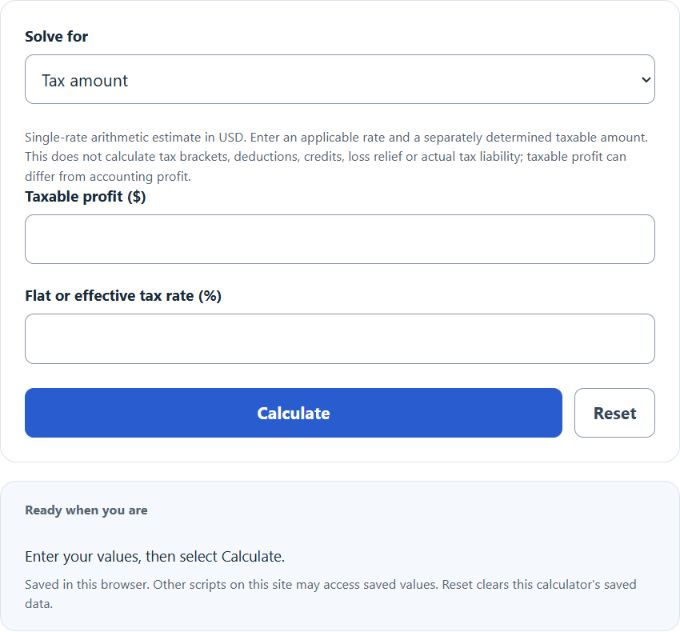
Calculate tax on profit, taxable profit, or profit tax rate with an explicit solve mode and two inputs. This is a single-rate arithmetic estimate, not a jurisdiction-specific tax-liability calculation.
Related Calculators
- Annual Profit Calculator
- Variable Margin Calculator
- Incremental Cost Calculator
- Suggested Retail Price (SRP) Calculator
- All Business Calculators
Tax On Profit Formula
The tax on profit calculator uses the taxable profit, the profit tax rate, and the tax amount. Select the value to solve for and enter the other two. Use a separately determined nonnegative taxable amount and a flat or effective rate from 0% to 100%.
- TOP = tax on profit, in dollars
- PBT = taxable profit, in dollars (which can differ from accounting profit before tax)
- TR = profit tax rate, as a percentage
If you enter taxable profit and the tax rate, the calculator finds the tax on profit. If you enter tax on profit and the tax rate, it finds the taxable profit. If you enter taxable profit and tax on profit, it finds the implied profit tax rate.
Profit Tax Rate Reference Tables
These tables illustrate arithmetic only; none of these percentages is asserted to be your applicable legal tax rate.
| Tax Rate | Decimal Used in Formula | Tax per $1,000 Profit |
|---|---|---|
| 5% | 0.05 | $50 |
| 10% | 0.10 | $100 |
| 15% | 0.15 | $150 |
| 20% | 0.20 | $200 |
| 25% | 0.25 | $250 |
| 30% | 0.30 | $300 |
| Taxable Profit | Tax Rate | Tax on Profit | Taxable Amount Less Modeled Tax |
|---|---|---|---|
| $10,000 | 15% | $1,500 | $8,500 |
| $25,000 | 20% | $5,000 | $20,000 |
| $50,000 | 25% | $12,500 | $37,500 |
Tax On Profit Examples
Example 1: Calculate tax on profit
You have taxable profit of $40,000 and a profit tax rate of 18%.
The tax on profit is $7,200.
Example 2: Calculate the profit tax rate
You paid $6,000 in tax on $30,000 of taxable profit.
The implied profit tax rate is 20%.
Tax On Profit Calculator FAQ
What is taxable profit?
Taxable profit is the profit amount that is subject to tax. It is usually calculated after subtracting allowable business expenses, deductions, or other adjustments from revenue. The calculator treats the value you enter as the profit amount that will be taxed.
Is tax on profit the same as profit after tax?
No. Tax on profit is the tax amount owed on the taxable profit. The calculator reports the taxable amount less modeled tax; this is not necessarily accounting profit after tax. For example, if taxable profit is $10,000 and tax is $2,000, the remaining taxable amount is $8,000.
Can the tax rate be zero?
A zero tax rate means no tax is applied to the profit, so the tax on profit is $0. The calculator cannot use a 0% rate to calculate taxable profit from a tax amount, because dividing by zero is not valid.