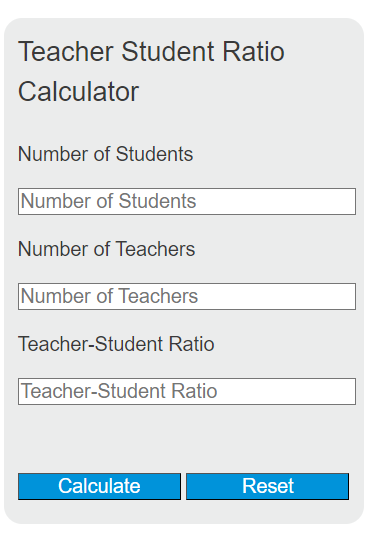
Calculate students per teacher, estimate whole teachers needed for a target ratio, or find student capacity using teacher headcount or full-time-equivalent staffing.
Related Calculators
- Student to Faculty Ratio Calculator
- Class Size Calculator
- Average Monthly Attendance of Students Calculator
- Percentage Achievement Calculator
- Decimal to Ratio Calculator
- All Math and Numbers Calculators
Teacher-Student Ratio Formula
The teacher-student ratio measures how many students are assigned to each teacher. In calculator form, the main value is usually expressed as students per teacher, which can then be written in ratio form for reporting.
Where:
- R = students per teacher
- S = total number of students
- T = total number of teachers
If you need to solve for a missing input instead of the ratio, use the rearranged formulas below.
How to Read the Result
If the calculator returns 30, that means there are 30 students for every 1 teacher. The same relationship can be reported in two common ways:
- Student-to-teacher form: 30:1
- Teacher-to-student form: 1:30
This distinction is important because people often say “teacher-student ratio,” but the raw calculation is still based on students divided by teachers.
How to Calculate Teacher-Student Ratio
- Count the total number of students in the class, grade, program, or school.
- Count the total number of teachers serving that same group.
- Divide students by teachers to find students per teacher.
- Write the result in the ratio format that fits your use case, such as 20:1 or 1:20.
Why This Ratio Matters
Teacher-student ratio is commonly used for staffing analysis, enrollment planning, hiring decisions, budgeting, and comparing instructional support across classrooms or schools. A lower number means fewer students per teacher, while a higher number means each teacher is responsible for more students.
Examples
Finding the ratio from student and teacher counts
This means 30 students per teacher. It can also be stated as 30:1 in student-to-teacher form or 1:30 in teacher-to-student form.
Finding the number of students from a target ratio
If a school has 25 teachers and wants to maintain 18 students per teacher, it can support 450 students at that ratio.
Finding how many teachers are needed
If enrollment is 540 students and the goal is 18 students per teacher, 30 teachers are needed.
Quick Reference Table
| Students | Teachers | Students per Teacher | Student-to-Teacher Form | Teacher-to-Student Form |
|---|---|---|---|---|
| 60 | 3 | 20 students per teacher | 20:1 | 1:20 |
| 120 | 4 | 30 students per teacher | 30:1 | 1:30 |
| 315 | 15 | 21 students per teacher | 21:1 | 1:21 |
| 450 | 25 | 18 students per teacher | 18:1 | 1:18 |
Teacher-Student Ratio vs. Class Size
Teacher-student ratio and average class size are not always the same. Ratio is a broad staffing measure, while class size describes how many students are physically placed in a specific classroom. A school can have a favorable overall ratio and still have larger individual classes depending on scheduling, specialist teachers, intervention staff, or shared instructional roles.
Tips for Accurate Results
- Use student and teacher counts from the same group and the same time period.
- Be consistent about whether part-time staff are counted as full teachers or by full-time-equivalent staffing.
- Decide in advance whether aides, paraprofessionals, specialists, and support teachers are included.
- Do not reverse the ratio order when reporting results; 25:1 and 1:25 describe the same relationship in different formats.
- If you are comparing schools or programs, make sure each one uses the same counting rules.
When the Answer Is Not a Whole Number
Some planning problems produce a decimal result for teachers needed.
In staffing decisions, that usually means you would round up to 23 teachers if your goal is to stay at or below 22 students per teacher. Rounding down would create a higher actual ratio than the target.
Using This Calculator Effectively
This calculator is most useful when you know any two of the three values: students, teachers, or ratio. Enter the two known values, leave the unknown blank, and calculate. The result can help with classroom planning, staffing targets, school comparisons, and enrollment forecasting.