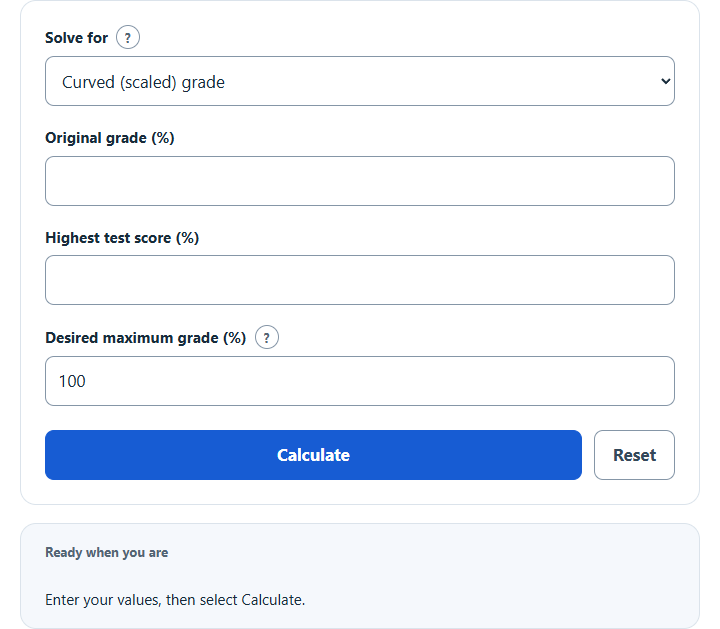
Curve grades by scaling to the highest score: enter a grade and the top score in the class to get the curved grade, or solve for any missing value.
- All Statistics Calculators
- Quiz Grade Calculator
- Average of Percentages Calculator
- Overall Grade Calculator
- Square Root Curve
Calculator Functions
| Function | What it does | What it requires |
|---|---|---|
| Curved (scaled) grade | Finds a curved grade by scaling every score so the highest score becomes the desired maximum | Requires the original grade, the highest test score and the desired maximum grade, which starts at 100% |
| Original grade | Finds the grade before the curve from the curved grade | Requires the curved grade, the highest test score and the desired maximum grade |
| Highest test score | Finds the top score that turns an original grade into a given curved grade | Requires the original grade, the curved grade and the desired maximum grade |
| Desired maximum grade | Finds the maximum the top score was scaled to | Requires the original grade, the highest test score and the curved grade |
| Target class average | Curves a grade so the class average moves to a target, by adding points or by multiplying | Requires the original grade, the current class average, the target class average and the adjustment method |
| Bell curve | Rescales a grade to a target class average and spread, and estimates its percentile | Requires the original grade, the current class average and the class standard deviation; the target average is 75% and the target standard deviation is 10 points when blank |
All grades are percentages on the same basis. No function caps a result at 100% or rounds it to a letter grade, so limits and rounding from the course policy are applied afterwards.
Scaling Grades Formulas
| SG | Curved (scaled) grade (%) |
| OG | Original grade (%) |
| D | Desired maximum grade (%), usually 100 |
| MG | Highest score on the test (%) |
Curved (scaled) grade
Every score is multiplied by the same factor, D ÷ MG, so the top score lands on the desired maximum. With a top score of 95% and a maximum of 100%, an 80% becomes 80 × 100 ÷ 95 = 84.21%. An original grade above the highest score is rejected.
Original grade
The curve is undone by multiplying by the highest score and dividing by the maximum. A curved 84% on a test whose top score was 95% started as 84 × 95 ÷ 100 = 79.8%.
Highest test score
If an 80% became a 90% after scaling to 100%, the top score was 80 × 100 ÷ 90 = 88.89%.
Desired maximum grade
If an 80% became an 88% on a test with a top score of 95%, the scores were scaled to a maximum of 88 × 95 ÷ 80 = 104.5%.
Target class average
CG is the curved grade, TA is the target class average and CA is the current class average. This is the add or subtract points method: every student gets the same number of points, which is a common way to curve a test [1]. The multiply method scales each grade in proportion:
Moving a class average from 60% to 75% turns an 80% into 95% with added points and into 80 × 75 ÷ 60 = 100% with the multiplier. Both methods move the class average to exactly 75% before any capping.
Bell curve
SD is the standard deviation of the class scores and TSD is the target standard deviation. The z-score says how many standard deviations a grade sits from the class average, and the curved grade puts it the same number of target deviations from the target average. Shifting by an average and stretching by a standard deviation is how any distribution is moved to a new center and spread [3]. A 78% in a class averaging 70% with a standard deviation of 8 has z = 1, which becomes 75 + 1 × 10 = 85%. The percentile is the standard normal cumulative probability at z [2], 84.13% in this case.
How to Curve a Grade
Pick the method the course uses. To scale to the highest score, divide 100 by the top score and multiply every grade by the result: with a top score of 80%, each grade is multiplied by 1.25, so a 60% becomes 75%. To add points instead, find the gap between the top score and 100% and add it to every grade [1]: with a top score of 95%, every grade gains 5 points and an 80% becomes 85%. To curve to a class average or a bell curve, the class average is needed, and the standard deviation as well for a bell curve.
Limits of This Estimate
- Scaling to the highest score helps the top student least and depends on one score. A single outlier at the top leaves everyone else with almost no curve.
- The percentile assumes the class scores follow a normal distribution. A real class rank needs every student's score.
- Capping curved grades at 100% changes the class average and spread the curve was aiming for.
- The instructor or the course policy decides which method applies. The calculator only does the arithmetic for each one.
Sources
- Anthology, Blackboard Help for Instructors, Curve Grades: curving by adding the same points to every score
- NIST/SEMATECH e-Handbook of Statistical Methods, Section 1.3.6.6.1, Normal Distribution: the standard normal cumulative distribution used for the percentile
- NIST/SEMATECH e-Handbook of Statistical Methods, Section 1.3.6.4, Location and Scale Parameters: shifting and stretching a distribution by location and scale