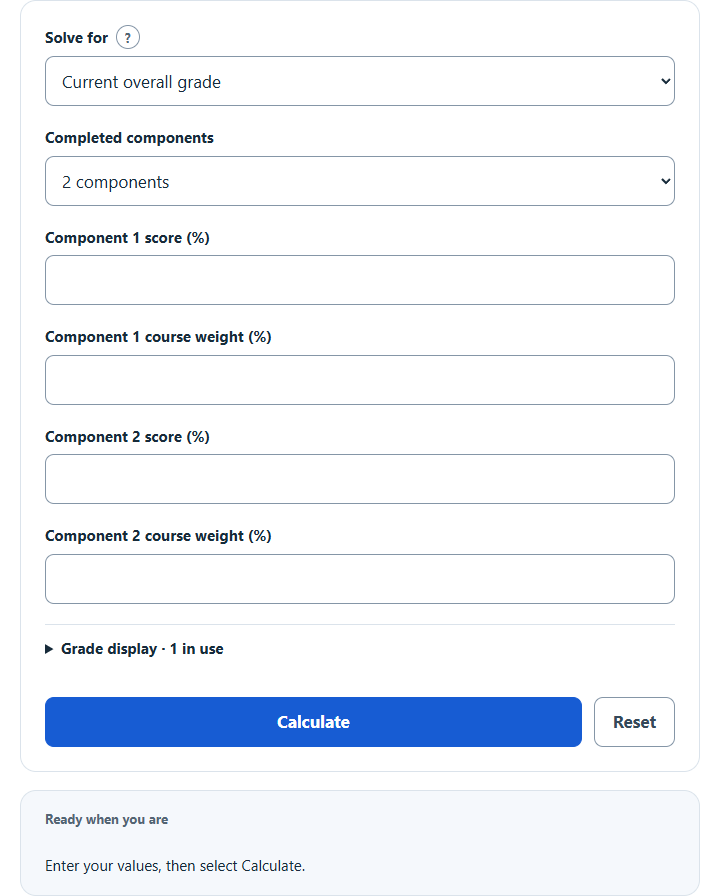
Calculate your overall course grade from weighted scores, or find the score you need on the remaining work to reach your target final grade.
- Every Day Life And Education Calculators
- Quiz Grade Calculator
- Marks Percentage Calculator
- QPA (Quality Point Average) Calculator
- DGPA to Percentage Calculator
- Square Root Curve
Overall Grade Formula
The following formula is used to calculate the overall grade in a class.
- Where G is the overall grade (typically expressed as a percent).
- Ci are the individual grade results (e.g., percent scores).
- Wi are the weights for each grade item (e.g., percent of the final grade).
- N is the total number of graded items included.
Overall Grade Definition
An overall grade combines component scores using course weights. The current mode normalizes the completed weight; it is a final weighted course grade only when all 100% is included. The remaining-work mode uses (target minus earned course percentage points) divided by remaining weight as a fraction.
Overall Grade Example
How to calculate an overall grade?
- First, determine the individual grades.
Determine each individual grade percentage.
- Next, determine the weights of those grades.
Determine how much each grade counts towards the total grade.
- Finally, calculate the overall grade.
Calculate the overall grade using the equation above.
FAQ
An overall grade combines component scores using their course weights. With partial work, this tool normalizes only the completed weight; a final course grade requires the full course and its grading rules.
The reason that some grades affect the overall grade more than others is that they have a higher weight. This weight means these grades count more toward the final grade.
Weighted grade: G = Σ(score × course weight) ÷ Σ(course weight). Divide by the sum of weights, not the number of components. When only part of the course is entered, this is a normalized completed-work average.