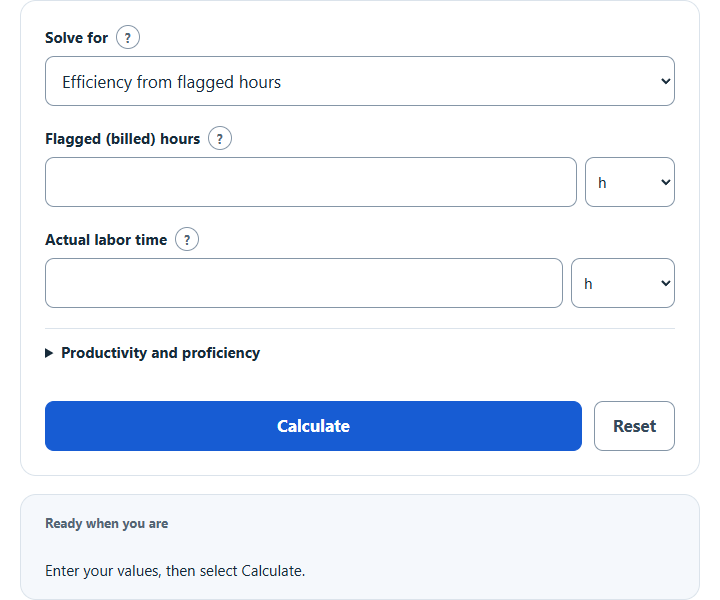
Calculate technician efficiency from flagged hours and actual hours worked, or from jobs and standard times, plus productivity and proficiency.
Related Calculators
- Billable Hours Calculator
- Sales Per Hour Calculator
- Efficiency Increase Calculator
- Cost Per Visit Calculator
- All Business Calculators
Technician Efficiency Formula
Technician efficiency compares earned hours to actual hours worked.
Rearranged formulas:
- TE = technician efficiency percentage
- J = jobs completed
- ST = standard time per job
- AH = actual hours worked
Time values must use the same base unit. The calculator converts minutes and days to hours before calculating. Standard time should represent the allowed labor time for one job or equivalent job. A day is 24 elapsed hours, not an assumed shift. Efficiency is distinct from utilization of paid hours.
Useful Tables
| Efficiency result | What it means |
|---|---|
| Below 100% | Actual time was greater than earned standard time. |
| 100% | Actual time matched the standard time exactly. |
| Above 100% | Actual time was less than earned standard time. |
| Time unit | Hours equivalent |
|---|---|
| 1 minute | 0.0167 hours |
| 1 hour | 1 hour |
| 1 day | 24 hours |
Example
If a technician completes 8 jobs, each with a standard time of 1.5 hours, the earned time is 12 hours. If the technician worked 10 actual hours, efficiency is:
A 120% result means earned standard time is 1.2 times actual labor time. It does not by itself establish quality, safety or overall employee performance.