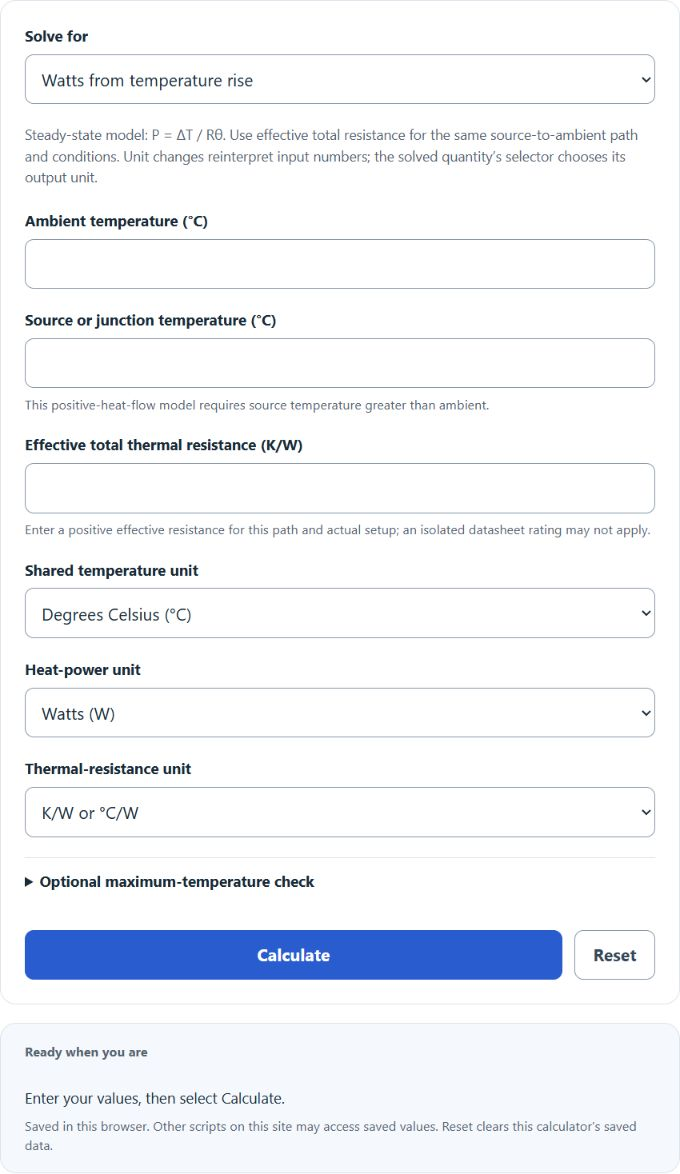
Calculate watts from a temperature difference and thermal resistance (K/W), or solve the source temperature or K/W needed, in °C or °F and W or kW.
- All Unit Converters
- Thermodynamics and Fluid Unit Converters
- Vacuum Temperature Calculator
- Heater Power for a Target Temperature
Temperature To Watts Formula
The following steady-state equation calculates thermal heat flow through an assumed constant thermal conductance. Temperature alone cannot be converted directly to watts.
- P is the steady thermal heat-transfer or dissipation rate (watts)
- ΔT is source temperature minus ambient temperature, expressed as a kelvin or Celsius temperature interval
- CF is the effective total thermal conductance G = 1/Rθ in W/K (numerically equal to W/°C), for the same source-to-ambient path
Multiply the temperature difference by conductance, or equivalently divide it by the effective total thermal resistance: P = ΔT/Rθ. The calculator also rearranges this relation as Tsource = Tambient + P × Rθ and Rθ = ΔT/P. The table below uses k to mean the same conductance as CF; its “Power Output” column is thermal heat flow, not electrical generation.
Choose the solve target and enter the visible values. The units are °C or °F, W or kW, and K/W or K/kW. A Celsius temperature interval equals a kelvin; Fahrenheit intervals scale by 9/5 without adding 32. One kW is 1,000 W, and 1 K/kW is 0.001 K/W. Changing a unit selector reinterprets the entered numbers, so check the labels. The optional maximum-temperature margin is maximum minus source temperature: positive means below the entered limit, zero means at it, and negative means above it.
These estimates require steady conditions, a hotter source than ambient, positive heat flow and positive effective total resistance. The 50%, 100% and 150% power scenarios hold ambient and resistance fixed. Use resistance for the actual assembly and operating conditions; a partial path or a datasheet test-board value is not automatically the total source-to-ambient resistance. See MIT’s heat-transfer notes, equation 2.10, and TI’s thermal-metrics guidance, section 1.8.
| Temperature Difference (°C) | Conversion Factor (W/°C) | Power Output (W) |
|---|---|---|
| 2 | 0.5 | 1.0 |
| 5 | 0.5 | 2.5 |
| 10 | 0.5 | 5.0 |
| 15 | 0.5 | 7.5 |
| 20 | 0.5 | 10.0 |
| 2 | 1.0 | 2.0 |
| 5 | 1.0 | 5.0 |
| 10 | 1.0 | 10.0 |
| 15 | 1.0 | 15.0 |
| 20 | 1.0 | 20.0 |
| 2 | 2.0 | 4.0 |
| 5 | 2.0 | 10.0 |
| 10 | 2.0 | 20.0 |
| 15 | 2.0 | 30.0 |
| 20 | 2.0 | 40.0 |
| 2 | 3.0 | 6.0 |
| 5 | 3.0 | 15.0 |
| 10 | 3.0 | 30.0 |
| 15 | 3.0 | 45.0 |
| 20 | 3.0 | 60.0 |
| Formula: P (W) = k (W/°C) × ΔT (°C). Note: A temperature difference in K is numerically equal to °C; for °F, use k in W/°F or convert accordingly. | ||
What is a Temperature To Watts Calculator?
Definition:
This Temperature To Watts Calculator estimates steady thermal heat flow from a source-to-ambient temperature difference and an entered effective total thermal resistance. It can also solve source temperature or infer resistance from the other values. When the source temperature is a chosen limit, the resistance result is the maximum allowable total resistance under this model; a smaller resistance predicts a cooler source at the same power and ambient temperature. The result is not an equipment certification.
How to Calculate Temperature To Watts?
Example Problem:
The following example calculates steady thermal heat flow using conductance, the reciprocal of the resistance entered in the calculator.
First, determine the temperature difference. For a source at 75°C and ambient at 25°C, the difference is 50°C, or 50 K.
Next, use conductance CF = 2 W/°C, equivalent to total thermal resistance Rθ = 1/CF = 0.5 K/W. In the calculator, enter ambient 25°C, source 75°C and resistance 0.5 K/W.
Finally, calculate the thermal heat flow using the formula above:
P = ΔT * CF
P = 50 * 2
P = 100 watts
FAQ
What factors can affect the power output calculation?
The estimate depends on temperature measurements and the effective resistance or conductance of the actual thermal path. Airflow, mounting, materials and other operating conditions can change that resistance. Fixed-resistance scenarios assume those conditions remain applicable.
How accurate is the Temperature To Watts Calculator?
Its mathematical result follows the entered steady-state model. Physical accuracy depends on input measurements and whether the total resistance represents the actual setup at the operating point. The calculator does not predict warm-up time, thermal storage or changing convection and radiation behavior.
Can this calculator be used for different thermal systems?
Use it for a hotter source rejecting heat to cooler ambient when an effective total resistance is appropriate. This tool requires positive heat flow and does not model cooling below ambient, heat-pump performance or conversion of heat into electrical power. A temperature difference is not by itself an electrical-power source specification.