Convert tension to torque with τ = F × r for a pulley, drum or lever arm, or solve torque to tension or radius, in N·m, lbf·ft, N, lbf or kgf.
- All Physics Calculators
- Acceleration to Torque Calculator
- Belt Tension Frequency Calculator
- Power to Torque Calculator
- Pressure to Torque Calculator
- Torque to Force Calculator
- Bolt Pretension Calculator (Torque and Clamp Tension)
Torque From Tension Formula
The following formula is used to calculate the Torque From Tension.
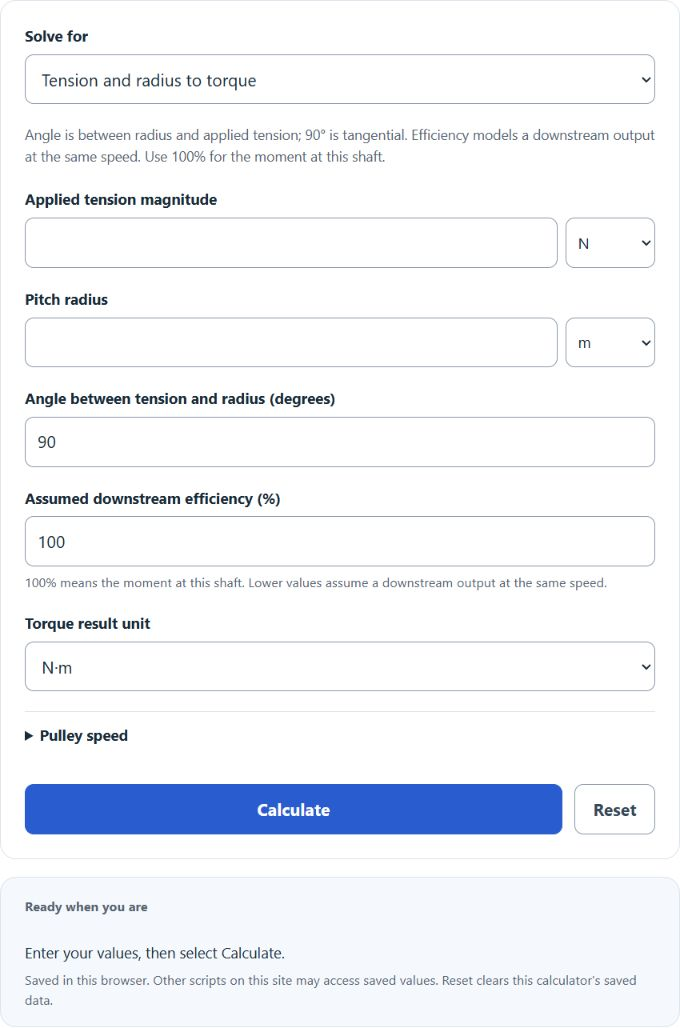
Note: The general moment magnitude is τ = rF sin(θ), where θ is the angle between radius and applied force. The calculator accepts that angle, with 90° selected initially. Its 100% efficiency default gives the moment at this shaft; a lower efficiency models a downstream output at the same speed. The simple T = F × r examples below use 90° and 100%, rather than assuming every input force is already tangential.
- Tt is delivered torque magnitude (N·m) under the stated downstream efficiency assumption
- Tf is applied tension magnitude (N), or T₁ − T₂ for the belt mode
- r is the radius the tension is acting on (m)
Use the selected angle and efficiency in the displayed formula; η is efficiency percent divided by 100. In a belt drive, the torque-producing force is T₁ − T₂. The separate T₁ + T₂ shaft-load estimate applies to parallel outgoing spans and is not a general bearing reaction. Optional speed gives ω = 2π rpm/60, power = delivered torque × ω, and rim speed = rω. Blank speed omits those outputs; zero speed gives zero power. Zero multiplying geometry or efficiency can make an inverse result nonunique at zero torque or impossible for a positive requested torque.
| Tension Force (N) | Torque (N-m) |
|---|---|
| 5 | 2.500 |
| 10 | 5.000 |
| 20 | 10.000 |
| 25 | 12.500 |
| 30 | 15.000 |
| 40 | 20.000 |
| 50 | 25.000 |
| 60 | 30.000 |
| 75 | 37.500 |
| 80 | 40.000 |
| 100 | 50.000 |
| 120 | 60.000 |
| 150 | 75.000 |
| 200 | 100.000 |
| 250 | 125.000 |
| 300 | 150.000 |
| 400 | 200.000 |
| 500 | 250.000 |
| 750 | 375.000 |
| 1000 | 500.000 |
| * At θ = 90° and η = 100%, τ = F × r; r = 0.50 m. Torque scales with r. | |
How to Calculate Torque From Tension?
The following two examples use a single applied force at 90° to the radius and 100% efficiency, so torque simplifies to force × radius.
Example Problem #1:
- First, determine the total tension force (N). In this example, the total tension force (N) is given as 100.
- Next, determine the radius the tension is acting on (m). For this problem, the radius the tension is acting on (m) is given as 30.
- Finally, calculate the Torque From Tension using the equation above:
Tt = Tf * r
Inserting the values from above and solving the equation with the imputed values gives:
Tt = 100 * 30 = 3000 (N-m)
Example Problem #2:
Using the same process as above, first define the variables required by the formula. In this case, these values are:
total tension force (N) = 200
radius the tension is acting on (m) = 50
Entering these values yields:
Tt = 200 * 50 = 10000 (N-m)