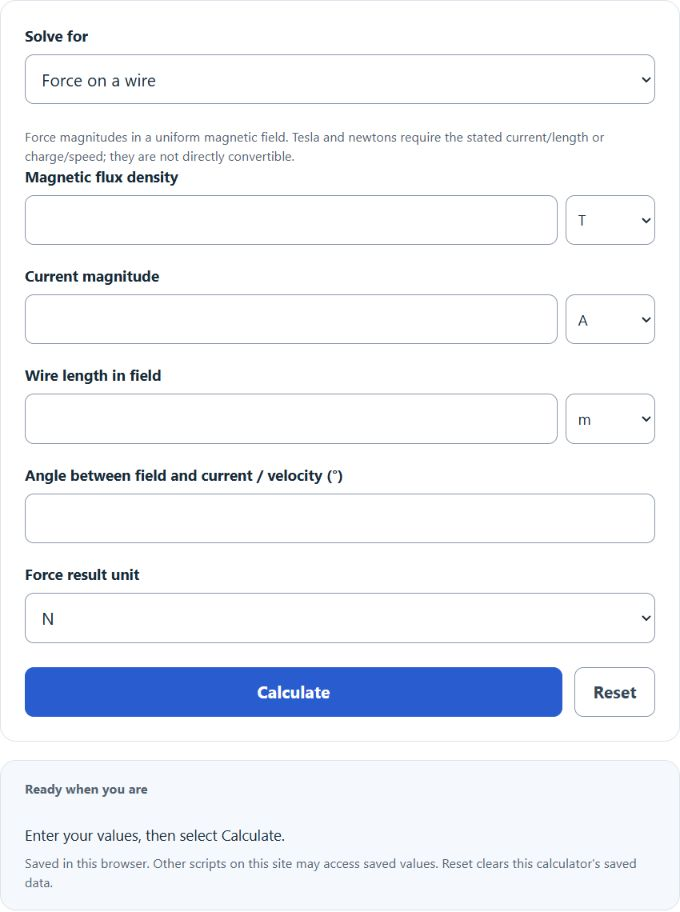
Calculate magnetic force on a current-carrying wire from tesla, current, length, and angle, or solve tesla from force in newtons and vice versa.
- All Unit Converters
- Ampere’s Law Calculator
- Magnetic Levitation Calculator
- Hall Voltage Calculator
- Newton to kg
Tesla To Newton Formula
For a straight wire in a uniform field, F = B × I × L × sin(θ), and B = F / (I × L × sin(θ)) when the denominator is nonzero. Here I is current magnitude and L is wire length in the field. The moving-charge mode uses the following formula for force magnitude.
Variables:
- F is the magnetic-force magnitude (newtons, N)
- q is the electric charge (coulombs, C); the sign of q affects direction, not the magnitude
- v is the speed of the charge (meters/second, m/s)
- B is the magnetic field strength (tesla, T)
- θ is the angle between the velocity direction and the magnetic field direction
To calculate moving-charge force magnitude, multiply |q| by speed, magnetic flux density and sin(θ). At θ = 90°, F = |q| v B. Angles run from 0° to 180°; 0° and 180° give zero force. Zero current or wire length also gives zero forward force, but a zero denominator cannot determine a unique field in the reverse solve.
| Magnetic Field (T) | Force (N) |
|---|---|
| 0.00005 | 0.00005 |
| 0.00010 | 0.00010 |
| 0.001 | 0.001 |
| 0.005 | 0.005 |
| 0.010 | 0.010 |
| 0.020 | 0.020 |
| 0.050 | 0.050 |
| 0.10 | 0.10 |
| 0.20 | 0.20 |
| 0.30 | 0.30 |
| 0.50 | 0.50 |
| 0.75 | 0.75 |
| 1.00 | 1.00 |
| 1.50 | 1.50 |
| 2.00 | 2.00 |
| 2.50 | 2.50 |
| 3.00 | 3.00 |
| 4.00 | 4.00 |
| 5.00 | 5.00 |
| 10.00 | 10.00 |
| *Assumes θ = 90° (perpendicular motion) and |q| = 1 C, v = 1 m/s so that F (N) = B (T). Adjust proportionally for other |q|, v, or angles using sin(θ). | |
What is Tesla To Newton?
A Tesla to Newton conversion is not a direct conversion because they are units measuring different physical quantities. Tesla (T) measures magnetic flux density, while newton (N) measures force. However, they are related through the magnetic part of the Lorentz force law: the magnetic-force magnitude on a moving charge is F = |q| v B sin(θ) (vector form: F = q(v × B)), where θ is the angle between the velocity and magnetic field.
How to Calculate Tesla To Newton?
The following steps outline how to relate tesla (magnetic field strength) to newtons (magnetic-force magnitude) using the formula: F = |q| · v · B · sin(θ).
- First, determine the charge (q) in coulombs (C).
- Next, determine the speed of the charge (v) in meters/second (m/s).
- Next, determine the magnetic field strength (B) in tesla (T).
- Next, determine the angle (θ) between the velocity direction and the magnetic field direction (θ = 90° means perpendicular).
- Next, use the formula F = |q| · v · B · sin(θ) to calculate the magnetic-force magnitude (F) in newtons (N).
- After inserting the variables and calculating the result, check your answer with the calculator above.
Example Problem :
Use the following variables as an example problem to test your knowledge.
charge (q) = 2 coulombs
speed of the charge (v) = 5 meters/second
magnetic field strength (B) = 3 tesla
Assume the velocity is perpendicular to the magnetic field (θ = 90°), so sin(θ) = 1. Then: F = |q| · v · B · sin(θ) = 2 · 5 · 3 · 1 = 30 N.