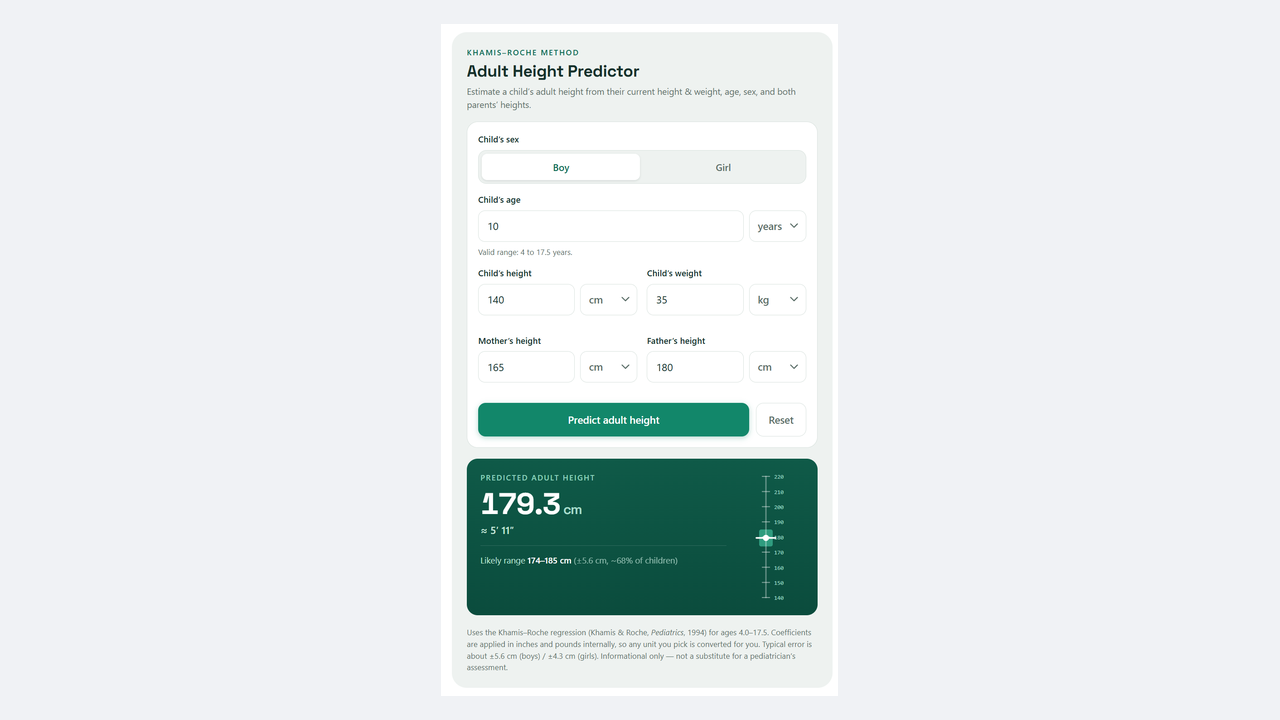
Calculate a child’s predicted adult height in cm from age, sex, height, weight, and parents’ heights with the Khamis-Roche method.
Adult Height Predictor
Estimate a child’s adult height from their current height & weight, age, sex, and both parents’ heights.
Uses the Khamis–Roche regression (Khamis & Roche, Pediatrics, 1994) for ages 4.0–17.5. Coefficients are applied in inches and pounds internally, so any unit you pick is converted for you. Typical error is about ±5.6 cm (boys) / ±4.3 cm (girls). Informational only — not a substitute for a pediatrician’s assessment.
- All Health and Medical Calculators
- Bone Age Height Calculator
- Midparental Height Calculator
- Growth Velocity Percentile Calculator
- Tibia Length to Height Calculator
- Bone Length to Body Height Calculator
Calculator Functions
| Function | What it does | What it requires |
|---|---|---|
| Predicted adult height | Estimates the adult height of a child aged 4 to 17.5 years, in cm and in feet and inches, with a likely range around it | Requires the child’s sex, age, current height and current weight, and the height of both biological parents |
Heights can be entered in cm or inches and weight in kg or pounds. Each measurement has its own unit, so metric and US figures can be mixed.
Khamis-Roche Method Formulas
β₃ × m [2]
| H | Predicted adult height (in) |
| h | Child’s current height (in) |
| w | Child’s current weight (lb) |
| m | Mid-parent height (in): the mother’s height plus the father’s height, divided by 2 |
| β₀ | Intercept for the child’s sex and age |
| β₁–β₃ | Multipliers for height, weight and mid-parent height, also set by sex and age |
The method predicts adult height from the child’s present size and the parents’ heights, without the hand-wrist X-ray that a skeletal age would need [1]. It has a separate set of four coefficients for boys and for girls at every half year of age from 4.0 to 17.5 [2]. The calculator holds all 56 sets. For an age between two half years, such as 10.3, it takes each coefficient part of the way between the rows on either side.
The coefficients work in inches and pounds, so metric entries are converted first at 2.54 cm per inch and 2.2046 lb per kg, and the answer is converted back to cm. For a 12-year-old boy the coefficients are −9.3522, 0.68325, −0.020076 and 0.60927. At 150 cm (59.06 in) and 40 kg (88.18 lb), with a 165 cm mother and a 180 cm father (mid-parent 67.91 in), the prediction is −9.3522 + 40.35 − 1.77 + 41.38 = 70.60 in, or 179.3 cm.
The likely range shown under the result is the prediction plus or minus 5.6 cm for boys and 4.3 cm for girls. The foot-and-inch figure is rounded to the nearest inch.
Limits of This Estimate
- The method was built from children in the Fels Longitudinal Study, 223 boys and 210 girls from southwest Ohio who were white and free of disease. Its authors limit it to white American children without a condition that alters growth in height [1]. For other children the result is a rougher guide.
- A prediction is not a measurement. The median error reported for boys aged 4.0 to 17.5 is 2.2 cm [2], which means half of predictions miss by more than that. Early or late puberty moves a child away from the estimate.
- Both parents’ heights should be measured. Self-reported heights tend to be overstated [2], and that error carries into the result.
- The coefficient table and the likely range are taken from published versions of the method. These estimates are based on the best available data and estimations.
- The result is for information only. It does not replace a pediatrician’s assessment of a child’s growth.
Sources
- Khamis and Roche, Predicting Adult Stature Without Using Skeletal Age: The Khamis-Roche Method, Pediatrics 94(4), 1994 (Wright State University record): purpose of the method, the study sample and who it applies to
- Radnor and others, Maturity Has a Greater Association than Relative Age with Physical Performance in English Male Academy Soccer Players, Sports 9(12), 2021: the form of the equation, its inputs, half-year coefficients, the median error for boys and overstated self-reported heights