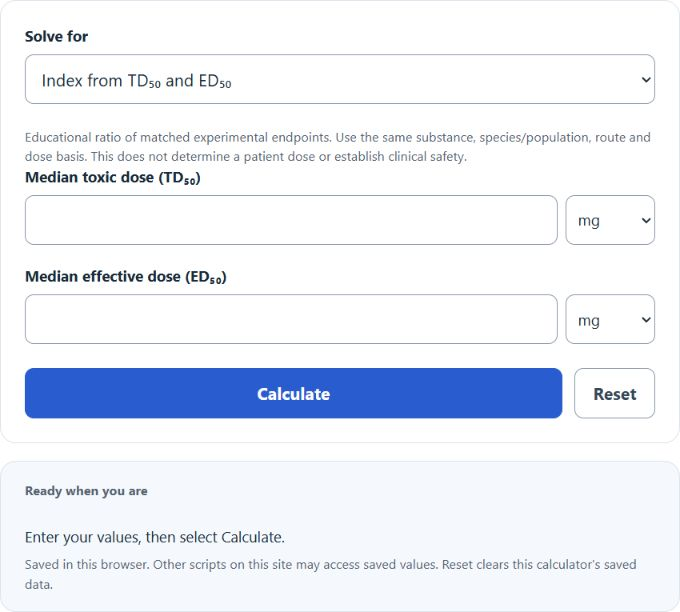
Calculate a drug’s therapeutic index as TD50 ÷ ED50 (or LD50 ÷ ED50), or solve for the missing dose from the index, with doses in mg, g, µg or kg.
Calculator Functions
| Function | What it does | What it requires |
|---|---|---|
| Index from TD₅₀ and ED₅₀ | Finds the therapeutic index based on the median toxic dose | Requires the median toxic dose and the median effective dose |
| TD₅₀ from index and ED₅₀ | Finds the median toxic dose that a given index implies | Requires the therapeutic index and the median effective dose |
| ED₅₀ from TD₅₀ and index | Finds the median effective dose that a given index implies | Requires the median toxic dose and the therapeutic index |
| Index from LD₅₀ and ED₅₀ | Finds the therapeutic index based on the median lethal dose | Requires the median lethal dose and the median effective dose |
| LD₅₀ from index and ED₅₀ | Finds the median lethal dose that a given index implies | Requires the therapeutic index and the median effective dose |
| ED₅₀ from LD₅₀ and index | Finds the median effective dose that a given index implies | Requires the median lethal dose and the therapeutic index |
Each dose can be entered in µg, mg, g or kg, and the two doses do not have to use the same unit, because both are converted before the ratio is taken. The functions that return a dose let the result unit be chosen. The index itself has no unit.
Therapeutic Index Formulas
| TI | Therapeutic index, a ratio with no unit |
| TD50 | Median toxic dose: the dose that causes a defined toxic effect in 50% of the population tested |
| ED50 | Median effective dose: the dose that produces the intended effect in 50% of the population given it [1] |
A larger index means a wider gap between the dose that works and the dose that harms. Drugs with a low index, such as warfarin, lithium and theophylline, need close monitoring, while a drug with a very high index, such as penicillin, is generally safe [1].
Index from TD₅₀ and ED₅₀
The main formula applies directly. A median toxic dose of 50 mg and a median effective dose of 10 mg give 50 ÷ 10 = 5. With mixed units, 1 g and 250 mg, the toxic dose becomes 1,000 mg first and the index is 4.
TD₅₀ from index and ED₅₀
An index of 5 and a median effective dose of 10 mg imply a median toxic dose of 50 mg.
ED₅₀ from TD₅₀ and index
A median toxic dose of 50 mg and an index of 5 imply a median effective dose of 10 mg.
Index from LD₅₀ and ED₅₀
LD50 is the dose that is lethal to 50% of the population tested, and it is usually measured in animal studies before a drug is tried in people [1]. A median lethal dose of 400 mg and a median effective dose of 20 mg give an index of 20. An index built on LD50 is not the same number as one built on TD50 for the same drug, so the two are labeled separately in the result.
LD₅₀ from index and ED₅₀
An index of 20 and a median effective dose of 20 mg imply a median lethal dose of 400 mg.
ED₅₀ from LD₅₀ and index
A median lethal dose of 400 mg and an index of 20 imply a median effective dose of 20 mg.
Limits of This Estimate
- The ratio is educational. It does not determine a dose for a patient or establish that a drug is safe, and it does not replace drug-specific clinical evidence or professional judgment.
- Both doses must come from the same substance, the same species or population, the same route and the same dose basis. A ratio of mismatched figures has no meaning.
- The index is not a therapeutic window. The window is the range of doses that treats effectively without serious side effects, and the FDA identifies narrow therapeutic index drugs by several characteristics, such as little separation between therapeutic and toxic doses, rather than by one number [2].
- A median describes half of a tested group. It does not predict how one person will respond, and risk does not always rise in step with dose [1].
Sources
- Kenny, Preuss and McPhee, ED50, StatPearls, National Library of Medicine Bookshelf (updated January 9, 2024): definitions of ED50, TD50 and LD50, the therapeutic index formula and low and high index examples
- U.S. Food and Drug Administration, Setting and Implementing Standards for Narrow Therapeutic Index Drugs (current as of February 26, 2024): therapeutic window and the characteristics of narrow therapeutic index drugs