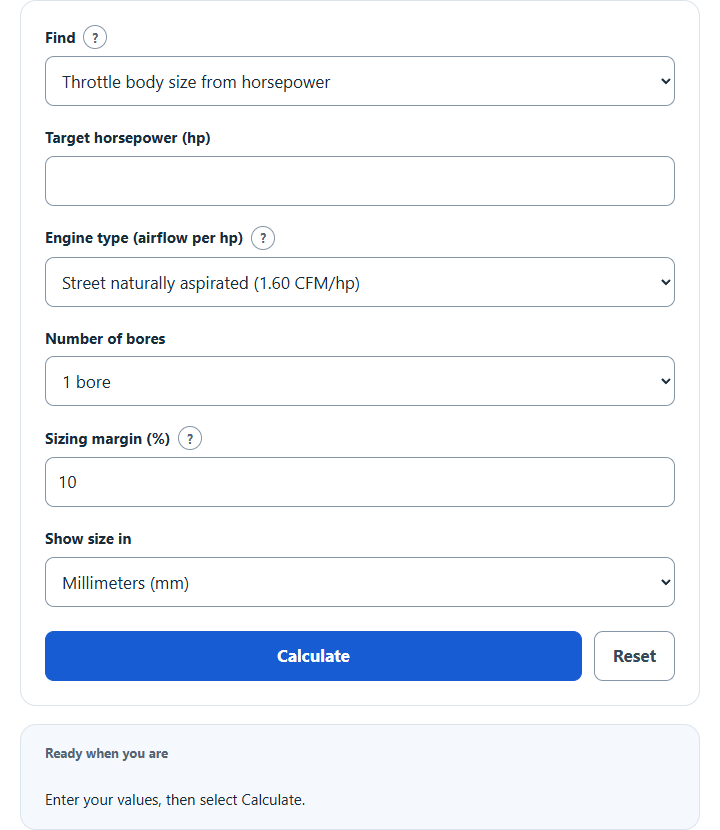
Calculate what size throttle body you need from target horsepower or engine size, or the horsepower and CFM a throttle body bore in mm can support.
Formula
The calculator uses two core relationships depending on the mode you pick.
Airflow demand from engine specs:
CFM = (CID × RPM × VE) ÷ 3456
For a four-stroke engine, CID is displacement in cubic inches, RPM is engine speed, and VE is volumetric efficiency as a decimal (90% = 0.90). The divisor combines two revolutions per intake cycle with 1,728 cubic inches per cubic foot. This volume estimate follows the Holley displacement/RPM relationship; it does not determine a throttle body’s pressure drop. In the sizing modes, the entered percentage margin multiplies demand by (1 + margin/100).
Throttle body bore from airflow:
D = √(CFM ÷ (0.17 × N))
where D is diameter in mm per bore, N is the number of equal round bores, and CFM is total modeled airflow, including any entered margin. The inverse is CFM = 0.17 × D² × N. The fixed 0.17 CFM/mm² coefficient is an assumed screening rule, not a measured flow curve; it does not model blade or shaft blockage, discharge coefficient, or pressure drop.
Assumed airflow-to-horsepower conversion:
HP = CFM ÷ k
The selectable assumptions are k = 1.60, 1.40, 1.08, 0.88, or 0.75 CFM/hp. These are arithmetic comparison factors, not validated naturally aspirated, racing, or boost-pressure ratings. Use a consistent airflow reference basis: Garrett distinguishes volume flow from mass flow through air density. Pressure alone does not establish a universal CFM-per-horsepower factor.
Interpretation
The result is a bore diameter under the selected assumptions, not a guaranteed minimum that avoids restriction or delivers a horsepower target. Check the actual throttle body’s published flow curve and test pressure, acceptable pressure drop, blade/shaft geometry, flange fit, and the rest of the intake. Jenvey’s selection guidance considers power, RPM, cylinder-head design, displacement, and position in the inlet path. Larger bores can reduce resistance but can change throttle response. The following diameter bands are illustrative size categories only.
- Under 55 mm: illustrative smaller-bore category, not an engine-application rating.
- 55–75 mm: illustrative intermediate-bore category; verify actual flow data.
- 75–92 mm: illustrative larger-bore category, without an assigned horsepower or boost limit.
- 92–105 mm: illustrative large-bore category; intake geometry and response still matter.
- Over 105 mm: illustrative very-large-bore category, not a threshold that requires twin throttle bodies.
Quick Reference Table
| TB Diameter | Model CFM | Model HP (k=1.6) | Model HP (k=1.4) | Model HP (k=0.88) |
|---|---|---|---|---|
| 58 mm | 572 | 357 | 408 | 650 |
| 65 mm | 718 | 449 | 513 | 816 |
| 75 mm | 956 | 598 | 683 | 1,087 |
| 85 mm | 1,228 | 768 | 877 | 1,396 |
| 92 mm | 1,439 | 899 | 1,028 | 1,635 |
| 102 mm | 1,769 | 1,105 | 1,263 | 2,010 |
FAQ
Does a bigger throttle body always add horsepower?
Only if the current one is actually restrictive at your peak airflow demand. If your TB is already sized correctly for the engine, a larger one adds no power and can soften throttle response.
What volumetric efficiency (VE) should I use?
Enter an engine-specific value at the RPM and airflow reference conditions being modeled; this is a manual input, not a dropdown recommendation. Naturally aspirated engines can exceed 100% VE. For boosted operation, distinguish actual intake volume from air mass or volume referred to other pressure and temperature conditions. Do not apply a pressure multiplier again when its density effect is already represented in the chosen VE or airflow basis. This calculator does not calculate boost, air temperature, or density corrections.
Should I measure the TB at the bore or the blade?
Use the bore diameter — the inside measurement of the housing where the blade sits. Manufacturers spec throttle bodies by bore, and that’s what the formula assumes.
Can I use one big throttle body instead of twin TBs?
The equal-bore calculation divides modeled airflow among the selected number of round bores. It does not compare actual single, twin, oval, or rectangular throttle bodies. There is no universal 1,500 CFM or 105 mm crossover in this model; compare manufacturer flow data, test conditions, intake geometry, packaging, and throttle control for the actual parts.