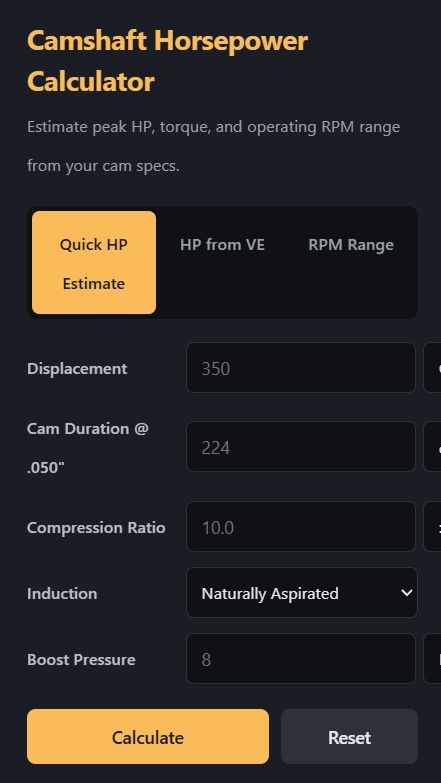
Enter your engine displacement, cam duration at .050″ lift, compression ratio, and induction type to estimate peak horsepower, torque, and the RPM range where the cam makes power.
Formula
The calculator chains three core equations.
Airflow: CFM = (CID × RPM × VE × B) / 3456
where CID = displacement in cubic inches, RPM = engine speed, VE = volumetric efficiency (decimal), B = induction multiplier (1.0 for NA).
Horsepower: HP ≈ CFM × 1.9
where 1.9 is the typical HP-per-CFM factor for a well-tuned gasoline engine.
Torque: T = (HP × 5252) / RPM
where T is in lb-ft and 5252 is the HP–torque crossover constant.
Peak RPM from cam duration:
Peak Torque RPM = 2000 + 100·Δd − 0.5·Δd²
Peak HP RPM = Peak Torque RPM + 1700 + 8·Δd
where Δd = cam duration at .050" − 200°.
Interpretation
The peak HP number is an airflow-based estimate of what the long block can make with a matched intake, heads, exhaust, and tune. Real dyno numbers usually land within about ±10% if the rest of the combination is built around the cam. The peak RPM values tell you where to shift and what stall speed or gearing to target — a cam with 224° duration wants a very different converter than one with 258°.
Typical output ranges for V8s:
- Under 200 HP: stock or economy tune, short duration cam.
- 200–350 HP: street performance, mild cam, pump gas friendly.
- 350–500 HP: hot street or street/strip with a larger cam and higher compression.
- 500–700 HP: serious performance, race-style cam or moderate boost.
- 700+ HP: dedicated race combinations or high-boost builds.
Cam Duration vs. Powerband
Duration at .050" lift is the most reliable single spec for predicting where a cam makes power. Bigger cams trade low-RPM torque for top-end horsepower.
- 200–214°: stock-like idle, peak power around 4,500–5,000 RPM, strong off-idle torque.
- 215–228°: mild street, peak around 5,200–5,700 RPM, good with stock converters.
- 229–244°: hot street, peak around 5,800–6,400 RPM, needs a 2,400–3,000 stall.
- 245–260°: street/strip, peak around 6,500–7,000 RPM, rough idle, 3,500+ stall.
- 261°+: race, peak above 7,000 RPM, poor vacuum, dedicated drivetrain required.
FAQ
What duration number should I enter — advertised or at .050"?
Use duration at .050" lift. Advertised duration varies by manufacturer and lobe profile, so it can't be compared cleanly across cams. Every value in this calculator is built around the .050" standard.
Why is my estimate higher than my actual dyno number?
The formula assumes the intake, heads, exhaust, carb or injectors, and tune all flow enough to support the cam. If any one of those is undersized — small-port heads, restrictive exhaust, lean tune — real output will fall below the estimate. The cam sets the ceiling, not the floor.
How do I handle a turbo or supercharger?
Pick the induction type and enter boost in PSI. The calculator scales airflow by roughly (1 + boost/14.7), with a small efficiency penalty for superchargers versus turbos. For high-boost builds over 20 PSI, treat the output as a rough ballpark since intercooling and IAT swings matter more at that level.
Does this work for diesel or rotary engines?
No. The 1.9 HP-per-CFM factor and the RPM-from-duration model are based on four-stroke gasoline piston engines. Diesels run much lower peak RPM and different BSFC; rotaries don't use a camshaft in the same sense.