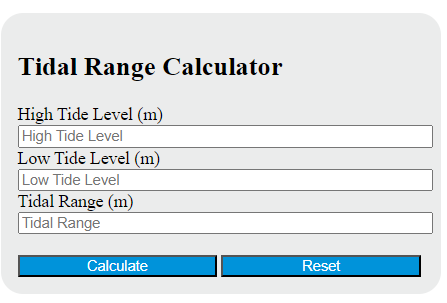
Calculate tidal range or reverse-solve high and low water levels in metric or imperial units, with mean tide level, quarter stages, and scenario comparison.
Related Calculators
- Water Temperature Calculator
- Lightning Distance Calculator
- Ground Speed Calculator
- Humidity Effect On Temperature Calculator
- All Physics Calculators
Tidal Range Formula
The following formula is used to calculate the tidal range.
Variables:
- TR is the tidal range (meters)
- HT is the high tide level (meters)
- LT is the low tide level (meters)
To calculate the tidal range, subtract the low tide level from the high tide level. The result represents the total vertical distance water travels between its lowest and highest points in a given tidal cycle. This value is fundamental to coastal engineering, navigation safety, habitat mapping, and tidal energy feasibility studies.
What is Tidal Range?
Tidal range is the vertical difference between the water surface at high tide and low tide at a specific location. It is driven primarily by the gravitational pull of the Moon and, to a lesser extent, the Sun acting on Earth's ocean water. Because the Moon is roughly 390 times closer to Earth than the Sun, its tide-generating force is about 2.2 times greater despite the Sun's far larger mass. The interplay between these two bodies, combined with Earth's rotation, produces the semi-diurnal (two highs and two lows per day) or diurnal (one high and one low per day) tidal patterns observed at different coastlines.
Tidal range is not constant. It changes on daily, monthly, and even annual cycles depending on the relative positions of the Moon, Sun, and Earth, as well as local geography. Narrow bays, funnel-shaped estuaries, and continental shelf width all amplify or dampen the astronomical tidal signal, producing dramatically different ranges at locations only a few hundred kilometers apart.
Tidal Range Classifications
Coastlines are grouped into three tidal regime categories based on their mean spring tidal range. These classifications, first standardized by Davies (1964) and widely adopted in coastal geomorphology, influence sediment transport, estuary morphology, and habitat distribution.
| Classification | Mean Spring Range | Typical Coastlines | Dominant Processes |
|---|---|---|---|
| Microtidal | Less than 2 m (6.6 ft) | Mediterranean, Baltic, Gulf of Mexico, Caribbean | Wave-dominated; barrier islands, beach ridges |
| Mesotidal | 2 to 4 m (6.6 to 13.1 ft) | U.S. East Coast, most of Australia, North Sea | Mixed wave and tidal; tidal inlets, salt marshes |
| Macrotidal | Greater than 4 m (13.1 ft) | Bay of Fundy, Bristol Channel, Cook Inlet | Tide-dominated; wide tidal flats, funnel estuaries |
Some researchers add a fourth class, megatidal, for ranges exceeding 8 m. Approximately 25% of the world's coastline is microtidal, 60% is mesotidal, and 15% is macrotidal or greater.
World's Largest Tidal Ranges
Extreme tidal ranges occur where coastal geometry amplifies the tidal wave through resonance, funneling, or shoaling. Below are measured record or mean spring ranges at notable locations.
| Location | Country | Mean Spring Range | Maximum Recorded |
|---|---|---|---|
| Bay of Fundy (Burntcoat Head) | Canada | 11.7 m (38.4 ft) | 16.3 m (53.5 ft) |
| Ungava Bay (Leaf Basin) | Canada | 9.8 m (32.2 ft) | ~12.5 m (41 ft) |
| Severn Estuary (Avonmouth) | United Kingdom | 12.2 m (40 ft) | ~15 m (49 ft) |
| Mont-Saint-Michel | France | 10.5 m (34.4 ft) | ~14 m (46 ft) |
| Cook Inlet (Anchorage) | United States | 9.2 m (30 ft) | ~12 m (40 ft) |
| Rio Gallegos | Argentina | 8.1 m (26.6 ft) | ~10.4 m (34 ft) |
The Bay of Fundy holds the record largely because of tidal resonance: the bay's natural oscillation period of roughly 12.5 hours nearly matches the dominant semi-diurnal tidal period of 12.42 hours. Each incoming tide reinforces the previous oscillation, progressively building the range. During a single tidal cycle, approximately 100 billion tonnes of water flow in and out of the bay, a volume that exceeds the combined discharge of all the world's rivers.
Spring Tides vs Neap Tides
Tidal range at any location follows a roughly 14.8-day cycle driven by the relative alignment of the Sun and Moon.
Spring tides occur at new moon and full moon when the Sun, Moon, and Earth are approximately aligned (syzygy). The gravitational forces add together, producing the largest tidal ranges of the lunar month, typically 20% or more above the mean range. The term "spring" has no connection to the season; it derives from an Old English word meaning to rise or swell.
Neap tides occur at first quarter and third quarter moon when the Sun and Moon are at roughly 90 degrees relative to Earth (quadrature). Their gravitational forces partially cancel, resulting in the smallest tidal ranges, often 20% or more below the mean. The ratio of spring range to neap range at a given location is called the tidal form number and is a key parameter in tidal analysis.
There is also a perigean spring tide that occurs when the Moon is at perigee (closest approach to Earth, about 356,500 km) during a spring tide alignment. These produce the highest tides of the year and are sometimes informally called "king tides." The Moon's elliptical orbit causes its distance from Earth to vary by about 50,000 km over a month, directly affecting tidal force magnitude.
The Rule of Twelfths
The Rule of Twelfths is a practical approximation used by sailors and coastal navigators to estimate water height at any point between high and low tide without detailed tide tables. It models the tidal curve as a sinusoidal rise and fall over approximately 6 hours.
The rule divides the total tidal range into 12 equal parts and distributes them across 6 hourly intervals in a 1:2:3:3:2:1 pattern. In the first hour after low tide, the water rises by 1/12 of the total range. In the second hour, it rises by 2/12. The third and fourth hours each see 3/12 of the range, meaning half the total range change occurs in the middle two hours. The fifth hour adds 2/12, and the final hour adds 1/12.
For example, at a location with a 6-meter tidal range, each twelfth equals 0.5 m. One hour after low tide the water has risen 0.5 m; after two hours, 1.5 m; after three hours, 3.0 m (half the range); after four hours, 4.5 m; after five hours, 5.5 m; and after six hours, the full 6.0 m. This approximation works best at locations with regular semi-diurnal tides and should not replace official tide tables for critical navigation.
Tidal Range and Energy Generation
Tidal range directly determines the energy potential of a tidal barrage or lagoon. The theoretical energy per tidal cycle from a barrage is proportional to the basin surface area multiplied by the square of the tidal range (E = 0.5 x rho x g x A x R squared), which means doubling the range quadruples the available energy. This is why most tidal power projects target macrotidal sites.
The world's two largest commercial tidal power plants are the Sihwa Lake Station in South Korea (254 MW, operational since 2011) and the La Rance Barrage in France (240 MW, operational since 1966). La Rance has operated continuously for nearly 60 years, demonstrating the long lifespan of tidal infrastructure compared to wind or solar installations. Canada's Annapolis Royal station, built in the Bay of Fundy, generates 20 MW and was the first tidal plant in North America.
Global tidal energy potential is estimated at roughly 120 to 400 GW of extractable capacity. A study identified the 27 most promising barrage sites worldwide with a combined potential of 152 GW. The MeyGen project in Scotland, currently under development, will be the world's largest tidal stream station at up to 398 MW when fully operational. Unlike barrage systems that rely on tidal range, tidal stream turbines harness tidal current velocity, but both technologies benefit from locations with large tidal ranges since greater ranges generally produce stronger currents.
Factors That Influence Tidal Range
Tidal range at a specific location is shaped by a combination of astronomical, geographic, and meteorological factors. Astronomical forces set the baseline through the gravitational interactions of the Moon and Sun with Earth, but local geography often amplifies or diminishes the signal by an order of magnitude.
Coastal geometry: Funnel-shaped bays and estuaries compress the incoming tidal wave into a narrowing channel, forcing the water level higher. The Bay of Fundy and the Severn Estuary are textbook examples of this amplification. Conversely, open ocean islands and straight coastlines typically exhibit smaller ranges.
Continental shelf width: Broad, shallow continental shelves create friction that slows the tidal wave, often increasing local range through energy piling. The North Sea and the Yellow Sea both experience amplified ranges due to their extensive shallow shelves.
Basin resonance: When the natural oscillation period of a bay or sea matches the tidal period (approximately 12.42 hours for the dominant M2 constituent), resonance occurs and ranges grow dramatically. This is the primary driver of the extreme tides in the Bay of Fundy.
Meteorological effects: Sustained onshore winds and low barometric pressure can produce storm surges that temporarily add 1 to 3 meters to the predicted high tide. Conversely, high pressure systems and offshore winds suppress the tide. These non-astronomical contributions are sometimes called the "meteorological tide" or "surge residual."
Latitude: Diurnal inequality (the difference between successive high or low tides in a day) tends to be more pronounced at higher latitudes due to the Moon's orbital declination relative to Earth's equator. Locations near the equator often see more uniform semi-diurnal patterns with smaller diurnal inequality.