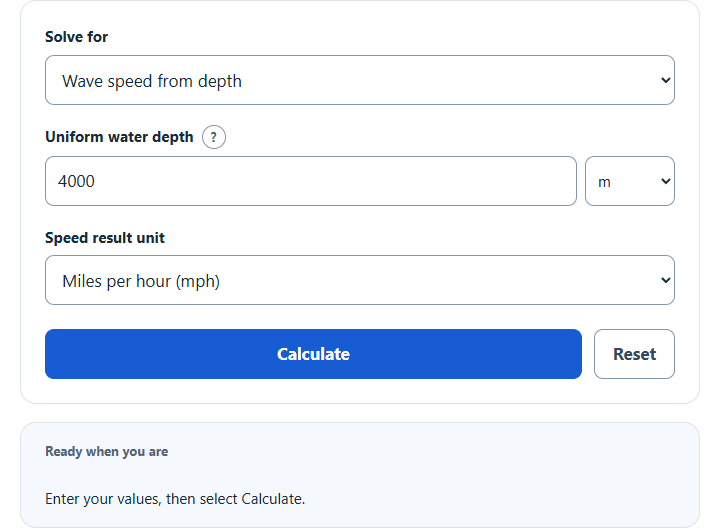
Calculate tsunami speed from ocean depth with v = √(g·d), using a typical 4,000 m open-ocean depth or your own, plus depth from speed and travel time.
Calculator Functions
| Function | What it does | What it requires |
|---|---|---|
| Wave speed from depth | Finds how fast a tsunami travels over water of a given depth | Requires the water depth in m, ft, cm or in |
| Depth from wave speed | Finds the water depth at which a tsunami travels at a given speed | Requires the wave speed in mph, km/h, m/s or knots |
| Travel time from depth | Finds how long a tsunami takes to cover a distance over water of one depth | Requires the path distance in km, mi, nmi or m, and the water depth |
| Travel time from known speed | Finds how long a wave takes to cover a distance at a set speed | Requires the path distance and the wave speed |
The depth starts at 4,000 m, a typical open-ocean depth, with quick picks of 10 m for a shallow coast, 200 m for a continental shelf and 8,000 m for a deep trench. Speed results are shown in mph, km/h, m/s and knots, depth results in m, ft, cm or in, and time results in hours, minutes or seconds.
Tsunami Velocity Formulas
| v | Tsunami speed (m/s) |
| g | Acceleration due to gravity, 9.81 m/s² |
| d | Water depth (m) |
A tsunami’s speed depends on the depth of the water under it: it is the square root of gravity times depth [1]. The wave moves the whole water column from the surface to the sea floor, so it travels fastest over deep ocean and slows as the water gets shallow [1].
Wave speed from depth
The formula above applies directly. At 4,000 m the speed is √(9.81 × 4,000) = 198.09 m/s, which is 443.1 mph or 713.1 km/h. Speeds in other units use 1 mph = 0.44704 m/s and 1 knot = 1,852 ÷ 3,600 m/s.
| Water depth | Speed (mph) | Speed (km/h) |
|---|---|---|
| 10 m | 22.2 | 35.7 |
| 200 m | 99.1 | 159.5 |
| 4,000 m | 443.1 | 713.1 |
| 4,572 m (15,000 ft) | 473.7 | 762.4 |
The last row agrees with the National Oceanic and Atmospheric Administration, which gives almost 475 mph in 15,000 ft of water and 20 to 30 mph near shore [1].
Depth from wave speed
This is the main formula rearranged. A wave moving at 500 mph is at 223.52 m/s, which fits a depth of 223.52² ÷ 9.81 = 5,092.9 m. The answer is the depth the formula implies, not a measured one.
Travel time from depth
D is the path distance in meters and t is the time in seconds. A 4,000 km path over water 4,000 m deep takes 4,000,000 ÷ 198.09 = 20,193 seconds, or 5.61 hours. The speed is held constant for the whole path.
Travel time from known speed
The same 4,000 km path at a known 500 mph takes 4,000,000 ÷ 223.52 = 17,895 seconds, or 4.97 hours.
Limits of This Estimate
- This is an educational model. It must not be used for warnings or evacuation decisions, and it does not forecast arrival time, wave height or flooding. Official forecasts come from tsunami warning centers, which run numerical models fed by seismic networks, deep-ocean buoys and coastal water-level stations [2]. Follow official alerts and local instructions.
- The formula holds for waves much longer than the water is deep, which is the case for tsunamis in the open ocean. It gives the speed of the wave, not the speed of the water itself.
- Travel time assumes one depth and a straight path. A real ocean floor changes depth along the route, and using the average depth does not give the true time. Near shore the wave slows, shortens and grows in height, and reefs, bays and the slope of the beach change its effect [1][2].
Sources
- National Oceanic and Atmospheric Administration, JetStream, Tsunami Propagation: speed as the square root of gravity times depth, example speeds and slowing near shore
- U.S. Tsunami Warning System, Tsunami Frequently Asked Questions: how warning centers detect and forecast tsunamis, and what affects their impact at the coast