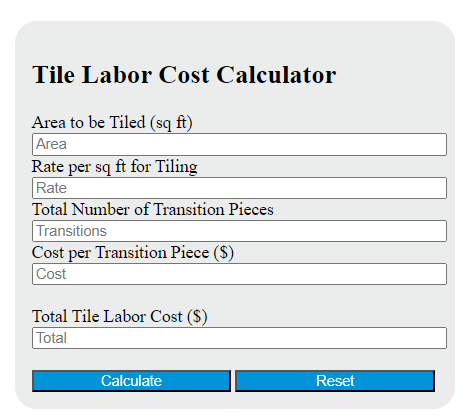
Calculate tile labor cost from tiled area, labor rate, number of transition pieces, and cost per transition in square feet, meters, or yards.
- All Construction Calculators
- Mortar Calculator
- Tiles Per Square Meter Calculator
- Roof Tile Spacing Calculator
Tile Labor Cost Formula
This calculator estimates total tile installation labor by combining the labor charged for the tiled area with the labor charged for transition pieces such as thresholds, reducers, T-moldings, or other edge changes between surfaces.
| Variable | Meaning | Typical Unit | Notes |
|---|---|---|---|
| TC | Total tile labor cost | Dollars | The final labor-only estimate produced by the calculator. |
| A | Area to be tiled | sq ft, sq m, or sq yd | Use the same area unit that matches the labor rate. |
| R | Labor rate per area unit | Dollars per sq ft, sq m, or sq yd | This is the installer’s charge for laying tile over the measured area. |
| T | Number of transition pieces | Pieces | Count each location where a trim or transition must be installed. |
| C | Cost per transition piece | Dollars per piece | Represents labor allocated to each transition installation. |
Rearranged Forms
The calculator can solve for a missing value when the other four are known. These rearranged forms are useful when you know the target labor total and want to back into one unknown input.
For sensible results, keep units consistent, avoid zero denominators, and make sure the total labor cost is at least large enough to cover the other labor component already entered.
How to Calculate Tile Labor Cost
- Measure the tileable area. Use the net area that will actually receive tile. Exclude permanent cabinets, built-ins, tubs, or other sections that will not be tiled.
- Select the matching labor rate unit. If the area is entered in square feet, the labor rate should also be priced per square foot. The same rule applies for square meters and square yards.
- Count transition locations. Include doorways, material changes, height changes, and other edge conditions that require transition labor.
- Enter the cost per transition piece. This can be an installer’s line-item price or your own estimated labor amount per transition.
- Compute the total. The result combines area-based labor and piece-based transition labor into one total estimate.
Example
Suppose a project has 100 square feet of tile, a labor rate of $2.50 per square foot, 5 transition pieces, and a labor cost of $10 per transition piece.
The estimated tile labor cost is $300.
What Changes Tile Labor Cost Most
| Factor | Why It Matters | Usual Effect on Labor |
|---|---|---|
| Tile size | Small tiles and mosaics require more placement, alignment, and grout handling. | Higher labor for smaller-format tile. |
| Layout pattern | Diagonal, herringbone, chevron, and offset patterns increase cutting and setup time. | Higher labor than straight-lay patterns. |
| Surface preparation | Leveling, crack isolation, backer board, waterproofing, or patching adds prep time. | Can materially increase total labor. |
| Room shape | Niches, corners, plumbing penetrations, and irregular walls create more cuts. | Higher labor for complex spaces. |
| Wall vs. floor installation | Vertical installations often require more care, staging, and alignment. | Wall tile commonly takes longer. |
| Demolition and removal | Removing old flooring or existing tile is typically a separate labor task. | Often not included in a simple install-only rate. |
| Transitions and trim | Reducers, thresholds, and edge finishing add detail work beyond field tile placement. | Raises the project total through piece-based charges. |
| Job size | Very small jobs may carry a minimum charge because setup time is spread over less area. | Higher effective rate on small projects. |
What This Estimate Usually Covers
This type of calculation is best for estimating installation labor. Depending on the quote structure, it may include some or all of the following:
- Layout and basic tile setting
- Cutting and fitting tiles
- Grouting and cleanup
- Installing thresholds or transition pieces
Items that are often priced separately include:
- Tile, grout, mortar, spacers, and other materials
- Demolition and debris disposal
- Subfloor repair or wall repair
- Waterproofing systems and specialty membranes
- Heated floor systems
- Sealing, trim profiles, or specialty edge treatments
- Travel charges, minimum service charges, permits, or taxes
Tips for Better Inputs
- Measure net tile area, not gross room size. Subtract islands, tubs, vanities, and other permanent obstructions if they will not be tiled beneath.
- Keep area and rate units aligned. A rate per square foot should never be multiplied by square meters or square yards.
- Count every transition location. Missing just one doorway or reducer can understate labor.
- Use the correct labor scope. A simple floor replacement rate may not be appropriate for showers, backsplashes, stairs, or large-format wall tile.
- Separate labor from material waste. Waste affects how much tile to buy, but labor is generally estimated from installed area and installation complexity.
Common Estimating Mistakes
- Using the material purchase quantity instead of the installed area
- Forgetting thresholds, reducers, or doorway transitions
- Applying a floor-tile rate to a detailed shower or backsplash job
- Ignoring prep work needed for an uneven substrate
- Mixing square feet with a rate that was quoted per square meter
Frequently Asked Questions
Is tile labor usually separate from material cost?
Yes. This calculator is intended for labor estimation. Materials such as tile, grout, mortar, trim, and underlayment are commonly quoted separately unless your contractor provides a bundled price.
What is a transition piece?
A transition piece is a trim or connector installed where tile meets another flooring surface, changes elevation, or ends at a doorway or edge. Common examples include thresholds, reducers, and T-moldings.
Can this calculator be used for wall tile?
Yes, as long as the labor rate reflects the actual scope. Wall tile, shower surrounds, and decorative layouts often require a higher rate than standard floor tile.
Should I include demolition in the labor rate?
Only if the quoted rate already includes it. If demolition, removal, or disposal is being priced separately, keep those amounts out of the calculator and add them afterward as separate line items.
Why might the actual quote be higher than the estimate?
Actual quotes often include minimum charges, travel, substrate correction, waterproofing, difficult cuts, pattern alignment, trim work, or schedule constraints that are not captured by a simple area-and-transition formula.