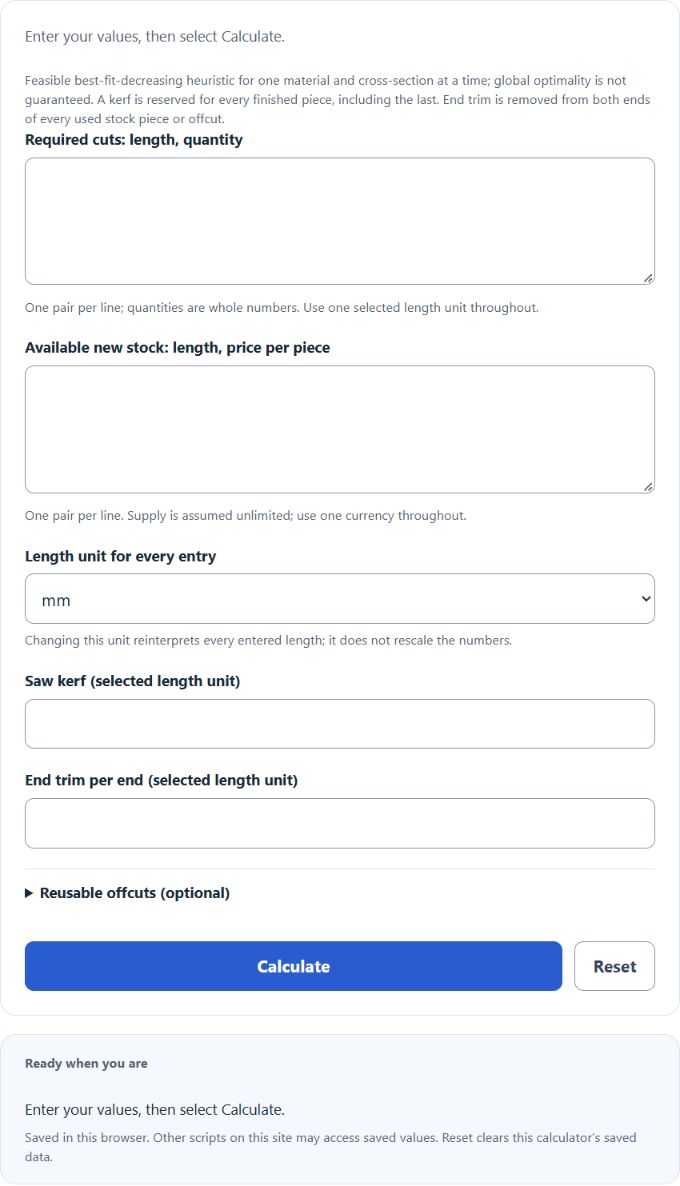
Build a feasible timber cutting plan from required lengths, stock options and reusable offcuts. The calculator shows which cuts go into each piece, material cost, kerf, trim and remaining length.
Length accounting
For each used piece: stock length = sum of finished cuts + cut count × kerf + 2 × end trim + remainder. Use one length unit and one material cross-section per calculation. Changing the selected unit reinterprets every entered cut, stock, offcut, kerf and trim length; it does not rescale the numbers.
Example
Two 400 mm cuts in a 1,000 mm piece, with a 3 mm kerf and 5 mm trim at each end, use 800 + 6 + 10 = 816 mm. The remainder is 184 mm. If that piece costs 12 currency units, the new material cost is 12.
Frequently asked questions
Is the plan guaranteed to be optimal?
No. Longest cuts are placed first using the tightest fitting open piece. Offcuts are used before buying stock; new stock is selected by price per usable length. This heuristic produces a feasible plan without proving the lowest cost or waste.
Why is kerf charged for the last cut?
The model reserves one full kerf for every finished piece. This conservative convention is consistent throughout the plan; a real cutting sequence may save a final cut.
What does the lower bound mean?
It is an optimistic minimum number of new pieces based on finished length, the largest usable stock and all offcut capacity. It ignores kerf and does not measure a cost gap. Keep unused offcuts for another job.
Related method: Google OR-Tools explanation of bin packing and capacity constraints.