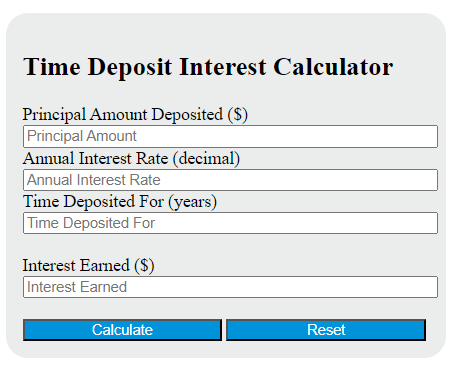
Calculate time deposit interest, withholding tax, and net maturity value from your deposit amount, annual rate, and term, or solve for the deposit, rate, or term needed.
Time Deposit Interest Formula
Time deposit interest is the amount earned when money is left in a fixed-term account for a defined period. The exact interest depends on four inputs: the starting deposit, the annual rate, the length of the term, and whether interest compounds during the term.
For most time deposits, certificates of deposit, and similar fixed-term savings products, compound interest is the most useful formula:
If the account uses simple interest instead of compounding, use:
If you want the maturity value after calculating interest earned, add the interest back to the original deposit:
Variable Definitions
| Symbol | Meaning | Typical Unit |
|---|---|---|
| P | Principal amount deposited at the start | Dollars |
| r | Annual interest rate entered as a decimal | Decimal form |
| t | Total deposit term | Years |
| n | Number of compounding periods per year | Times per year |
| A | Ending balance at maturity | Dollars |
| I | Interest earned over the term | Dollars |
How to Calculate Time Deposit Interest
- Enter the principal deposit amount.
- Enter the annual rate in the format selected by the calculator.
- Choose whether the deposit uses simple interest or compound interest.
- If compounded, select the compounding frequency.
- Enter the term in years, months, and days.
- Read the calculated interest earned.
When the term is split across years, months, and days, the calculator converts the total time into years before applying the interest formula:
This means day-based entries are treated using a 365-day year.
Rate Entry Tip
- In decimal mode, a 5 percent annual rate should be entered as 0.05.
- In percent mode, the same rate should be entered as 5.
Simple Interest vs. Compound Interest
Simple interest pays interest only on the original deposit. Compound interest pays interest on both the original deposit and previously earned interest. Over longer terms, compound interest produces a larger return when the stated annual rate is the same.
| Method | How Interest Accumulates | Best Use Case |
|---|---|---|
| Simple Interest | Only the principal earns interest | Basic fixed-return estimates |
| Compound Interest | Interest earns additional interest over time | Most CDs and time deposits |
Common Compounding Frequencies
| Compounding Type | n Value | Meaning |
|---|---|---|
| Annually | 1 | Interest is added once each year |
| Semiannually | 2 | Interest is added twice per year |
| Quarterly | 4 | Interest is added every three months |
| Monthly | 12 | Interest is added every month |
| Daily | 365 | Interest is added each day |
APR, Nominal Rate, and APY
The annual rate used in the compound interest formula is usually the stated nominal rate. If you want to compare different compounding schedules on an equal basis, convert the nominal rate into an effective annual yield:
This is helpful when two deposits advertise the same nominal rate but compound at different frequencies. More frequent compounding creates a slightly higher effective annual yield.
Example
Suppose a deposit account starts with $5,000, earns 5 percent annually, compounds monthly, and remains untouched for 3 years.
The maturity value is about $5,807.36.
The interest earned is about $807.36.
If the same deposit used simple interest instead, the interest would be:
That produces $750.00 in interest, which is lower because the earnings do not compound during the term.
What Affects Time Deposit Interest?
- Principal: Larger deposits earn more interest because the calculation starts from a larger base.
- Annual rate: Higher rates increase both simple and compound returns.
- Term length: A longer holding period gives interest more time to accumulate.
- Compounding frequency: Monthly or daily compounding generally earns more than annual compounding at the same nominal rate.
- Withdrawal restrictions: Early withdrawals can reduce or eliminate expected earnings if penalties apply.
Important Assumptions
This calculator is most accurate when the deposit follows a straightforward fixed-rate structure. Results generally assume:
- The interest rate stays constant for the full term.
- No additional deposits are made after the initial principal.
- No partial withdrawals occur before maturity.
- Taxes are not deducted from the reported interest.
- Early withdrawal penalties are not included in the result.
If your bank changes the rate during the term, compounds on a nonstandard schedule, or charges a penalty for closing early, actual earnings may differ from the calculator output.
When This Calculator Is Useful
- Comparing two CDs with different term lengths
- Estimating how much interest a time deposit will generate before maturity
- Checking the effect of monthly versus daily compounding
- Projecting the return from a fixed lump-sum deposit
- Converting a quoted annual rate into a more realistic earnings estimate
Frequently Asked Questions
Is time deposit interest the same as CD interest?
In most practical situations, yes. A certificate of deposit is one of the most common forms of a time deposit, so the same interest formulas are typically used.
Why does compounding frequency matter?
Each time interest is added to the balance, future interest is calculated on a larger amount. More frequent compounding gives the balance more opportunities to grow.
Should I use the stated rate or APY in the calculator?
If you are choosing a compounding frequency in the calculator, the best input is usually the stated annual nominal rate. If you only know the APY, be careful not to apply extra compounding on top of a rate that already reflects compounding.
Does the calculator include penalties for early withdrawal?
No. It estimates interest earned based on the deposit terms entered. Any institution-specific penalty would need to be subtracted separately.
What if my term includes months and days?
The calculator converts the full term into years so the formula can be applied consistently. That makes it easier to estimate interest for nonstandard deposit lengths.