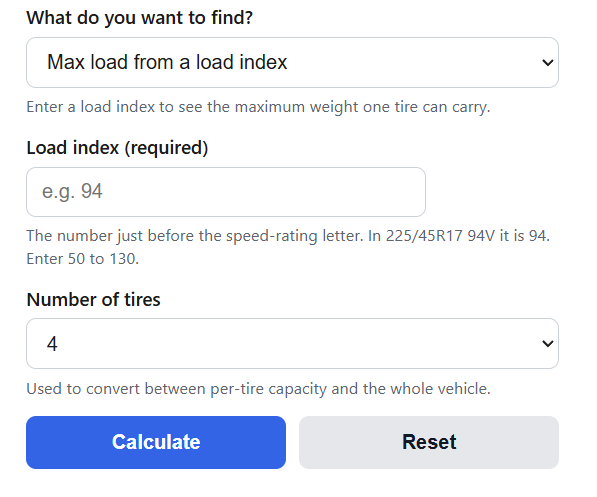
Calculate the maximum load a tire can carry from its load index in pounds and kilograms, find the minimum index for a given weight, and check your load reserve.
- All Automotive Calculators
- Staggered Tire Calculator
- Trailer Tire Pressure Calculator
- RPM Tire Size Calculator
Tire Load Index Formula
The load index is a code from a standardized table. Each number maps to the maximum weight one tire can carry when it is inflated to the pressure on its sidewall. The calculator works in three directions and uses these relationships.
To split a vehicle’s weight onto each tire:
Load per tire = Total load / Number of tires
To turn an index into a whole-vehicle capacity:
Vehicle capacity = Rated load(LI) * Number of tires
To measure how hard a tire is working and what is left over:
Capacity used = Load per tire / Rated load(LI) * 100
 Reserve = Rated load(LI) - Load per tire
The rated loads themselves come from the standard table, but they follow a clear pattern. Capacity roughly doubles every 24 index points, which this approximation captures:
Rated load(kg) = 45 * 2^(LI / 24)
Variables:
- LI is the load index, a whole number printed on the sidewall just before the speed rating letter
- Rated load(LI) is the maximum weight one tire carries at that index, read from the standard table (for example LI 100 is 800 kg, or 1,764 lb)
- Load per tire is the share of the loaded vehicle weight resting on one tire
- Number of tires is the count of tires carrying the load, usually 4
- Capacity used is how much of the tire’s rating the actual load takes up, as a percent
- Reserve is the spare capacity left before the tire reaches its rating
Pick what you want to find at the top of the calculator. “Max load from a load index” turns an index into the weight one tire can carry and multiplies it by the number of tires for the whole vehicle. “Load index you need” takes the weight you want to carry, splits it across the tires and returns the lowest index that covers it. “Check a load index against your load” compares an index you already have with your real load and reports the capacity used and the reserve left.
Load Index to Weight Chart
This chart lists the maximum load per tire for common load indexes in both pounds and kilograms. Read across from your index to its capacity, then multiply by the number of tires for the vehicle total.
| Load index | Max load per tire (lb) | Max load per tire (kg) |
|---|---|---|
| 75 | 853 lb | 387 kg |
| 80 | 992 lb | 450 kg |
| 85 | 1,135 lb | 515 kg |
| 90 | 1,323 lb | 600 kg |
| 95 | 1,521 lb | 690 kg |
| 100 | 1,764 lb | 800 kg |
| 105 | 2,039 lb | 925 kg |
| 110 | 2,337 lb | 1,060 kg |
| 115 | 2,679 lb | 1,215 kg |
| 120 | 3,086 lb | 1,400 kg |
| 125 | 3,638 lb | 1,650 kg |
| 126 | 3,748 lb | 1,700 kg |
The calculator also reports how much of a tire’s rating your load uses, which the raw chart does not show. This table explains what that percentage means and why leaving a reserve matters.
| Capacity used | Reserve left | What it means |
|---|---|---|
| Up to 85% | About 15% or more | Comfortable margin for heat build-up, potholes and uneven loading. Common on factory tire fitments. |
| 85% to 100% | Under 15% | The tire meets the load with little spare. Workable if you keep the pressure at the recommended setting. |
| Over 100% | None | The load is above the tire’s rating. The tire runs hot and can fail. Move to a higher index or add tires. |
Example Problems
Example 1: Max load from an index.
A tire marked 225/45R17 94V has a load index of 94. From the table one tire carries 1,477 lb (670 kg). With 4 tires the vehicle can carry 4 * 1,477 = 5,908 lb (2,680 kg), as long as every tire is at its rated pressure.
Example 2: Checking the reserve.
Your tires are load index 100, rated 1,764 lb (800 kg) each. Fully loaded, the vehicle puts about 1,300 lb on each tire. Capacity used = 1,300 / 1,764 = 73.7 percent, which leaves a reserve of 464 lb (210 kg) per tire. That is a comfortable margin.
Frequently Asked Questions
What load index do I need for my car?
Use the number on the tire placard in the driver’s door jamb, or in the owner’s manual, and match or exceed it. That figure already includes a margin for a fully loaded vehicle, so a replacement tire with an equal or higher load index is safe. A lower index is not safe, even if the tire looks identical and fits the wheel.
Can I fit a tire with a higher load index than standard?
Yes. A higher load index carries more weight and is fine to fit. The trade-off is usually a slightly firmer ride, because higher-capacity tires often use stronger construction, so keep the same size and speed rating when you step up. Going below the specified index is the only change to avoid.
Does the load index change with tire pressure?
The rated capacity assumes the tire is inflated to the pressure marked on its sidewall. Running below that pressure lowers how much the tire can safely carry, which is why underinflation combined with a heavy load is a common cause of tire failure. Set pressure to the vehicle placard value for normal driving and to the higher sidewall value when you carry close to the maximum.