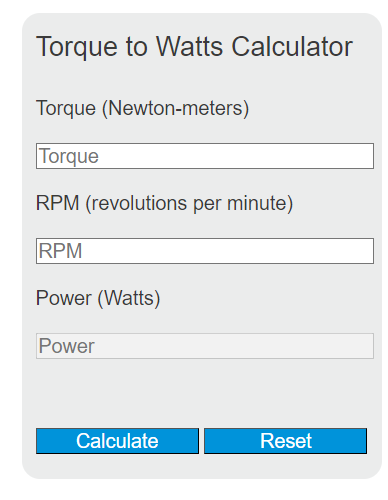
Calculate power in watts from torque and speed. Enter Nm, lb-ft or oz-in with RPM to get W, kW and hp, plus motor input power, current draw and run cost.
- All Unit Converters
- Wind Turbine Power Output Calculator
- Mechanics and Physics Unit Converters
- Torque To kW Calculator
- Watts To Torque Calculator
Torque to Watts Formula
The core relationship between torque and power is expressed as P = T x w, where P is mechanical power in watts, T is torque in newton-meters (N·m), and w (omega) is angular velocity in radians per second. Because most motor specifications list speed in RPM rather than rad/s, the practical form becomes:
The constant 2π/60 (approximately 0.10472) converts RPM into rad/s. When torque is given in foot-pounds (ft-lbs) instead of newton-meters, multiply ft-lbs by 1.3558 to convert to N·m before applying the formula. For output in kilowatts, divide the watt result by 1,000, or equivalently use P (kW) = T (N·m) x RPM / 9,548.8.
Shaft Power vs. Electrical Input Power
The torque-to-watts formula calculates mechanical shaft power, which is the useful rotational energy delivered at the output shaft. This is not the same as the electrical power drawn from the supply. Every motor loses energy to copper resistance in the windings, iron core hysteresis, bearing friction, and windage. The ratio between shaft output and electrical input is the motor’s efficiency (η), typically expressed as a percentage. To find the electrical input power required to produce a given shaft output, use P_electrical = P_shaft / η. A motor rated at 1,000 W shaft power with 88% efficiency draws approximately 1,136 W from the mains.
Motor Efficiency Classes (IEC 60034-30-1)
The International Electrotechnical Commission defines four efficiency tiers for electric motors under IEC 60034-30-1. These classes directly affect the relationship between mechanical torque output and electrical consumption:
| Rated Power | IE1 (Standard) | IE2 (High) | IE3 (Premium) | IE4 (Super Premium) |
|---|---|---|---|---|
| 0.75 kW | 72.1% | 77.4% | 80.7% | 83.5% |
| 1.5 kW | 77.2% | 81.4% | 84.2% | 86.7% |
| 4 kW | 82.6% | 86.6% | 88.6% | 90.6% |
| 7.5 kW | 86.0% | 88.7% | 90.4% | 92.6% |
| 15 kW | 88.7% | 90.6% | 91.8% | 93.5% |
| 37 kW | 90.8% | 92.7% | 93.7% | 95.0% |
| 75 kW | 92.7% | 94.0% | 95.0% | 95.8% |
| 160 kW | 93.8% | 95.0% | 95.8% | 96.6% |
| Source: IEC 60034-30-1 standard. IE2 is the global minimum for most regions. EU mandates IE3 for motors 0.75 to 200 kW since July 2021, and IE4 for 75 to 200 kW since July 2023. | ||||
The practical impact is significant. Upgrading a 7.5 kW motor from IE1 (86.0%) to IE3 (90.4%) reduces the electrical input from 8,721 W to 8,296 W for the same shaft output, saving approximately 425 W continuously. Over 8,000 operating hours per year at $0.12/kWh, that single motor saves roughly $408 annually.
NEMA Motor Design Classes and Torque Behavior
In North America, NEMA classifies induction motors into design types (A, B, C, D) based on their torque-speed characteristics. The design class determines how torque and power relate across the motor’s operating range, not just at the rated point:
| Design | Starting Torque | Breakdown Torque | Full-Load Slip | Typical Applications |
|---|---|---|---|---|
| Design A | 70 – 275% | 175 – 300% | 0.5 – 5% | Injection molding, machine tools |
| Design B | 70 – 275% | 175 – 300% | 0.5 – 5% | Fans, pumps, blowers, centrifugal compressors |
| Design C | 200 – 285% | 190 – 225% | 1 – 5% | Loaded conveyors, crushers, stirring machines |
| Design D | 275 – 400% | 275% | 5 – 13% | Punch presses, hoists, cranes, elevators |
| Design B (equivalent to IEC Design N) accounts for the vast majority of industrial motor installations worldwide. | ||||
Starting torque matters because a motor must overcome static friction and load inertia before reaching operating speed. A Design D motor producing 300% of rated torque at startup delivers three times the rated shaft power momentarily, but at a much lower speed than its rated RPM. The torque-to-watts relationship is not fixed at a single operating point but varies continuously along the motor’s speed-torque curve.
Torque and Power in Real-World Systems
The torque-to-watts conversion applies across every rotating mechanical system, but the practical numbers vary enormously depending on the application. Below is a reference table showing typical torque values and the resulting shaft power for common motor-driven systems:
| Application | Typical Torque (N·m) | Typical Speed (RPM) | Shaft Power (W) |
|---|---|---|---|
| Computer cooling fan | 0.002 – 0.01 | 1,200 – 3,000 | 0.25 – 3.1 |
| Cordless drill (no load) | 0.5 – 3 | 400 – 1,800 | 21 – 565 |
| Household washing machine | 3 – 10 | 800 – 1,400 | 251 – 1,466 |
| HVAC blower motor | 2 – 8 | 1,075 – 1,725 | 225 – 1,445 |
| Small CNC spindle motor | 1 – 4 | 6,000 – 24,000 | 628 – 10,053 |
| Electric vehicle motor (sedan) | 200 – 400 | 4,000 – 12,000 | 83,776 – 502,655 |
| Industrial pump (15 kW) | 48 – 100 | 1,450 – 2,900 | 7,288 – 30,369 |
| Wind turbine generator (2 MW) | 95,000 – 320,000 | 10 – 20 | 99,484 – 670,206 |
| Ship propulsion motor | 50,000 – 500,000 | 80 – 200 | 418,879 – 10,471,976 |
| Values represent typical operating ranges at rated conditions. Actual output depends on load, efficiency, and operating point on the torque-speed curve. | |||
Notice the inverse relationship between torque and speed for a given power level. Wind turbines produce enormous torque at very low RPM, while CNC spindles produce modest torque at extremely high RPM, yet both can output comparable power. This is why gearboxes exist: they trade speed for torque (or vice versa) while keeping power roughly constant (minus gear losses of 1 to 3% per stage).
Torque and Power at Partial Load
Motors rarely operate at their nameplate rating 100% of the time. Most industrial motors run at 60 to 80% of rated load on average. At partial load, motor efficiency drops, sometimes significantly. A motor rated at 91% efficiency at full load may fall to 85% at 50% load and below 75% at 25% load. This means the torque-to-watts calculation gives the shaft power correctly, but the actual electrical consumption per watt of shaft output increases as load decreases. Engineers size motors to run between 65% and 100% of rated load for optimal efficiency.
Torque to Watts Conversion Table
| Torque (N·m) | Rotational Speed (rpm) | Power (W) |
|---|---|---|
| 0.5 | 60 | 3.142 |
| 1 | 100 | 10.472 |
| 2 | 300 | 62.832 |
| 5 | 300 | 157.080 |
| 2 | 500 | 104.720 |
| 5 | 500 | 261.799 |
| 10 | 500 | 523.599 |
| 2 | 750 | 157.080 |
| 5 | 750 | 392.699 |
| 10 | 750 | 785.398 |
| 2 | 1000 | 209.440 |
| 5 | 1000 | 523.599 |
| 10 | 1000 | 1047.198 |
| 20 | 1000 | 2094.395 |
| 10 | 1500 | 1570.796 |
| 20 | 1500 | 3141.593 |
| 30 | 1800 | 5654.867 |
| 50 | 1800 | 9424.778 |
| 30 | 2500 | 7853.982 |
| 50 | 3600 | 18849.556 |
| P(W) = T(N·m) x w(rad/s) = T x 2π x RPM / 60. Using 1 RPM = 0.104719755 rad/s. Values rounded to 3 decimals. | ||
Key Unit Conversion Factors
Working with torque and power across different unit systems requires precise conversion constants. The most frequently used factors in torque-to-watts calculations:
| Conversion | Factor |
|---|---|
| 1 ft-lb to N·m | 1.3558 |
| 1 in-lb to N·m | 0.1130 |
| 1 kgf·cm to N·m | 0.0981 |
| 1 RPM to rad/s | 0.10472 |
| 1 hp (mechanical) to W | 745.7 |
| 1 hp (metric) to W | 735.5 |
| 1 kW to W | 1,000 |
| P(kW) = T(N·m) x RPM / x | x = 9,548.8 |
| P(hp) = T(ft-lb) x RPM / x | x = 5,252 |
The constants 9,548.8 (for kW) and 5,252 (for hp) are the most commonly referenced shortcut values in motor specification sheets and engineering handbooks. They combine the 2π/60 angular velocity conversion with the appropriate power unit conversion into a single divisor.
Why Torque and Speed Are Inversely Related at Constant Power
Since P = T x w, for any fixed power output, doubling the speed halves the required torque, and vice versa. This is the fundamental principle behind gear reduction. A gearbox with a 10:1 ratio multiplies the motor’s output torque by 10 while reducing shaft speed to 1/10th, keeping power nearly constant minus friction losses. This is why a 100 W motor spinning at 10,000 RPM (producing about 0.095 N·m of torque) can, through a 50:1 gearbox, deliver approximately 4.77 N·m at 200 RPM. Every gear stage typically loses 1 to 3% of power to friction and heat, so real-world output is slightly lower than the theoretical calculation.
Torque Measurement Methods
Accurate torque measurement is essential for valid power calculations. The primary methods used in industry include strain gauge torque sensors (bonded to the shaft, measuring torsional deformation with accuracy of 0.1 to 0.5%), rotary torque transducers (inline sensors between motor and load, common in dynamometer setups), reaction torque sensors (measuring torque on a stationary component), and the prony brake method (an older technique using friction to absorb and measure shaft power directly). In laboratory settings, dynamometers combine torque measurement with speed sensing to produce real-time power curves. Modern dynamometers achieve measurement uncertainty below 0.25%, making them the standard for motor testing per IEC and IEEE protocols.