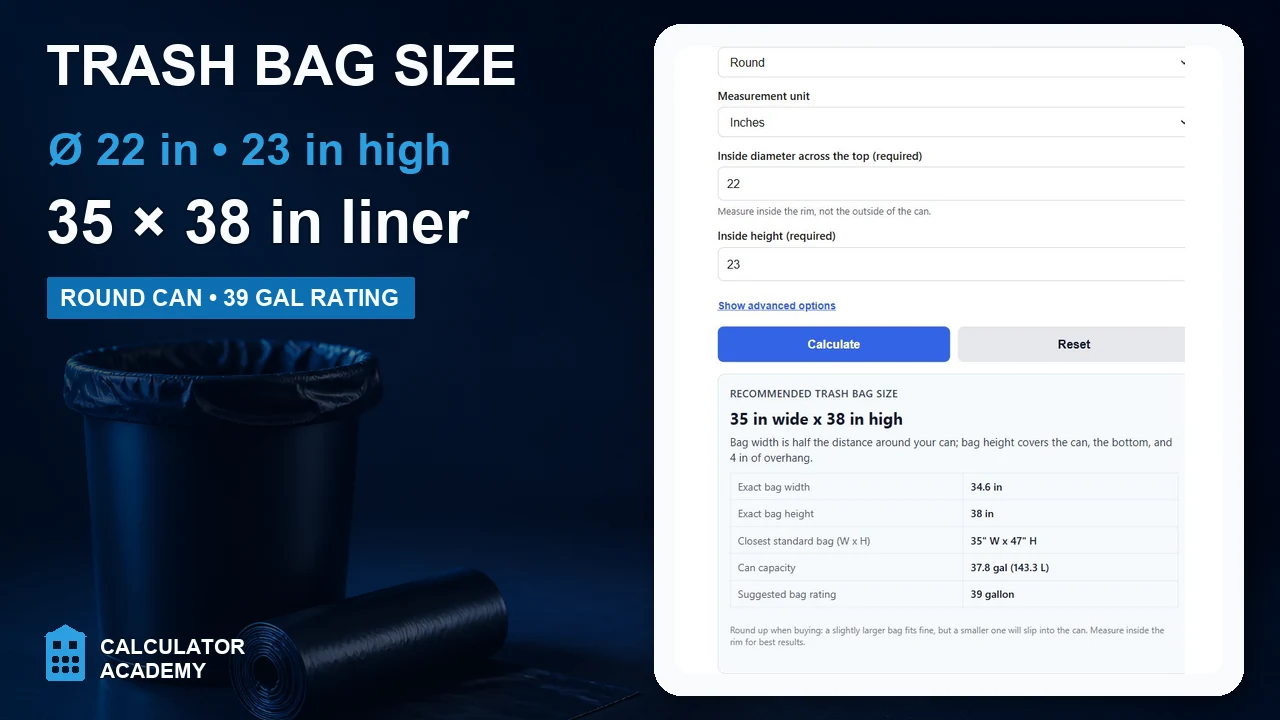
Calculate the right trash bag size from trash can capacity or can dimensions in gallons or liters, and get the recommended bag size and flat dimensions.
Related Calculators
- Freezer Capacity Calculator
- Flat Bag Volume Calculator
- Box Volume Calculator
- Package Girth Calculator
- Room Volume Calculator
- All Everyday Life and Education Calculators
How to Use the Trash Bag Size Calculator
The trash bag size calculator estimates the capacity of a rectangular trash can in gallons using its length, width, and height. This is most useful when you know the bin dimensions but do not know what gallon-rated liner to buy. For the best result, measure the inside of the can rather than the outside shell.
Trash Bag Size Formula
The calculator first converts inches to feet, finds the container volume in cubic feet, and then converts that volume to gallons.
Where:
- L = trash can length in inches
- W = trash can width in inches
- H = trash can height in inches
- TBS = estimated trash bag size in gallons
How to Measure Your Trash Can
- Measure the inside length from one interior side to the other.
- Measure the inside width at the widest usable point.
- Measure the inside height from the bottom to the top edge where the liner sits.
- Enter the values into the calculator and review the gallon result.
- If your result falls between common bag sizes, choose the next larger size for easier fit and better overhang.
Example
If a trash can is 15 inches long, 10 inches wide, and 30 inches high, the estimated bag size is:
A container with this volume is typically paired with a bag rated at about 20 gallons or slightly larger, especially if you want extra material at the top for folding over the rim.
What the Gallon Result Means
The calculator gives you the container’s approximate internal capacity. That is the fastest way to narrow down bag choices, but actual liner fit also depends on:
- Overhang: extra bag material above the rim helps prevent the liner from slipping.
- Load type: bulky, sharp, or heavy trash may require a larger and thicker bag.
- Can shape: tapered cans, swing-top bins, and bins with rounded corners may need more slack than the volume alone suggests.
- Bag style: drawstring bags, flap-tie bags, and straight liners do not all fit the same way.
Common Trash Bag Capacity Ranges
| Estimated Capacity | Typical Use | Selection Tip |
|---|---|---|
| 4–8 gallons | Bathroom, bedroom, small office bins | Choose a slightly taller liner if you want the bag to wrap over the rim. |
| 10–13 gallons | Standard kitchen trash cans | One of the most common household sizes; a little extra height improves fit. |
| 20–30 gallons | Utility rooms, medium commercial bins | Useful when the can is deeper or receives heavier waste. |
| 30–33 gallons | Large office or janitorial cans | A common step up when 20-gallon liners feel too tight. |
| 39–45 gallons | Large commercial containers | Check thickness as well as capacity if the waste is dense or abrasive. |
| 55+ gallons | Outdoor, contractor, or drum-style use | Capacity alone is not enough; strength and puncture resistance matter. |
Tips for Better Bag Fit
- Round up when in doubt: a bag that is slightly too large usually works better than one that is too tight.
- Use interior dimensions: wall thickness can make outside measurements misleading.
- Allow for folding: if you fold the liner over the rim, the bag must be taller than the can depth alone.
- Consider waste volume growth: paper, packaging, and food containers trap air and can fill a bag faster than the raw can volume suggests.
- Upgrade thickness for sharp items: cardboard edges, cans, or broken materials can tear a thin liner even when the gallon rating is correct.
Important Accuracy Notes
This calculator is most accurate for rectangular and square trash cans. If the can is noticeably rounded, heavily tapered, or shaped with curved walls, the result should be treated as an estimate. In those cases, choosing the next larger bag size often gives a more reliable real-world fit.
Frequently Asked Questions
Should I match the bag size exactly to the calculated gallons?
Not always. Exact matching can work for light trash and straight-sided cans, but a slightly larger liner usually fits better because it provides slack at the rim and reduces tearing during removal.
Why does a bag with the right gallon rating still feel too small?
Bag fit is affected by more than container volume. A tall can, a wide rim, a tapered body, or a bulky load can all make a correctly rated bag feel undersized.
Is gallons or liters better?
Either is fine as long as you stay consistent. Gallons are common for household trash bag packaging, while liters are often used for metric product listings.
Using the calculator before buying liners helps reduce wasted money, poor fit, and ripped bags, especially when replacing an unfamiliar can or moving between brands with different size labels.