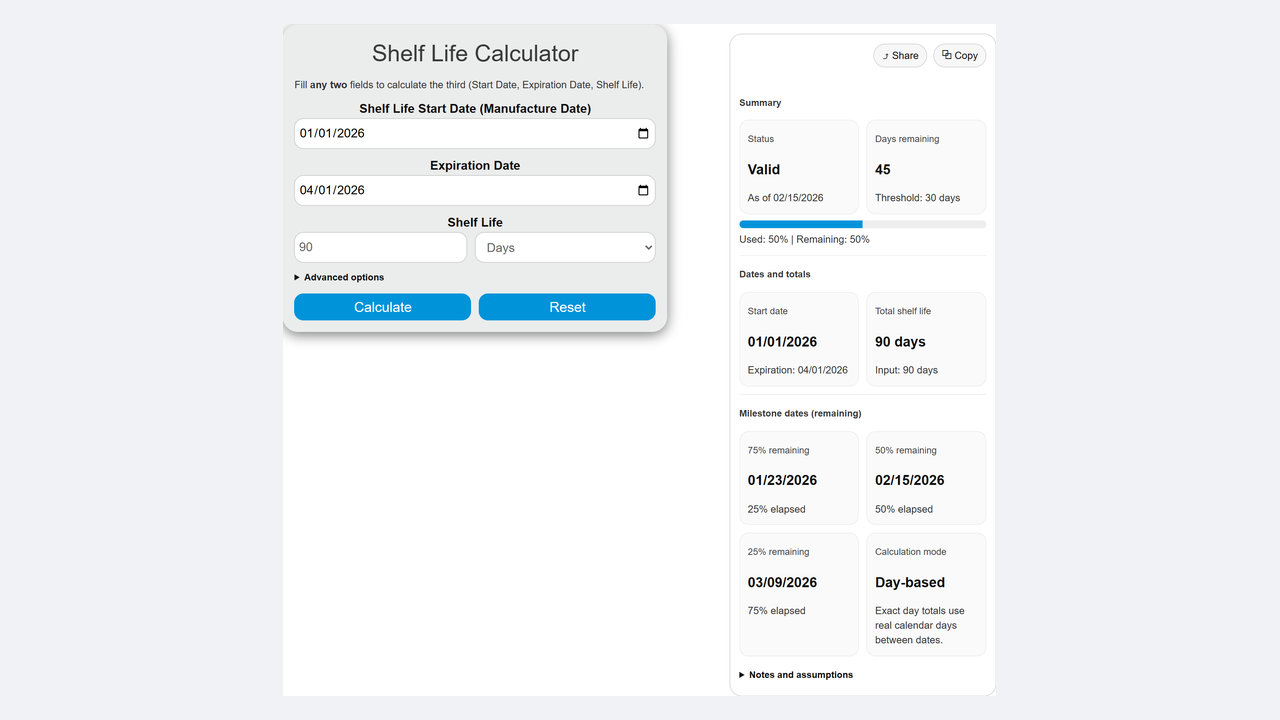
Enter the manufactured date and the expiration date into the Shelf Life Calculator. The calculator will evaluate the Shelf Life. This can also calculate the date at 25%, 50%, and 75% of shelf life remaining.
- All Chemistry Calculators
- Food Waste Percentage Calculator
- Food Cost Percentage Calculator
- Trash Bag Size Calculator
- Food Delivery Charge Calculator
Calculator Functions
| Function | What it does | What it requires |
|---|---|---|
| Shelf Life | Finds the time between manufacture and expiration, in days, weeks, months or years | Requires the start date and the expiration date, with the shelf life field left blank |
| Expiration Date | Finds the date a product expires by adding its shelf life to the start date | Requires the start date and the shelf life, with the expiration date left blank |
| Shelf Life Start Date (Manufacture Date) | Finds the manufacture date by counting the shelf life back from the expiration date | Requires the expiration date and the shelf life, with the start date left blank |
Whichever field is solved, the result also gives a status, the days remaining, the percent of shelf life used and remaining, the total shelf life in days and the dates at which 75%, 50% and 25% of the shelf life remain. The advanced options set the date the remaining life is checked against (today if blank), calendar or approximate months and years, the number of days that counts as expiring soon (30 to start), and an opened date with the days the product is usable after opening.
Shelf Life Formulas
| SL | Shelf life (days) |
| ED | Expiration date |
| MD | Manufacture date, the start of the shelf life |
Shelf life is the period, counted from the date of manufacture, during which a product is expected to stay within its specification when handled and stored as directed [1]. The subtraction counts actual calendar days, so a product made on September 20, 2022 that expires on September 20, 2024 has a shelf life of 731 days, because the span includes February 29, 2024.
Shelf life in weeks, months and years
When the shelf life is found from two dates, the day count is exact and the other units are rounded up to the next whole number: weeks are days ÷ 7, months are days ÷ 30 and years are days ÷ 365. The 731 days above show as 105 weeks, 25 months or 3 years, although the dates are exactly two calendar years apart. The total in days is the figure to rely on.
Expiration date from manufacture date
Days and weeks are added as days, so 90 days from March 1, 2026 is May 30, 2026. Months and years follow the calendar unless the approximate setting is chosen. A product made on January 15, 2026 with an 18-month shelf life expires on July 15, 2027, which is 546 days later. On the approximate setting a month is 30 days and a year 365, so the same 18 months is 540 days and ends on July 9, 2027. A calendar month added to the 31st stops at the last day of a shorter month: one month from January 31, 2026 is February 28, 2026.
Manufacture date from expiration date
The shelf life is counted back from the expiration date by the same rules. A product that expires on June 30, 2027 with a 2-year shelf life was made on June 30, 2025.
Shelf life percentage
T is the date the product is checked, which is today unless another date is set. The days remaining are divided by the total shelf life and rounded to a whole percent, and the percent used is 100 minus that figure. A product made on January 1, 2026 that expires on January 1, 2027 has 365 days of shelf life. On October 1, 2026 it has 92 days left, which is 92 ÷ 365 × 100 = 25% remaining and 75% used. The figure stops at 0% after the expiration date and at 100% before the start date.
The three milestone dates run the same sum the other way. For that product, 75% remains on April 2, 2026, 50% on July 2, 2026 and 25% on October 1, 2026. For any other percentage, multiply the total days by the percent that must remain and count back from the expiration date: 80% of 365 is 292 days, so 80% remains on March 15, 2026.
Buyers often set a minimum remaining shelf life, the period left between delivery and the expiry date [1]. The World Health Organization’s example for medical products with a total shelf life of more than 24 and up to 36 months is 20 months remaining at dispatch from the manufacturer, 15 months at the port of entry and 6 months at the end user [1].
Status and opened items
The status is Expired once the check date is past the expiration date, Expires today on that date, Expiring soon when the days remaining are within the threshold, and Valid otherwise. With an opened date and a number of usable days, the use-by date after opening is the opened date plus those days, and it is never later than the expiration date. A product opened on December 20, 2026 with 30 usable days and a January 1, 2027 expiration is shown as use by January 1, 2027.
Limits of This Estimate
- This is date arithmetic. It does not work out how long a product stays good: the manufacturer sets the expiry date from stability testing in the product’s packaging under stated storage conditions [1], and storage outside those conditions can shorten the real life.
- A shelf life shown in weeks, months or years is rounded up, and a month counted as 30 days or a year as 365 drifts from the calendar. Use the total in days where a contract or audit depends on it.
- Percent remaining is rounded to a whole number, so a product slightly short of a required 75% can still show 75%. Compare the milestone date with the delivery date for a pass or fail decision.
- The days usable after opening come from the product label. The result only adds them to the opened date.
Sources
- World Health Organization, Technical Report Series No. 1044 (2022), Annex 8, Points to consider for setting the remaining shelf-life of medical products upon delivery: definitions of shelf-life, expiry date and remaining shelf-life, how expiry dates are set, and example minimum remaining shelf-life