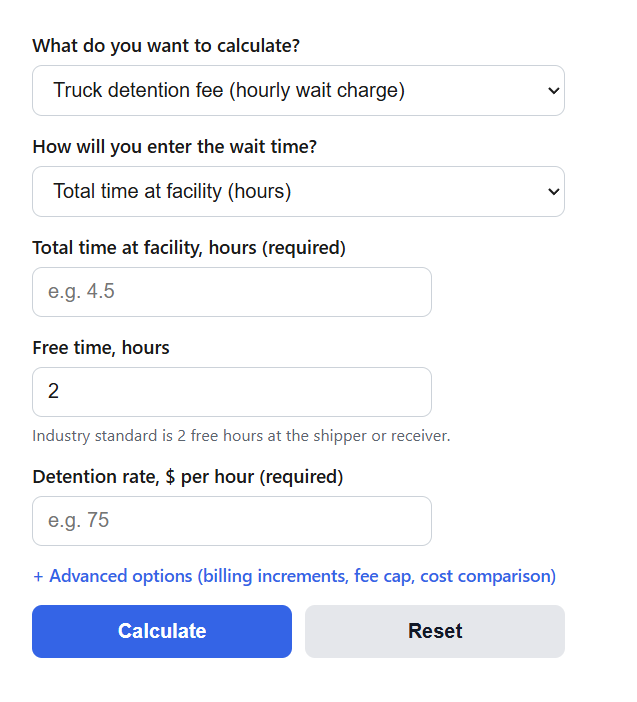
Calculate truck detention fees and container demurrage charges from wait time, free time, and hourly or daily rates, including tiered port rate structures.
Truck Detention & Demurrage Fee Formula
DF = (T - FT) * R
DEM = (TD - FD) * DR * N
- DF is the truck detention fee ($)
- T is the total time the truck spent at the facility (hours)
- FT is the agreed free time before charges begin (hours)
- R is the detention rate ($ per hour)
- DEM is the demurrage fee ($)
- TD is the total days the container sat at the terminal
- FD is the number of free days allowed
- DR is the demurrage rate ($ per container per day)
- N is the number of containers
The detention mode subtracts your free time from the total time at the shipper or receiver and multiplies the remainder by your hourly rate. You can enter the wait as a single number of hours or as check-in and check-out times, and the advanced options let you round billed time up to 15, 30, or 60 minute increments, apply a maximum fee cap, and compare the fee against your hourly operating cost to see whether the payment actually covers the delay.
The demurrage mode subtracts free days from total days at the terminal and bills the remaining days at either a flat daily rate or a tiered structure. With tiered rates, the first block of chargeable days bills at the tier 1 rate, the next block at tier 2, and every day after that at tier 3, which mirrors how ocean carriers and terminals escalate charges the longer a container sits. Partial chargeable days round up because terminals bill by the calendar day.
Typical Detention and Demurrage Charges
Rates vary by contract, lane, and facility, but the ranges below reflect what carriers and shippers commonly see in the United States.
| Charge type | Free time | Typical rate |
|---|---|---|
| Dry van detention | 2 hours | $50 to $100 per hour |
| Reefer detention | 2 hours | $75 to $125 per hour |
| Specialized or hazmat detention | 1 to 2 hours | $100 to $150 per hour |
| Demurrage, tier 1 (first days over) | 2 to 7 free days | $75 to $175 per container per day |
| Demurrage, tier 2 | n/a | $150 to $300 per container per day |
| Demurrage, tier 3 (10+ days over) | n/a | $300 to $500+ per container per day |
The table below shows something most rate discussions leave out: whether a detention fee actually covers what the delay costs the carrier. Industry cost studies put the all-in marginal cost of running a truck at roughly $90 per hour once driver wages, equipment, insurance, and overhead are included. At common detention rates, every detained hour still loses money.
| Detention rate paid | Approx. operating cost per hour | Net per detained hour |
|---|---|---|
| $50 | $90 | -$40 shortfall |
| $75 | $90 | -$15 shortfall |
| $90 | $90 | Break even |
| $100 | $90 | +$10 recovered |
This is why the calculator’s advanced options include an operating cost comparison. If your negotiated rate leaves a shortfall on every detained hour, that gap is a concrete number you can bring to the next rate negotiation.
Truck Detention & Demurrage Fee Example Problems
Example 1: Hourly truck detention. A driver checks in at a receiver at 8:00 AM and checks out at 1:30 PM, for 5.5 hours at the facility. The rate confirmation allows 2 free hours and pays $75 per hour of detention. Billable time is 5.5 – 2 = 3.5 hours. The detention fee is 3.5 * 75 = $262.50. If the carrier’s operating cost is $90 per hour, the delay cost 3.5 * 90 = $315, so the fee leaves a $52.50 shortfall.
Example 2: Tiered container demurrage. Two containers sit at a port terminal for 11 days with 4 free days, leaving 7 chargeable days each. The tariff bills the first 4 chargeable days at $110 per day and the next days at $220 per day. Each container owes 4 * 110 + 3 * 220 = 440 + 660 = $1,100, so the total demurrage for both containers is 2 * 1,100 = $2,200.
Truck Detention & Demurrage Fee FAQ
What is the difference between detention and demurrage? Detention is a time charge for holding transportation equipment or a driver beyond the allowed free period, most commonly billed per hour when a truck waits at a shipper or receiver. Demurrage is a daily charge for a container that stays inside a port or rail terminal past its free days. A related charge, per diem (also called container detention), applies per day when a container is kept outside the terminal beyond the allowed time. The same delay can trigger more than one of these charges on a single shipment.
When does detention time start? Detention starts when the agreed free time expires, not when the driver arrives. With the standard 2-hour free window, a driver who arrives for a 9:00 AM appointment starts accruing detention at 11:00 AM. Most brokers require the driver to be on time and to report the delay before free time expires, and many request timestamped in and out records from the facility, so documenting arrival and departure times is essential to getting paid.
Are demurrage charges negotiable? Often, yes. Free days and daily rates are set in the carrier tariff or service contract, and shippers with volume can negotiate extended free time before booking. After charges accrue, disputes are still possible when the delay was caused by the terminal itself, such as congestion, closed gates, or unavailable appointments. In the United States, the Ocean Shipping Reform Act of 2022 requires carriers to certify that demurrage and detention invoices comply with federal rules, which gives shippers a formal basis to challenge improper charges.