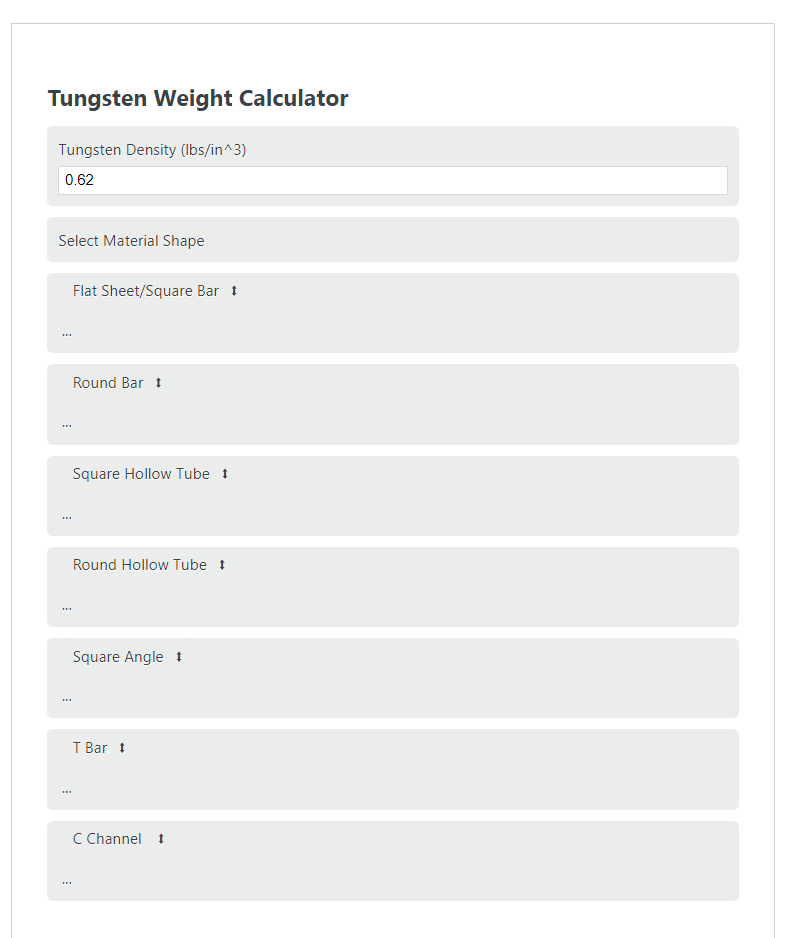
Calculate tungsten plate, rod, or tube weight by alloy density and dimensions, or reverse-solve cut length with unit conversion, purchase allowance, cost, and grade sensitivity.
- All Construction Calculators
- All Weight Calculators
- Titanium Weight Calculator
- Zinc Weight Calculator
- Bronze Weight Calculator
Tungsten Weight Formulas
The tungsten weight calculator finds the theoretical weight of a part from its dimensions and material density. In every case, the calculation starts with the same idea: weight equals volume multiplied by density. If you know any four values, you can leave the fifth field blank and let the calculator solve for it.
For flat sheet, plate, or rectangular block stock, the volume is simply length times width times thickness.
Common Tungsten Shape Equations
For other shapes, first determine the cross-sectional area, then multiply by length and density.
Round bar
Square hollow tube
Round hollow tube
Angle
T-bar
C-channel
Variable Definitions
- L = length
- W = width
- T = thickness or wall thickness
- H = overall height
- D = outside diameter
- R = outside radius
- r = inside radius
- d = material density
- T1 = channel flange thickness
- T2 = channel web thickness
Tungsten Density Reference
Pure tungsten is commonly taken as having a density of 19.25 g/cm3, which is equivalent to 19,250 kg/m3 or about 0.695 lb/in3. Because tungsten is extremely dense, even a small part can weigh much more than it appears. If you are working with a tungsten alloy rather than pure tungsten, use the actual density from the material specification for a more accurate result.
| Reference Volume | Approximate Tungsten Weight |
|---|---|
| 1 cm3 | 19.25 g |
| 100 cm3 | 1.925 kg |
| 1 in3 | 0.695 lb |
| 10 in3 | 6.95 lb |
| 1 m3 | 19,250 kg |
How to Use the Tungsten Weight Calculator
- Enter the tungsten density in your preferred unit set.
- Input the known dimensions of the part.
- Leave the unknown field blank if you want the calculator to solve for it.
- Select the output unit for the final weight value.
This is useful for estimating raw material requirements, shipping weight, machining loads, counterweight sizing, ballast, and shielding components.
Accuracy Tips
- Use actual measured dimensions when accuracy matters, especially for finished or machined parts.
- Keep units consistent if you calculate by hand. Do not mix inches with kg/m3 unless you convert first.
- For hollow sections, only the metal volume counts; subtract the empty interior.
- For round parts, confirm whether your measurement is a diameter or a radius.
- If the part includes holes, chamfers, grooves, or cutouts, subtract those volumes for a closer estimate.
- Alloys, sintered parts, and specialty grades may have densities that differ from pure tungsten.
Solving for a Missing Dimension
If you know the target weight and need to determine one rectangular dimension, rearrange the flat-stock formula. For example, thickness can be solved directly from weight, length, width, and density.
The same approach works for the other dimensions.
Common Questions
- Why is tungsten so heavy for its size?
- Tungsten has an exceptionally high density, so a small amount of material contains a large amount of mass.
- Can I use metric or imperial units?
- Yes. The calculator supports both systems, but manual calculations only work correctly when all units are compatible.
- Will alloy tungsten weigh the same as pure tungsten?
- Not always. Heavy alloys and specialty grades can vary, so the best practice is to use the exact density for your material.