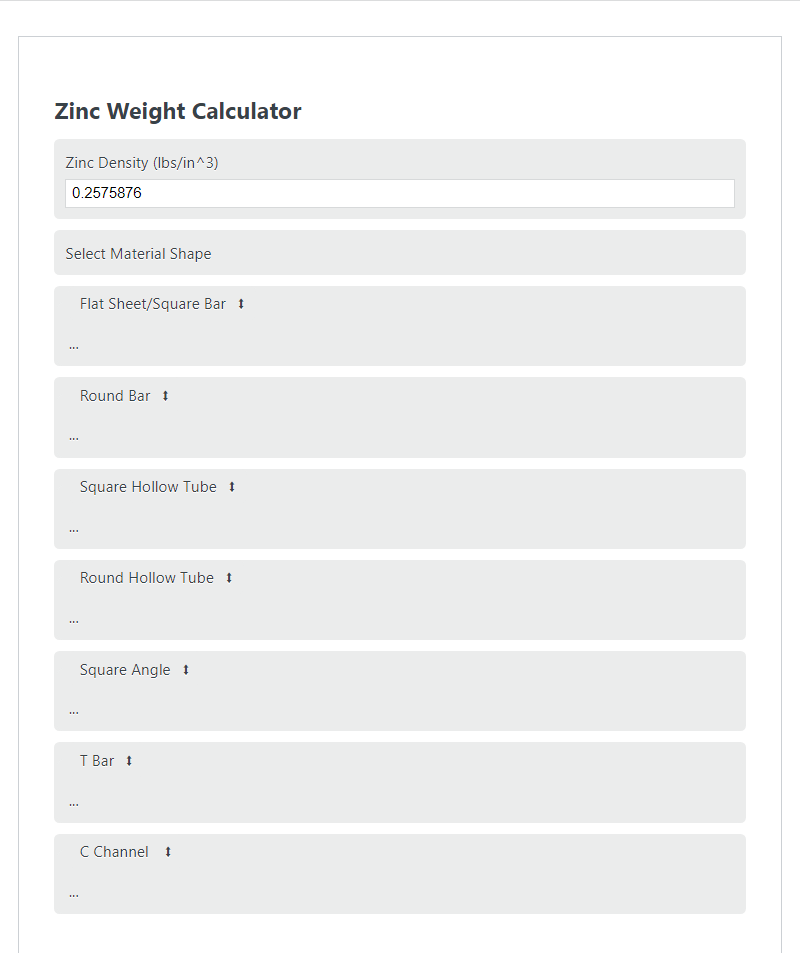
Calculate zinc plate, bar, tube, or galvanizing weight with real metric-imperial conversions, alloy density presets, quantities, and reverse length sizing.
- All Construction Calculators
- All Weight Calculators
- Bronze Weight Calculator
- Brass Weight Calculator
- Copper Weight Calculator
Zinc Weight Formulas
Every shape supported by this calculator follows the same core principle: compute the cross-sectional area of the profile, multiply by length to get volume, then multiply by density to get weight. The formulas below use inches for all linear dimensions and lbs/in³ for density. You can substitute any consistent unit system (metric, for example) as long as density units match the length units cubed.
Flat Sheet / Square Bar: Weight = L x W x T x d
Round Bar: Weight = pi x (D/2)² x L x d
Round Hollow Tube: Weight = pi x (R² – r²) x L x d
Square Hollow Tube: Weight = [W² – (W – 2T)²] x L x d
Square Angle (Equal-Leg): Weight = (2WT – T²) x L x d
T Bar: Weight = [WT + (H – T)T] x L x d
C Channel: Weight = (2W x T1 + H x T2) x L x d
Where L = length, W = width, H = height, T = thickness, D = outer diameter, R = outer radius, r = inner radius, d = density, T1 = thickness along width, T2 = thickness along height.
Zinc Density and Physical Properties
Pure zinc (element 30, hexagonal close-packed crystal structure) has a room-temperature density of 7.134 g/cm³, equivalent to 0.2575876 lbs/in³ or 445.3 lb/ft³. This places zinc between iron (7.874 g/cm³) and tin (7.265 g/cm³) on the density scale, and roughly 2.6 times denser than aluminum (2.70 g/cm³).
Zinc melts at 419.5 °C (787.1 °F) and boils at 907 °C (1665 °F). At room temperature, commercially pure zinc is somewhat brittle, but between 100 and 150 °C it becomes malleable enough to roll into sheet. Above 210 °C it turns brittle again. This narrow workability window directly affects which fabrication shapes are practical and, by extension, which weight formulas engineers need most often. Rolled zinc sheet and strip dominate construction applications (roofing, cladding, flashings), while cast shapes (bars, billets, ingots) feed die-casting and alloying operations.
Zinc Density Across Unit Systems
When switching units in the calculator, density must be converted to match. The following conversions are for pure zinc at 25 °C:
| Unit | Value |
|---|---|
| g/cm³ | 7.134 |
| kg/m³ | 7,134 |
| lb/in³ | 0.25759 |
| lb/ft³ | 445.3 |
| oz/in³ | 4.121 |
| kg/L | 7.134 |
| metric tons/m³ | 7.134 |
Zinc Alloy Density Reference
Pure zinc is rarely used as a structural material on its own. Most zinc weight calculations in practice involve one of the common zinc alloys. Alloying elements (primarily aluminum, copper, and magnesium) shift the density, sometimes significantly. If you are working with a zinc alloy rather than pure zinc, substitute the appropriate alloy density in the calculator’s density field to get accurate results.
| Alloy | Composition | Density (g/cm³) | Density (lb/in³) | Typical Application |
|---|---|---|---|---|
| Pure Zinc (SHG 99.995%) | None | 7.134 | 0.2576 | Galvanizing, anodes |
| Zamak 2 | 4% Al, 3% Cu | 6.60 | 0.238 | High-strength die casting |
| Zamak 3 | 4% Al | 6.60 | 0.238 | General die casting (most common) |
| Zamak 5 | 4% Al, 1% Cu | 6.70 | 0.242 | Die casting, hardware |
| Zamak 7 | 4% Al, low Mg | 6.60 | 0.238 | Thin-wall casting |
| ZA-8 | 8% Al, 1% Cu | 6.30 | 0.227 | Gravity/pressure casting |
| ZA-12 | 12% Al, 1% Cu | 6.03 | 0.218 | Sand and permanent mold casting |
| ZA-27 | 27% Al, 2% Cu | 5.00 | 0.181 | Bearing, bushing applications |
| Brass (yellow, C26000) | 30% Zn in copper | 8.53 | 0.308 | Fasteners, plumbing |
Notice that ZA-27, with its high aluminum fraction, is nearly 30% lighter than pure zinc. Zamak alloys cluster around 6.6 g/cm³, roughly 7.5% lighter than pure zinc. This difference is large enough that using the wrong density value on a production run of several thousand die-cast parts would meaningfully skew material cost and shipping weight estimates.
Temperature Effects on Zinc Density
Zinc expands when heated, so its density decreases at elevated temperatures. Solid zinc at 25 °C measures 7,134 kg/m³. By 400 °C (just below the melting point), the density drops to approximately 6,830 kg/m³, a roughly 4.3% reduction. Molten zinc at 420 °C (immediately after melting) has a density around 6,570 kg/m³, about 8% lower than room-temperature solid. This matters for galvanizing bath calculations, where molten zinc volume must be estimated for kettle sizing and zinc consumption rates. For most solid-state weight calculations at or near room temperature, the standard 7.134 g/cm³ value is accurate within 0.1%.
Galvanizing Coating Weight and Zinc Consumption
The single largest industrial use of zinc is hot-dip galvanizing of steel, which accounts for over 60% of global zinc consumption (roughly 8 million metric tons per year). Galvanizing adds a thin zinc layer that sacrificially corrodes to protect the underlying steel, and the weight of that coating is specified by ASTM standards.
Under ASTM A653 (continuous sheet galvanizing), the standard G90 coating designation means 0.90 oz/ft² of zinc on both sides combined, which translates to approximately 0.76 mils (19 microns) per side. For batch hot-dip galvanizing of fabricated steel (ASTM A123/A123M), minimum coating thicknesses range from 1.4 mils (35 microns) for steel under 1/16 inch thick to 3.9 mils (100 microns) for structural steel over 1/4 inch thick.
A useful conversion for estimating zinc coating weight: 1.00 oz/ft² of zinc = 305 g/m² = 0.00168 inches = 0.0427 mm of thickness. So for a steel beam with a total surface area of 50 ft² and a G90 coating, the zinc weight added is 50 x 0.90 = 45 oz, or about 2.81 lbs of zinc per beam.
Zinc vs. Other Common Metals by Weight
Comparing zinc to other metals helps put weight calculations in practical context, especially when selecting materials or estimating shipping loads.
| Metal | Density (g/cm³) | Ratio to Zinc | 1 ft³ Weight (lbs) |
|---|---|---|---|
| Aluminum 6061 | 2.70 | 0.38x | 169 |
| Titanium (Grade 2) | 4.51 | 0.63x | 282 |
| Cast Iron (gray) | 7.15 | 1.00x | 447 |
| Zinc (pure) | 7.13 | 1.00x | 445 |
| Tin | 7.27 | 1.02x | 454 |
| Steel (mild, 1018) | 7.87 | 1.10x | 491 |
| Copper | 8.96 | 1.26x | 559 |
| Lead | 11.34 | 1.59x | 708 |
Zinc is nearly identical in density to gray cast iron, roughly 10% lighter than mild steel, and about 2.6 times heavier than aluminum. This makes zinc a practical middle-ground metal for applications where moderate weight and excellent corrosion resistance are both needed. Notably, zinc is increasingly used as a lead replacement (fishing weights, tire balances, wheel weights) because it is substantially lighter than lead while being dense enough to serve the same function.