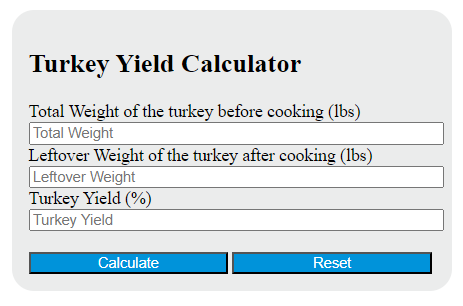
Calculate turkey cooking yield percentage, cooked weight, or raw weight from any two values using weight units like kg, lb, oz, g, or mg.
- All Food and Cooking Calculators
- Turkey Deep Fry Time Calculator
- Turkey Calculator (Cook Time/Defrost Time/+ More)
Turkey Yield Formula
Turkey yield, also called cooking yield, shows what percentage of the turkey’s starting raw weight remains after cooking. This is useful for estimating finished weight, comparing cooking methods, planning portions, and checking how much moisture and fat were lost during roasting, smoking, frying, or other cooking methods.
- TY = turkey yield percentage
- TW = raw turkey weight before cooking
- LW = cooked turkey weight after cooking
In most cases, turkey yield is below 100% because water and fat are lost during cooking. A higher yield means less weight loss. A lower yield means more moisture and rendered fat were lost. Any weight unit can be used, but the raw and cooked weights must be entered in the same unit.
Rearranged Formulas
The calculator can also solve for cooked weight or raw weight when the other values are known.
These forms are especially helpful when planning how large a turkey to buy or estimating how much cooked turkey will be available after preparation.
How to Calculate Turkey Yield
- Weigh the turkey before cooking to get the raw weight.
- Cook the turkey using your normal method.
- Let it rest, then weigh it again to get the cooked weight.
- Divide the cooked weight by the raw weight.
- Multiply by 100 to convert the result to a percentage.
For the most reliable result, compare like-for-like measurements. For example, weigh the whole bird before cooking and the whole bird after cooking. Do not compare a whole raw turkey to carved meat only, because that measures a different type of yield.
How to Use the Calculator
- Find yield percentage: enter raw weight and cooked weight.
- Estimate cooked weight: enter raw weight and expected yield percentage.
- Estimate raw turkey needed: enter desired cooked weight and expected yield percentage.
This makes the calculator useful both before cooking and after cooking. Before cooking, it helps with meal planning. After cooking, it helps evaluate shrinkage and compare different techniques.
What Affects Turkey Yield?
- Cooking method: roasting, smoking, grilling, and deep frying can all produce different levels of moisture loss.
- Final doneness: longer cooking usually reduces yield because more moisture evaporates.
- Brining or injection: added moisture can increase the finished weight.
- Resting time: juices released during resting can slightly reduce measured cooked weight.
- Covered vs. uncovered cooking: moisture retention changes the final result.
- Trimming and preparation: removing giblets, excess skin, or other parts can affect what is being weighed.
- Measurement timing: weighing immediately after cooking versus after cooling can change the number.
Practical Examples
| Use Case | Known Values | Result |
|---|---|---|
| Find cooking yield | Raw turkey: 16 lb; Cooked turkey: 12 lb | 75% yield |
| Estimate cooked weight | Raw turkey: 22 lb; Expected yield: 70% | 15.4 lb cooked weight |
| Estimate raw turkey needed | Desired cooked weight: 14 lb; Expected yield: 72% | About 19.44 lb raw weight |
Interpreting the Result
- Higher yield: the turkey retained more moisture during cooking.
- Lower yield: the turkey lost more water and fat.
- Near 100%: there was very little measurable loss, or added moisture was retained.
- Above 100%: this can happen if the turkey absorbs liquid from brining or injection, or if the raw and cooked measurements were not taken on the same basis.
Common Mistakes
- Using different units for raw and cooked weight.
- Comparing whole-bird raw weight to carved meat cooked weight.
- Weighing before the turkey has finished resting.
- Forgetting that stuffing, glaze, or injected liquid may change the final weight.
- Assuming cooking yield is the same as edible meat yield.
Turkey Yield vs. Edible Meat Yield
This calculator measures cooking yield, meaning cooked weight as a percentage of raw weight. That is not always the same as the amount of boneless edible meat you will actually serve. Bones, skin, trim loss, and carving waste all reduce the final edible portion. If you are planning servings, use turkey yield first to estimate cooked weight, then adjust further for the parts that will not be eaten.
Frequently Asked Questions
- Do I need to use pounds?
- No. Pounds, kilograms, ounces, grams, or any other weight unit can be used, as long as both weights use the same unit.
- Why is the cooked weight lower than the raw weight?
- Turkey usually loses water and fat during cooking, which reduces its total weight.
- Can this calculator help me decide what size turkey to buy?
- Yes. If you know how much cooked turkey you want and have an expected yield percentage, you can estimate the raw turkey weight needed.
- Should I weigh the turkey before or after carving?
- For accurate cooking yield, weigh it on the same basis both times. Whole raw turkey should be compared with whole cooked turkey.
- Is a higher yield always better?
- Not necessarily. A higher yield usually means better moisture retention, but texture, skin crispness, and flavor also depend on the cooking method.