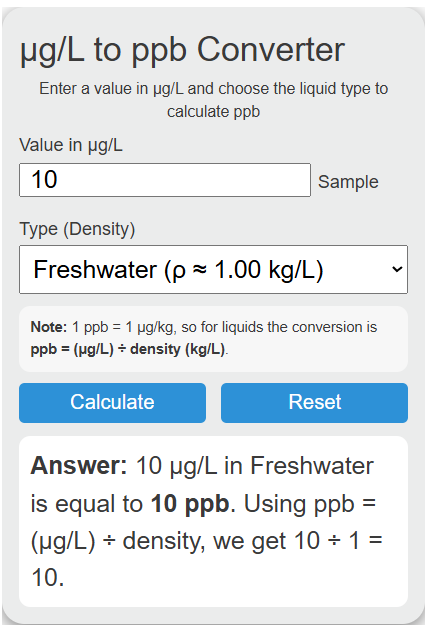
Convert micrograms per liter to parts per billion and back using water, seawater, or a custom liquid density, with mass-fraction and ppm details.
Quick overview: µg/L to ppb
Parts per billion is a mass-based concentration where 1 ppb = 1 µg/kg. When a result is reported in µg/L, you convert to ppb by accounting for the liquid density in kilograms per liter.
Formula: ppb = (µg/L) ÷ density (kg/L)
- Freshwater (ρ ≈ 1.00 kg/L): 10 µg/L ≈ 10 ppb
- Seawater (ρ ≈ 1.025 kg/L): 10 µg/L ≈ 9.76 ppb
- Light organic solvent (ρ ≈ 0.80 kg/L): 10 µg/L = 12.5 ppb
- Heavy brine (ρ ≈ 1.20 kg/L): 10 µg/L ≈ 8.33 ppb
- ug/g to ppm Converter
- ppm To Volume Calculator
- ug/ml to mg/ml Converter
- PPM to mg/L
- All Unit Converters
µg/L to ppb Formula
The following formula is used to convert a concentration from micrograms per liter (µg/L) to parts per billion (ppb).
Where:
- ppb is the concentration in parts per billion
- µg/L is the concentration in micrograms per liter
- ρ is the density of the liquid in kilograms per liter (kg/L)
Because 1 ppb = 1 µg/kg, you must divide the value in µg/L by the liquid density to convert liters of sample into kilograms of sample.
What is µg/L to ppb Conversion?
Converting µg/L to ppb is a way of expressing the same concentration on a mass-per-mass basis instead of a mass-per-volume basis. In many dilute water samples, especially freshwater, the density is close to 1 kg/L, so the numerical value in µg/L is nearly identical to the value in ppb. For denser or lighter liquids, however, the values differ and should be adjusted using the sample density.
How to Convert µg/L to ppb?
The following steps outline how to convert µg/L to ppb.
- First, determine the concentration in micrograms per liter (µg/L).
- Next, determine the density of the liquid in kilograms per liter (kg/L).
- Then divide the concentration in µg/L by the density using the formula ppb = (µg/L) ÷ ρ.
- Finally, check your answer with the calculator above.
Example Problem:
Use the following values as an example problem to test your knowledge.
Concentration = 10 µg/L
Sample Type = Seawater (ρ = 1.025 kg/L)
ppb = 10 ÷ 1.025 = 9.7561 ≈ 9.76 ppb
µg/L to ppb Conversion Table
The table below shows example conversions for a concentration of 10 µg/L in several common liquid samples.
| Sample Type | Typical Density (kg/L) | 10 µg/L in ppb |
|---|---|---|
| Freshwater | 1.00 | 10.00 ppb |
| Seawater | 1.025 | 9.76 ppb |
| Light Organic Solvent | 0.80 | 12.50 ppb |
| Heavy Brine | 1.20 | 8.33 ppb |
In many environmental and water-quality applications, a density of 1 kg/L is assumed for dilute aqueous samples, which is why µg/L and ppb are often treated as numerically equivalent. For more accurate work in seawater, brines, and process liquids, using the density-based conversion gives the correct ppb value.