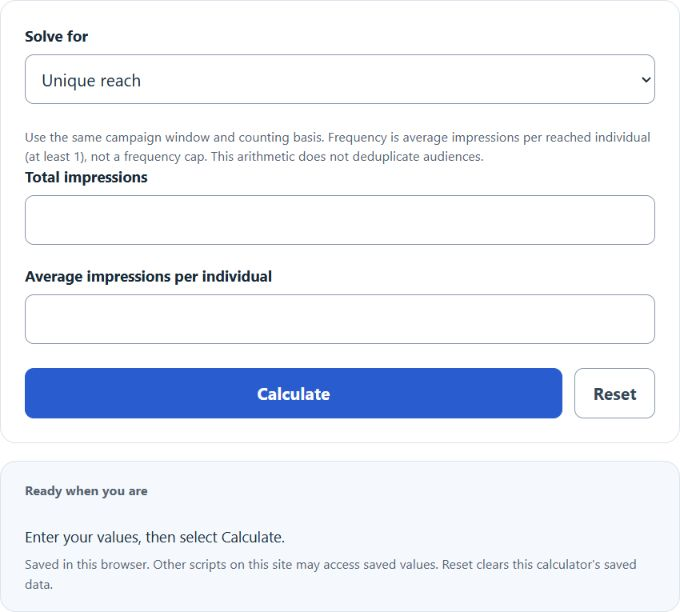
Calculate unique reach, impressions, or frequency by entering any two values and finding the missing variable in campaign planning.
Related Calculators
- Potential Reach Calculator
- Cost Efficiency Calculator
- Cost Per Call Calculator
- Incremental Cost Calculator
- All Business Calculators
Unique Reach Formula
The following formula is used to calculate unique reach:
- UR = unique reach (number of distinct individuals)
- I = total impressions served during the campaign
- F = average frequency (average exposures per unique individual)
This relationship is symmetrical: knowing any two values lets you solve for the third. A campaign delivering 1,200,000 impressions at an average frequency of 4 reaches 300,000 unique individuals. If a campaign needs to reach 500,000 people at a target frequency of 3, it must serve 1,500,000 total impressions.
What is Unique Reach?
Unique reach is the count of distinct individuals exposed to an advertisement at least once within a defined campaign window, regardless of how many total times that ad was served. It answers a fundamentally different question than impressions: not "how many times was the ad shown" but "how many different people were estimated to have been shown it."
The distinction matters because a single person viewing an ad ten times generates ten impressions but only one unit of unique reach. Without deduplication, impression-heavy campaigns on narrow audiences can appear massive in scale while actually touching a small pool of people repeatedly. Unique reach corrects for this by stripping out redundant exposures before counting.
Google Ads replaced cookie-based reach metrics with unique reach metrics in August 2020. Its statistical models estimate people across devices and formats. Current unique reach and frequency metrics also account for co-viewing on connected TV. Use impressions and average frequency with matching counting definitions, dates and campaign scope. Dividing ordinary device-level impressions by person-level reach can mix incompatible metrics. See Google’s reach and frequency definitions.
Unique Reach vs. Impressions vs. Effective Reach
These metrics are mathematically linked but measure different things. Understanding when each is the right signal separates efficient planning from inflated reporting.
| Metric | What It Counts | Primary Use |
|---|---|---|
| Impressions | Every individual ad display, including repeat views | Total volume served; CPM budgeting |
| Unique Reach | Distinct individuals exposed at least once, cross-device deduplicated | Audience breadth; unduplicated exposure planning |
| Frequency | Average exposures per unique individual | Message saturation; ad fatigue monitoring |
| Effective Reach | Individuals meeting a specified exposure threshold; the useful threshold depends on the campaign | Brand recall planning; awareness lift estimation |
A campaign showing 2,000,000 impressions to 200,000 unique people has an average frequency of 10 under a consistent individual-based counting model. The same impressions across 1,000,000 people give an average of 2. Neither average alone establishes an optimal exposure level or predicts ad fatigue.
Frequency Distribution and Reach Buckets
Some reach reports segment exposure into frequency buckets such as 1+, 2+, 3+, 5+ and 10+. Each threshold counts exposures; it does not by itself measure engagement or attention.
- 1+ reach: All unique individuals who saw the ad at least once. The broadest measure, used in awareness reporting and total audience sizing.
- 3+ reach: Individuals with at least three exposures. This threshold can be useful in a defined media plan, but it is not a universal minimum for effective exposure.
- 5+ reach: Individuals with at least five exposures. Compare the campaign’s outcomes across exposure levels before deciding whether repetition helps.
- 10+ reach: Individuals with at least ten exposures. Review performance and creative response before changing frequency controls.
Frequency distribution data also reveals audience concentration risk. When 10% of unique reach accounts for 50% of impressions, you are over-serving a small segment while under-serving the broader audience. This pattern is common in retargeting campaigns without frequency caps and in small remarketing pools.
Choosing Reach and Frequency Targets
Frequency targets depend on campaign objectives, audience, creative, channel and measurement window. Select inputs from comparable campaign data and test them against the outcome you want to improve.
Reach and frequency figures from one industry or campaign are not universal benchmarks. A useful comparison states the dates, audience, channel, creative and outcome measured.
There is no single frequency range that guarantees efficiency across digital campaigns. For connected TV, use the platform’s current co-viewing-adjusted person-level metrics consistently; Google Ads unique reach already includes co-viewing in its modeled estimates.
Frequency Capping and Unique Reach Efficiency
Frequency capping limits the number of times a given individual is served an ad within a defined time window. Its primary function is protecting unique reach quality: by preventing over-exposure to a small segment, the same impression budget reaches a larger number of distinct individuals.
Frequency controls can be tested against a campaign’s objectives. In a specific Triscuit video experiment, Google reported 93% higher absolute ad recall lift and 40% lower cost per lifted user for a weekly frequency of two versus that study’s comparison campaign. These results do not establish a general gain from frequency caps. Google’s Triscuit case study describes the comparison.
In programmatic buying, frequency controls change which impressions are eligible. Delivery, budget use and incremental reach depend on the audience, inventory, targeting and campaign settings; freed budget is not guaranteed to reach new individuals or be fully spent.
Reach vs. Frequency: When to Prioritize Each
With a fixed impression budget, maximizing unique reach means accepting lower average frequency, and vice versa. The right balance depends on campaign stage, competitive intensity, and message complexity.
Reach-first strategies fit product launches, mass-market brand building, and category entry point expansion. When a brand needs to introduce itself to new buyers, the cost of missing those individuals outweighs the benefit of reminding already-aware buyers one more time.
Frequency-first strategies make sense for competitive conquesting, considered purchases with multi-week buying cycles, and lower-funnel retargeting where the audience has already demonstrated intent. Simple emotional messages reach effective recall faster and need less frequency than detailed rational messages with multiple product claims.
One underutilized approach is sequential creative strategy: rather than repeating the same ad, frequency distribution data can trigger different creative to audiences in the 1+ bucket versus the 3+ bucket, progressing from awareness messaging to consideration and conversion messaging as frequency accumulates. This maintains unique reach breadth while using frequency constructively rather than redundantly.