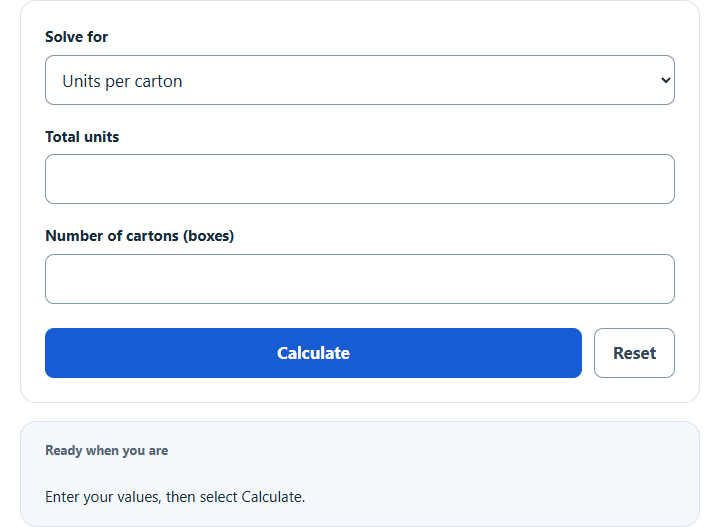
Find how many units per carton by dividing total units by cartons, work out cartons needed, or check how many items fit a box by size and weight.
Related Calculators
- EOQ Calculator (Economic Order Quantity)
- Safety Stock Calculator
- Optimal Stock Level Calculator
- Average Inventory Calculator
- All Business Calculators
Units Per Carton Formula
Variables:
- UPC is the Units Per Carton (units/carton)
- U is the number of units
- C is the number of cartons
To calculate Units Per Carton, divide the number of units by the number of cartons.
How to Calculate Units Per Carton?
The following steps outline how to calculate the Units Per Carton.
- First, determine the number of units.
- Next, determine the number of cartons.
- Next, gather the formula from above = UPC = U / C.
- Finally, calculate the Units Per Carton.
- After inserting the variables and calculating the result, check your answer with the calculator above.
Example Problem :
Use the following variables as an example problem to test your knowledge.
number of units = 400
Number of cartons = 234. The average is 400 ÷ 234 ≈ 1.7094 units/carton. A balanced whole-unit allocation puts 1 unit in 68 cartons and 2 units in 166 cartons, totaling 400 units.
FAQ
What is the importance of calculating Units Per Carton in logistics and inventory management?
The average supports inventory planning but does not establish physical fit or shipping cost. The dimension mode tests six uniform axis-aligned orientations and applies the product-weight limit. Mixed orientations may fit more items; clearance, packing material, carton tare and structural limits require separate checks.
Can the Units Per Carton formula be used for any type of product?
Yes, the Units Per Carton formula is versatile and can be applied to any type of product, regardless of its size or shape, as long as the number of units and cartons are known. This makes it a valuable tool for various industries, including retail, manufacturing, and shipping.
How can inaccuracies in calculating Units Per Carton affect a business?
Inaccuracies in calculating Units Per Carton can lead to several issues, such as overestimating or underestimating the amount of storage space needed, increased shipping costs due to inefficient packing, and potential stockouts or overstock situations. This can affect the overall efficiency and profitability of a business.