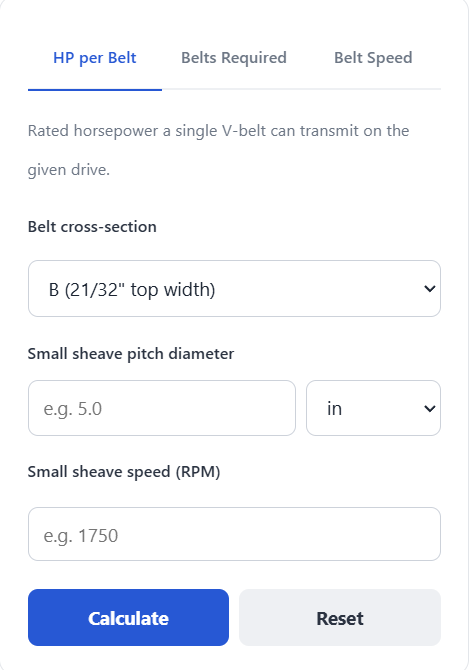
Enter the V-belt cross-section, small sheave pitch diameter, and RPM to get the rated horsepower one belt can transmit — or switch tabs to size the number of belts required or find the belt’s linear speed.
Related Calculators
- All Automotive Calculators
- Fan Horsepower Calculator
- Pump Brake Horsepower Calculator
- Corrected Horsepower Calculator
Formula
HP per belt:
HP = (Te × V / 33,000) × (1 − (V / Vmax)²)
where Te = effective tension for the belt section (lbf), V = belt speed (FPM), Vmax = maximum recommended belt speed (FPM).
Belt speed:
V = π × d × n / 12
where d = sheave pitch diameter (in), n = sheave RPM, V = belt speed (FPM).
Belts required:
N = ⌈(HPmotor × SF) / HPrated per belt⌉
where SF = service factor for the load type, and ⌈ ⌉ rounds up to the next whole belt.
Interpretation
The HP-per-belt figure tells you the usable power a single belt of that section can deliver at the given speed and diameter — not a theoretical maximum. It falls as belt speed approaches Vmax because centrifugal force lifts the belt out of the sheave groove and reduces grip.
- Below 1,000 FPM: inefficient; the drive is oversized or turning too slowly.
- 1,000–4,000 FPM: typical, efficient operating range for standard V-belts.
- 4,000–6,500 FPM: high-speed range; good power density but requires balanced sheaves.
- Above 6,500 FPM: beyond standard wrapped V-belt limits — use banded or high-speed belts.
For belt count, an exact result like 2.95 means you should round up to 3 belts. If the exact value lands close to the whole number (within about 0.15), add one more belt for a proper safety reserve.
Belt Section Quick Reference
| Section | Top width | Typical HP range per belt | Min. recommended sheave |
|---|---|---|---|
| A | 1/2″ | 0.5 – 5 HP | 3.0″ |
| B | 21/32″ | 1 – 10 HP | 5.4″ |
| C | 7/8″ | 5 – 25 HP | 9.0″ |
| D | 1-1/4″ | 15 – 75 HP | 13.0″ |
| E | 1-1/2″ | 30 – 150 HP | 21.6″ |
FAQ
Should I use the pitch diameter or the outside diameter of the sheave?
Use the pitch diameter. It is slightly smaller than the outside diameter and corresponds to where the belt’s neutral axis rides in the groove. Manufacturer catalogs list pitch diameters for each sheave.
What service factor should I pick?
Match it to the driven machine’s load character: 1.0 for smooth loads like fans, 1.2–1.3 for conveyors and mixers, and 1.4–1.5 for shock loads like crushers or hammer mills. When in doubt, round up.
Why does rated HP drop when belt speed gets too high?
Centrifugal force on the belt reduces the contact pressure in the sheave groove, so the belt can no longer transmit its full tension. The (1 − (V/Vmax)²) term in the formula captures that loss.
Does this apply to cogged or narrow (3V, 5V, 8V) belts?
The same equation form applies, but Te and Vmax are different. This calculator uses classical wrapped A–E sections. For narrow or notched belts, use the manufacturer’s rated HP tables directly in the “Belts Required” tab.