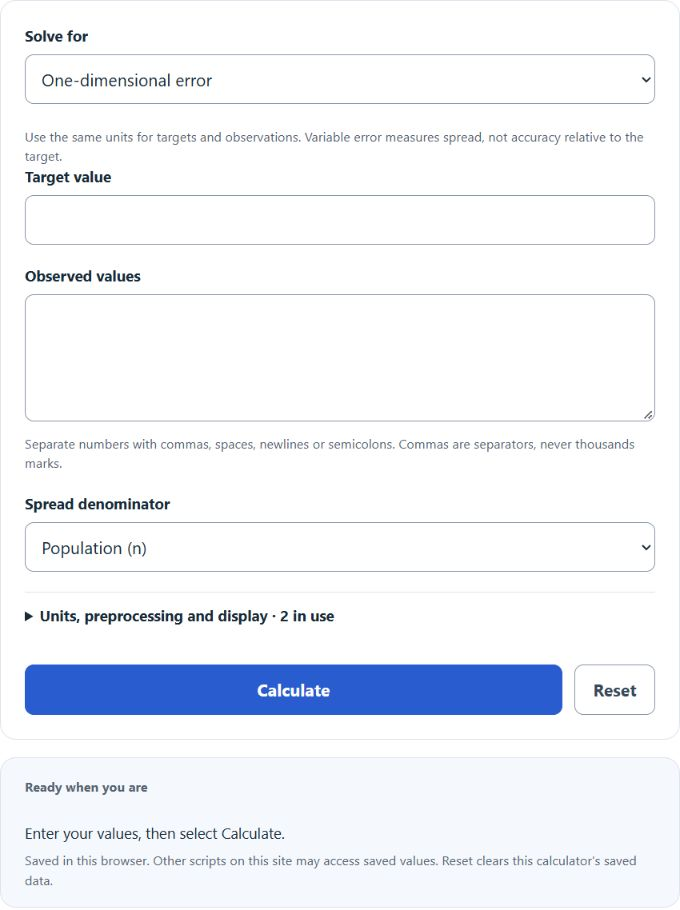
Calculate constant error, absolute error, and variable error from target and observed values, including 2D bias and radial error metrics.
Related Calculators
- Average Error Calculator
- Coefficient Of Dispersion Calculator
- RSD – Relative Standard Deviation Calculator
- Standard Error Of Difference Calculator
- All Statistics Calculators
Variable Error Formula
The following formulas calculate variable error from repeated observations. One-dimensional VE is the standard deviation of observed values (equivalently, signed errors). Population bivariate variable error is sqrt(Σ[(x − meanX)² + (y − meanY)²]/n); the n−1 version is labeled sample-adjusted 2D spread. This is not the SD of radial distances. Mean radial error measures distance to the target instead.
Variables:
- Xi is an observed (measured) value on trial i.
- T is the target (true/reference) value.
- ei is the signed error for trial i (can be positive or negative).
- X̄ is the mean of the observed values.
- n is the number of trials used in the calculation.
To calculate variable error, collect observations, compute their mean, then use the population denominator (n) or sample denominator (n−1) as appropriate. Sample spread requires at least two observations. Enter complete numbers without thousands separators; malformed entries are rejected. Optional one-pass z-score filtering or clipping changes the dataset and is a heuristic, not a formal outlier test. In 2D, preprocessing uses distance from the entered target. Relative SD is 100 × SD / |mean|, is undefined at mean zero, and needs ratio-scale data with a meaningful zero.
What is Variable Error?
Variable error is a measure of precision/consistency across repeated measurements or trials. It quantifies how much the observations vary around their mean (or, equivalently, how much the signed errors vary around the constant error). Variable error is always non‑negative: smaller values indicate more consistent performance/measurement, while larger values indicate more variability.
How to Calculate Variable Error?
The following steps outline how to calculate the Variable Error.
- Choose a target (true/reference) value T.
- Collect multiple observed (measured) values Xi from repeated trials.
- Compute the mean of the observed values: X̄.
- Compute variable error (VE) as the standard deviation of the observed values (using n or n−1 as appropriate).
- After inserting the variables and calculating the result, check your answer with the calculator above.
Example Problem :
Use the following variables as an example problem to test your knowledge.
Target (T) = 100 units; Observed values (X): 105, 98, 102, 100 units
Signed errors: 5, −2, 2, 0. Constant Error (CE) = 1.25 units, Absolute Error (AE) = 2.25 units, Variable Error (VE, population) ≈ 2.586 units (VE, sample) ≈ 2.986 units.