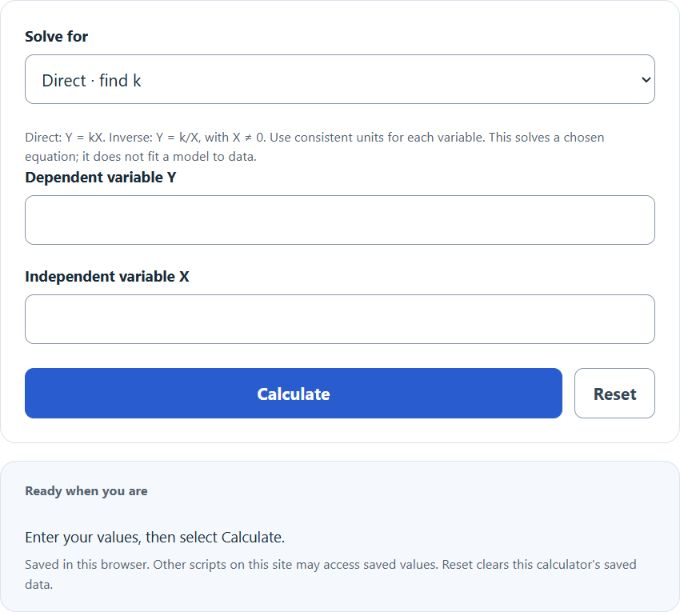
Calculate direct or inverse variation, finding Y, X, or constant k from two known values in Y = kX or Y = k/X, with step-by-step results.
- All Math and Numbers Calculators
- Joint Variation Calculator
- Variation Ratio Calculator
- Direct Variation Calculator
Variation Constant Formula
The variation constant, k, is the fixed value that links two variables in a proportional relationship. This calculator lets you choose a direct variation or inverse variation model, then solve for the missing value when any two of the three quantities are known.
| Variation type | Relationship | Formula for the constant | Interpretation |
|---|---|---|---|
| Direct variation | Y = kX |
k = (Y) / (X) |
As X changes, Y changes in the same proportion. |
| Inverse variation | Y = (k) / (X) |
k = XY |
The product XY stays constant, with X ≠ 0. For positive X and positive k, Y decreases as X increases. |
What the Calculator Solves
Once you select the variation type, the calculator can solve for Y, X, or k. The equation is simply rearranged based on the two known values you enter.
| Variation type | Solve for Y | Solve for X | Solve for k |
|---|---|---|---|
| Direct variation | Y = kX |
X = (Y) / (k) |
k = (Y) / (X) |
| Inverse variation | Y = (k) / (X) |
X = (k) / (Y) |
k = XY |
How to Calculate the Variation Constant
- Identify the relationship type. Check whether Y is a fixed multiple of X or whether the product XY is constant. The direction of change also depends on the sign of k.
- Enter the known values. Use any two of the three quantities: Y, X, and k.
- Apply the correct formula. Direct variation uses division to find the constant, while inverse variation uses multiplication.
- Interpret the result. The constant is an algebraic scale factor with units; it is not a measure of statistical association.
Examples
Direct variation example: if the dependent variable is 50 and the independent variable is 10, the constant is:
This means the model is:
For every 1-unit increase in X, the value of Y increases by 5 units.
Inverse variation example: if the dependent variable is 6 and the independent variable is 4, the constant is:
This gives the model:
If X doubles, Y is forced downward so the product remains 24.
How to Tell Direct and Inverse Variation Apart
- Use direct variation when one variable is a constant multiple of the other.
- Use inverse variation when the product of the variables is constant and X is nonzero.
A quick check for a set of values:
- If the ratio between the dependent and independent variables stays the same, the relationship is direct.
- If the product of the two variables stays the same, the relationship is inverse.
Meaning of the Constant
The constant does more than complete the equation. It gives the relationship practical meaning:
- In direct variation, k is the rate of change per unit of X.
- In inverse variation, k is the fixed product shared by every valid pair of values.
- The sign of k matters. A negative constant changes the sign behavior of the relationship.
Common Uses of Variation Models
- Direct variation: pay and hours at a fixed hourly rate, distance and time at a constant speed, circumference and diameter, scaling in geometry, and unit pricing.
- Inverse variation: speed and travel time for a fixed distance, pressure and volume in simplified gas-law settings, number of workers and completion time in basic work-rate problems, with constant productivity per worker. Intensity laws involving inverse-square distance require a different model.
Important Input Notes
- For direct variation, the constant is found by dividing by X, so the independent variable cannot be zero when solving for k.
- For inverse variation, the independent variable cannot be zero in the model.
- If you enter values that do not match the selected variation type, the result may be mathematically valid for the formula but not meaningful for your situation.
- Check units before interpreting the answer. The constant inherits units from the variables you use.
Common Mistakes
- Choosing the wrong variation type. This is the most frequent error and leads to a completely different result.
- Ignoring zero restrictions. Division by zero is undefined. In direct variation, X = Y = 0 leaves k undetermined, while X = 0 and nonzero Y are inconsistent. Zero k can also leave an inverse solve undetermined or inconsistent.
- Mixing units. Use consistent units for each variable across observations. X and Y may have different dimensions; k has units of Y/X for direct variation and XY for inverse variation.
- Assuming every proportional-looking problem is direct variation. Some relationships are inverse, joint, or not true variation at all.
Frequently Asked Questions
Can the variation constant be negative?
Yes. A negative constant is allowed if the variables can take signed values. The sign changes how the relationship behaves, but the same formulas still apply.
Does the constant have units?
Usually, yes. In direct variation, the constant often has units of the dependent variable per unit of the independent variable. In inverse variation, it often has combined units from both variables.
Can I solve for a missing variable instead of the constant?
Yes. Select the variation type and the quantity to find, then enter the two known values. A unique solution must exist. Standard nontrivial variation uses k ≠ 0; this calculator also handles uniquely solvable zero-output equations and labels them as degenerate.
What if my data does not produce one consistent constant?
Then the relationship is probably not a true variation model, or the data contains rounding, measurement error, or mixed units.