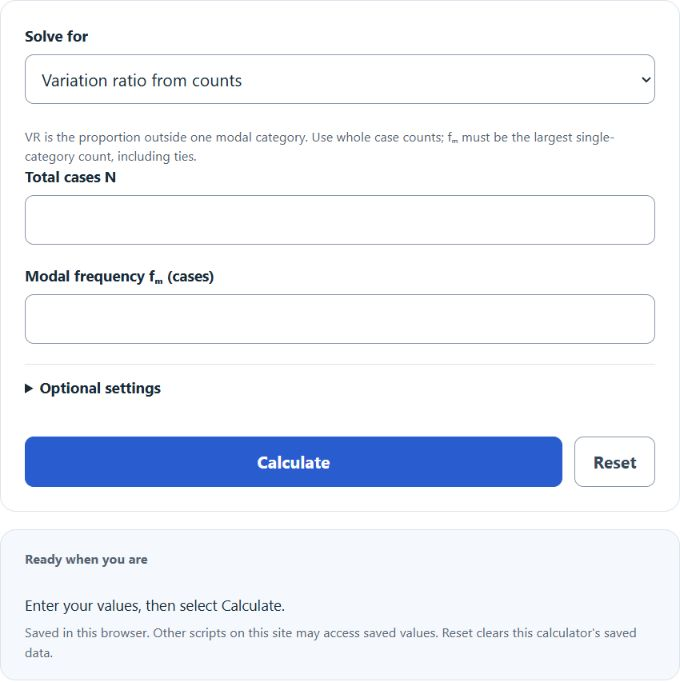
Calculate variation ratio, frequency of the mode, or total number of cases from any two values using VR = 1 − fₘ/N, where fₘ is the modal frequency and N is the total. Inverse solves require a whole case count and a sufficiently precise ratio.
Related Calculators
- Conditional Frequency Calculator
- Percentage Distribution Calculator
- Frequency Percentage Calculator
- Frequency Density Calculator
- All Statistics Calculators
Variation Ratio Formula
The following formula is used to calculate the Variation Ratio.
- Where v is the Variation Ratio
- f_m is the frequency of the mode (the count of observations in the most common category)
- N is the total number of cases across all categories
To calculate the variation ratio, divide the frequency of the modal category by the total number of observations, then subtract the result from 1. The output represents the proportion of cases that fall outside the most common category.
What Is the Variation Ratio?
The variation ratio is a measure of statistical dispersion designed specifically for nominal (categorical) data. It was formalized by Linton C. Freeman in 1965 as the simplest measure of qualitative variation. Unlike standard deviation or variance, which require numerical data on an interval or ratio scale, the variation ratio works with categories that have no inherent numerical order, such as colors, religions, languages, or political affiliations.
At its core, the variation ratio answers a single question: what proportion of observations do not belong to the most frequently occurring category? A dataset where nearly every observation falls into one category will have a variation ratio close to 0, indicating very low dispersion. A dataset where observations are spread across many categories, with no single category dominating, will push the variation ratio closer to 1.
The measure is important because many introductory statistics textbooks incorrectly imply that dispersion cannot be measured for nominal data at all. The variation ratio disproves that assumption and provides a concrete, interpretable number for how spread out a categorical distribution is.
Interpreting Variation Ratio Values
The variation ratio always falls between 0 and a value that approaches but never quite reaches 1 (a known mathematical property of the measure). Interpretation depends on context and the category scheme. The following ranges are illustrative descriptions, not validated universal benchmarks:
VR = 0: Every single observation falls into one category. There is zero dispersion. For example, if 200 out of 200 survey respondents all selected "English" as their primary language, the variation ratio is 0.
VR between 0.01 and 0.30: The data is highly concentrated around the mode. One category dominates the distribution. A VR of 0.05 means only 5% of observations fall outside the most common category.
VR between 0.30 and 0.60: Moderate dispersion. The modal category still holds a plurality, but a meaningful share of observations are distributed across other categories. A VR of 0.45 in a gender distribution (55% female, 45% male) is a classic example.
VR between 0.60 and 0.90: The modal share is relatively small. The ratio alone does not establish how evenly the non-modal cases are distributed, and such values require enough categories.
VR above 0.90: A small modal share, requiring more than ten occupied categories. For a variable with k categories, the theoretical maximum VR is (k-1)/k, which means VR can never actually equal 1 unless the mode has a frequency of zero (which is impossible by definition).
Real-World Applications by Field
The variation ratio has practical uses across many disciplines wherever categorical data needs to be summarized.
Market Research and Consumer Analysis: A consumer products company surveying 1,000 shoppers about their preferred beverage type (coffee, tea, juice, soda, water, energy drinks) might find that coffee is the mode with 280 respondents. The variation ratio would be 1 - (280/1000) = 0.72, indicating high dispersion and a competitive market with no single dominant preference. Compare this to a similar survey in a country where tea is culturally dominant at 750 out of 1,000 respondents, giving a VR of 0.25 and suggesting a concentrated market.
Demographics and Census Data: Variation ratios quantify how ethnically, linguistically, or religiously diverse a population is. A city where the most common ethnic group constitutes 40% of the population has a VR of 0.60. A city where one group makes up 92% of the population has a VR of 0.08. These numbers allow direct numerical comparisons of diversity between regions without subjective interpretation.
Healthcare and Epidemiology: When categorizing patients by diagnosis type in an emergency department, a low variation ratio means one type of case (e.g., respiratory illness) dominates. A high variation ratio suggests a broad mix of presenting conditions, which has staffing and resource allocation implications.
Ecology and Biodiversity: Ecologists use the variation ratio as a quick measure of species dominance in a habitat. If a forest sample of 500 trees has 350 of one species, the VR is 0.30, indicating that single species strongly dominates the ecosystem. A VR of 0.85 in a coral reef survey indicates high biodiversity with no single species controlling the habitat.
Education and Survey Design: Course evaluations with Likert-scale responses (treated as categories) can be assessed with the variation ratio. If most students select "Strongly Agree" for a question, the low VR confirms consensus. A high VR on a particular question signals mixed opinions and may warrant follow-up qualitative investigation.
Properties and Mathematical Bounds
The variation ratio has several important mathematical properties that affect its use and interpretation.
The minimum value is always 0, occurring when every observation belongs to one category (f_m = N). The theoretical maximum depends on the number of categories k. When observations are perfectly evenly distributed across k categories, each category has N/k observations, and the variation ratio equals (k-1)/k. For 2 categories, the maximum is 0.50. For 5 categories, it is 0.80. For 10 categories, it is 0.90. For 100 categories, it is 0.99. For finite whole counts, exact equality at (k−1)/k requires N to be divisible by k. More generally, the maximum for N cases and at most k categories is 1 − ceil(N/k)/N. The modal count is at least one, so VR is always below 1.
The variation ratio is also entirely dependent on the mode and ignores how the remaining observations are distributed among non-modal categories. Consider two datasets of 100 observations with 3 categories each. Dataset A has a distribution of 40, 35, 25. Dataset B has a distribution of 40, 40, 20 (two categories tie for the mode). Both produce the same variation ratio of 0.60 because the modal frequency is 40 in both cases, yet the actual shape of the distributions is quite different. This insensitivity to the distribution of non-modal categories is the primary reason alternative measures were developed.
Variation Ratio vs. Other Measures of Qualitative Variation
Several alternative measures address the variation ratio's limitations. Understanding when to use each one is important for choosing the right tool for a given analysis.
Index of Qualitative Variation (IQV): Also called the Mueller and Schuessler index, the IQV compares the observed diversity to the maximum possible diversity for a given number of categories. It ranges from 0 to 1 regardless of how many categories exist, unlike the variation ratio whose maximum depends on k. Use the IQV when you need a standardized 0-to-1 scale that accounts for the number of categories.
Simpson's Diversity Index (1 - D): Originally from ecology, this measure calculates the probability that two randomly selected observations belong to different categories. It accounts for the full distribution of all categories, not just the mode. Use Simpson's index when the distribution across all categories matters, not just whether observations are in the mode or not.
Shannon's Entropy (H): Borrowed from information theory, Shannon's entropy measures the average uncertainty or information content in the distribution. It is more sensitive to rare categories than either the variation ratio or Simpson's index. Use entropy when small categories carry important meaning, such as in linguistic diversity studies or network traffic analysis.
Normalized variation ratio: For k > 1, VR × k/(k−1) scales the continuous category-count bound to 1. With finite whole counts, 1 is attainable only when the categories can be equally populated. This normalization does not recover the distribution among non-modal categories or make different category definitions directly comparable.
The variation ratio remains the most commonly taught and easiest to compute of all these measures. For quick exploratory analysis or when a simple summary is sufficient, it is the preferred choice. For formal research where the full distributional shape matters, Simpson's index or Shannon's entropy is typically more informative.
Worked Example: Comparing Customer Preferences Across Regions
A retail chain surveys 500 customers in Region A and 500 customers in Region B about their preferred payment method. The options are cash, credit card, debit card, mobile payment, and check.
Region A results: Cash: 210, Credit card: 130, Debit card: 90, Mobile payment: 55, Check: 15. The mode is cash with f_m = 210. The variation ratio is 1 - (210/500) = 1 - 0.42 = 0.58.
Region B results: Cash: 105, Credit card: 110, Debit card: 100, Mobile payment: 95, Check: 90. The mode is credit card with f_m = 110. The variation ratio is 1 - (110/500) = 1 - 0.22 = 0.78.
Region B (VR = 0.78) shows substantially higher dispersion in payment preferences than Region A (VR = 0.58). These descriptive results alone do not determine payment infrastructure decisions; transaction volumes, costs, access and customer needs also matter. The maximum possible VR for 5 categories is (5-1)/5 = 0.80, so Region B is very close to maximum dispersion.
Common Mistakes When Using the Variation Ratio
There are several errors that frequently appear in student and professional work involving the variation ratio.
The most common mistake is confusing the variation ratio with the coefficient of variation (CV). The coefficient of variation is the ratio of standard deviation to the mean and applies to continuous numerical data. The variation ratio applies exclusively to categorical data. These are entirely different statistics with different formulas, different inputs, and different interpretations.
Another frequent error is using the variation ratio on ordinal data without acknowledging that it ignores ordering information. While it is technically valid to compute a VR on ordinal categories, doing so discards the information about the order of those categories. For ordinal data, Leik's measure of ordinal dispersion is often more appropriate.
Researchers sometimes compare variation ratios across datasets with different numbers of categories without adjusting for the different theoretical maximums. A VR of 0.70 is impossible with only 3 categories, whose continuous upper bound is 2/3, but possible with 20 categories. Normalization or IQV may address some category-count effects; comparisons still require consistent definitions and attention to the full frequency table.
Finally, the variation ratio should not be used as the sole measure of dispersion in formal research publications. Because it only considers the mode and ignores all other categories, it provides an incomplete picture. Supplementing it with at least one other measure (IQV, Simpson's index, or entropy) gives a much more robust characterization of categorical data spread.