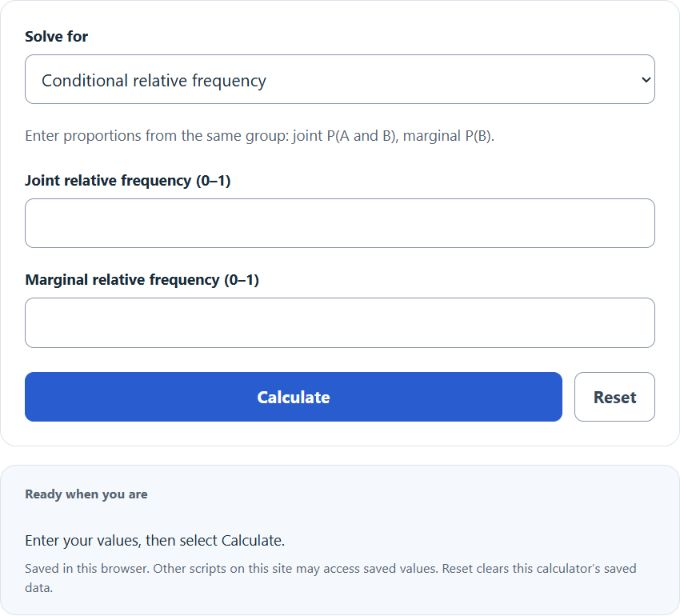
Select the relative frequency to solve and enter the two required proportions between 0 and 1.
Related Calculators
- TPR Calculator
- Dice Probability Calculator
- Probability Of Success After N Trials Calculator
- Event Rate Calculator
- All Statistics Calculators
Conditional Relative Frequency Formula
The main formula for conditional relative frequency is:
- CF = conditional relative frequency
- JRF = joint relative frequency
- MRF = marginal relative frequency
The calculator can also rearrange the formula to solve for the other two values:
- To find CF: divide the joint relative frequency by the marginal relative frequency.
- To find JRF: multiply the conditional relative frequency by the marginal relative frequency.
- To find MRF: divide the joint relative frequency by a positive conditional relative frequency.
Select the value to solve. The condition group must have a positive marginal frequency, and the joint frequency cannot exceed it. When CF and JRF are both zero, MRF is not uniquely determined.
Relative Frequency Values and Meaning
| Value | Percent form | Meaning |
|---|---|---|
| 0 | 0% | The event never occurs within the condition. |
| 0.25 | 25% | The event occurs one-fourth of the time within the condition. |
| 0.50 | 50% | The event occurs half the time within the condition. |
| 1 | 100% | The event always occurs within the condition. |
| Term | What it describes | Example wording |
|---|---|---|
| Joint relative frequency | The proportion that fits two categories at the same time. | The proportion who are seniors and prefer online classes. |
| Marginal relative frequency | The proportion in the total group that fits the condition. | The proportion who are seniors. |
| Conditional relative frequency | The proportion that fits one category, only among those already in another category. | Among seniors, the proportion who prefer online classes. |
Example Problems
Example 1: Find conditional relative frequency
Suppose the joint relative frequency is 0.18 and the marginal relative frequency is 0.60.
The conditional relative frequency is 0.30, or 30%.
Example 2: Find joint relative frequency
Suppose the conditional relative frequency is 0.40 and the marginal relative frequency is 0.25.
The joint relative frequency is 0.10, or 10%.
FAQ
What is conditional relative frequency?
Conditional relative frequency is the proportion of one event within a specific group or condition. For example, if you are looking only at students who play a sport, the conditional relative frequency could tell you what proportion of those students also take a math class.
How is conditional relative frequency different from joint relative frequency?
Joint relative frequency looks at two categories out of the entire total. Conditional relative frequency looks at one category within a smaller group. In formula form, the conditional relative frequency is the joint relative frequency divided by the marginal relative frequency.
Can a conditional relative frequency be greater than 1?
No. A valid relative frequency is between 0 and 1, inclusive. If your result is greater than 1, check that the joint relative frequency and marginal relative frequency were entered correctly. The joint relative frequency should not be greater than the related marginal relative frequency.