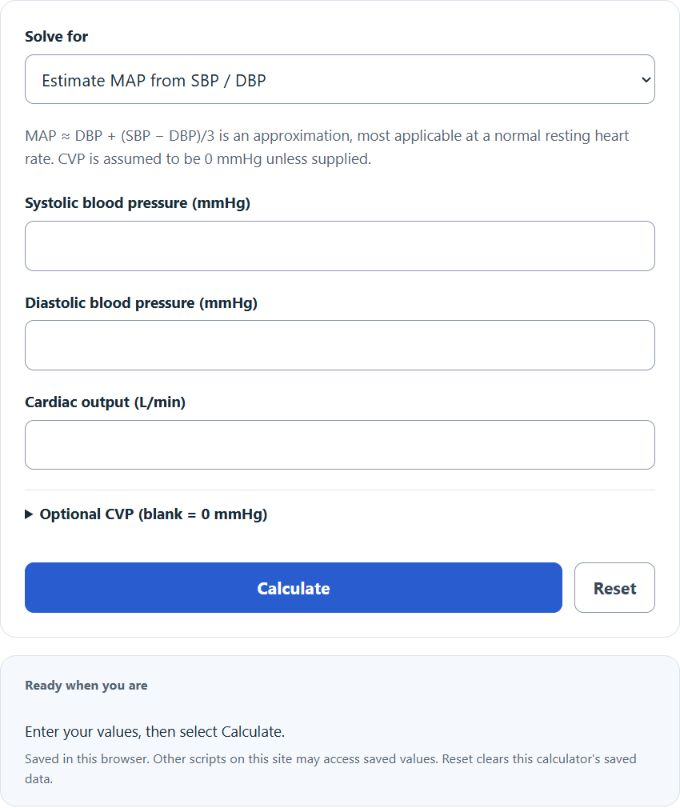
Calculate total peripheral resistance from systolic and diastolic blood pressure plus cardiac output, or from MAP and CVP in mmHg·min/L and dyn·s/cm⁵.
Related Calculators
- Pulmonary Vascular Resistance Calculator
- Mean Arterial Blood Pressure (MAP) Calculator
- Cardiac Index Calculator
- Central Venous Pressure Calculator
- Blood Flow Rate Calculator
- Average Blood Pressure Calculator
- All Statistics Calculators
TPR Formula
The following formula is used to calculate resistance (often called TPR, “total peripheral resistance”).
- Where TPR is the total peripheral resistance of the systemic circulation in this calculator
- ΔP is the pressure drop between upstream and downstream points (e.g., arterial − venous)
- Q is the flow rate through the vasculature
In many courses and clinical contexts, “TPR” is used synonymously with systemic vascular resistance (SVR). Confirm the definition used by your course/protocol.
- Systemic: SVR ≈ (MAP − CVP) / CO
- Pulmonary: PVR ≈ (mPAP − PCWP) / CO
To calculate systemic resistance, divide MAP − CVP by cardiac output in L/min. The result is in mmHg·min/L (Wood units); multiplying by the conventional rounded factor 80 gives dyn·s/cm⁵. The SBP/DBP task estimates MAP as DBP + (SBP − DBP)/3 and assumes CVP = 0 mmHg unless supplied. This MAP approximation is most applicable at a normal resting heart rate. Supplying MAP and CVP avoids that estimate but does not make the result exact. The pulmonary formula above is background only and is not calculated here. This is an educational calculation, not a basis for diagnosis or treatment.
What is TPR?
Definition:
TPR, short for total peripheral resistance, describes the systemic circulation’s opposition to blood flow, expressed as a pressure gradient divided by cardiac output. It is a resistance, not a force.
How to calculate TPR?
Example Problem:
The following example outlines how to calculate systemic resistance (often called SVR/TPR) using common clinical approximations.
First, estimate the pressure gradient (ΔP). For systemic circulation, ΔP is often approximated as MAP − CVP. Example: MAP = 93 mmHg and CVP = 5 mmHg, so ΔP = 88 mmHg.
Next, determine the flow (Q). For systemic circulation, Q is typically cardiac output (CO). Example: CO = 5.0 L/min.
Finally, calculate resistance using the formula above:
TPR = ΔP / Q
TPR = 88 / 5.0
TPR = 17.6 mmHg/(L/min) (≈ 1408 dyn·s/cm⁵)