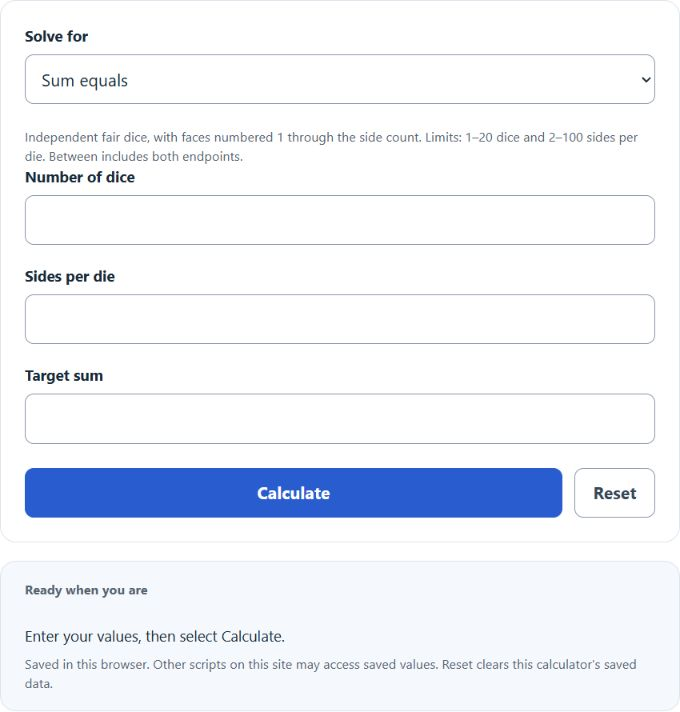
Calculate the probability that a dice sum equals, is at least, is at most, or falls between selected whole-number totals. Counts and reduced ratios use exact integer arithmetic; displayed decimals and percentages are rounded.
- All Statistics Calculators
- Conditional Probability Calculator
- Compound Probability Calculator
- Binomial Coefficient Calculator
- Spinner Probability Calculator
Dice Probability Formula
The dice probability calculator counts matching ordered outcomes and divides by the total. It assumes independent fair dice numbered 1 through the side count, with 1–20 dice and 2–100 sides per die. Between includes both endpoints. Whole-number bounds outside the possible sum range are allowed.
- P = probability as a decimal
- W = number of winning outcomes
- T = total number of possible outcomes
- T = total outcomes
- s = number of sides per die
- n = number of dice
For a specific sum, the calculator builds the count of ways each sum can occur. If all dice have the same number of sides, the number of ways to roll a sum can be represented as:
- W(k) = number of ways to roll the sum k
- k = target sum
- s = sides per die
- n = number of dice
The calculator supports four probability types:
- Sum equals counts only outcomes where the dice add exactly to the target sum.
- Sum is at least counts all outcomes from the target sum up to the maximum possible sum.
- Sum is at most counts all outcomes from the minimum possible sum up to the target sum.
- Sum is between counts all outcomes from the minimum selected sum through the maximum selected sum, including both endpoints.
Common Dice Sum Probabilities
For two standard six-sided dice, there are 36 total outcomes. The sums near 7 are more likely because they can be made in more ways.
| Sum | Ways to Roll It | Probability | Percent |
|---|---|---|---|
| 2 | 1 | 1/36 | 2.777778% |
| 3 | 2 | 2/36 | 5.555556% |
| 4 | 3 | 3/36 | 8.333333% |
| 5 | 4 | 4/36 | 11.111111% |
| 6 | 5 | 5/36 | 13.888889% |
| 7 | 6 | 6/36 | 16.666667% |
| 8 | 5 | 5/36 | 13.888889% |
| 9 | 4 | 4/36 | 11.111111% |
| 10 | 3 | 3/36 | 8.333333% |
| 11 | 2 | 2/36 | 5.555556% |
| 12 | 1 | 1/36 | 2.777778% |
Possible Sum Ranges by Dice Setup
| Dice Setup | Minimum Sum | Maximum Sum | Total Outcomes |
|---|---|---|---|
| 1d6 | 1 | 6 | 6 |
| 2d6 | 2 | 12 | 36 |
| 3d6 | 3 | 18 | 216 |
| 4d6 | 4 | 24 | 1,296 |
| 2d10 | 2 | 20 | 100 |
| 2d20 | 2 | 40 | 400 |
Dice Probability Examples
Example 1: Probability that 2d6 equals 7
You roll 2 dice with 6 sides each. The total outcomes are:
The sum 7 can occur in 6 ways: 1+6, 2+5, 3+4, 4+3, 5+2, and 6+1.
Example 2: Probability that 3d6 is at least 15
You roll 3 dice with 6 sides each. The total outcomes are:
The sums 15, 16, 17, and 18 have 10, 6, 3, and 1 outcomes, for 20 winning outcomes total.
Dice Probability FAQ
Why is rolling a 7 with two dice more likely than rolling a 2?
A 7 can be made in 6 different ordered ways with two six-sided dice. A 2 can only be made one way, by rolling 1 and 1. Since each ordered dice result is equally likely, sums with more combinations have higher probability.
What does “outcomes against” mean?
Outcomes against are the possible outcomes that do not match your selected condition. If there are 36 total outcomes and 6 winning outcomes, then there are 30 outcomes against.
What are the minimum and maximum possible sums?
The minimum possible sum is the number of dice, because each die can roll at least 1. The maximum possible sum is the number of dice multiplied by the number of sides per die. For example, 4 dice with 6 sides have a minimum sum of 4 and a maximum sum of 24.