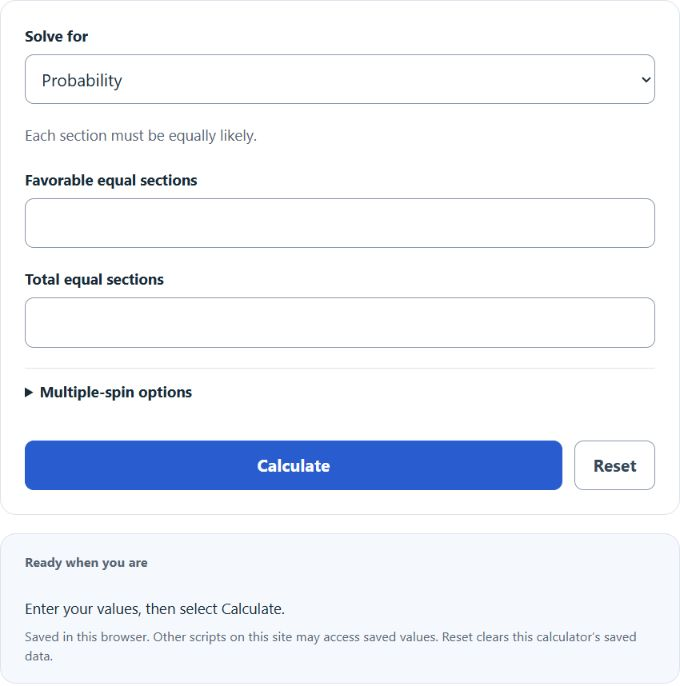
Calculate spinner probability from favorable and total equal sections, solve for missing sections, and find exactly, none, or at least one success over repeated spins.
- All Statistics Calculators
- Dice Probability Calculator
- Empirical Probability Calculator
- Implied Probability Calculator
- Overlapping Probability Calculator
Spinner Probability Formula
The following formula assumes equally likely sections on an unbiased spinner.
- Where P (X) is the probability of the spinner hitting a value X (%)
- Z is the total number of sections in which the value X appears
- Y is the total number of sections on the spinner
Divide favorable sections by total equally likely sections, then multiply by 100 for a percentage. For independent repeated spins with a constant decimal probability p, no successes has probability (1 − p)^n; at least one is 1 − (1 − p)^n; exactly k is choose(n,k) × p^k × (1 − p)^(n − k). See the NIST binomial distribution reference. Inverse results must be whole counts to describe a physical equal-section spinner. Zero favorable sections and zero probability do not uniquely determine its total.
What is a spinner probability?
Spinner Probability Definition:
Spinner probability is the chance that a spinner will land on a given value when spun.
For example, on an unbiased spinner with 10 equal sections, the chance of landing on one specified section is 1/10 = 10%.
How to calculate spinner probability?
The following example outlines the steps required to calculate a spinner probability:
First, determine the total number of sections on the spinner. In this example, there are 15 total sections the spinner could land on when spun.
Next, determine the total number of sections that have the desired result. In this example, two of the sections contain the desired result/value.
Finally, calculate the spinner probability using the formula above:
P (X) = Z / Y *100
P (X) = 2 / 15 *100
P (X) = 13.333%