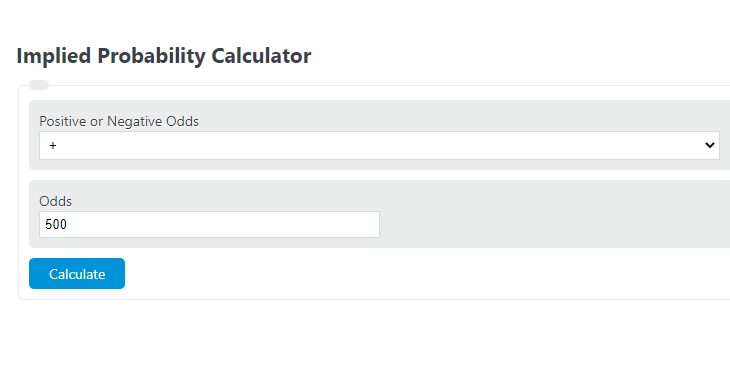
Enter American odds (positive or negative) to convert to implied probability, or enter a probability percentage to reverse-calculate the equivalent American odds.
Related Calculators
- Closing Line Value Calculator
- Odds Calculator (Success/Failure)
- Double Chance Bet Calculator
- Football Win Probability Calculator
- Bet Rollover Calculator
- All Sports and Fitness Calculators
Implied Probability Formula
The formula differs by odds format. American odds require two separate equations depending on whether the line is positive or negative. Decimal and fractional odds each use a single equation.
American Odds (Moneyline)
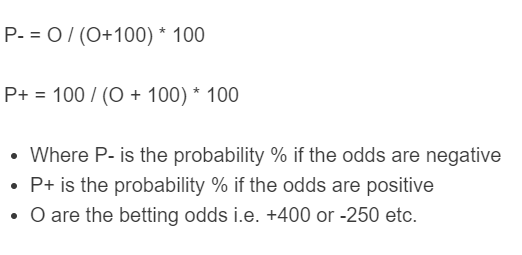
P_{-} = \frac{|O|}{|O|+100}\times 100 P_{+} = \frac{100}{O + 100}\times 100 - Where P- is the implied probability when the odds are negative
- P+ is the implied probability when the odds are positive
- O is the American odds value (use the absolute value for negative odds; e.g., for -250 use 250)
Decimal Odds
P = \frac{1}{D} \times 100- Where D is the decimal odds value (e.g., 1.91 for -110, or 3.00 for +200)
Fractional Odds
P = \frac{b}{a + b} \times 100- Where fractional odds are written as a/b (e.g., for 3/1: a=3, b=1, giving P = 1/4 x 100 = 25%)
Implied Probability Definition
Implied probability is the win percentage embedded in a bookmaker’s odds. It tells you the break-even win rate required to profit at those odds, before accounting for the bookmaker’s margin. Because sportsbooks build a profit margin (the vig or overround) into every market, the sum of implied probabilities across all outcomes in a market exceeds 100%, not exactly 100%. That excess is the bookmaker’s edge on every dollar wagered.
Implied Probability Example
How to calculate implied probability?
- First, determine if the odds are positive or negative.
For this example, we will say the odds are positive (a + sign in front of the number).
- Next, determine the odds value.
For this example we will say they are +500.
- Finally, calculate the implied probability.
Using the formula above we find the % chance of success of the bet to be 100/(500+100)*100 = 16.67%.
Common Odds Reference Table
The table below converts the most common American odds to decimal, fractional, and implied probability. The implied probability column is also the break-even win rate at those odds.
| American Odds | Decimal Odds | Fractional Odds | Implied Probability |
|---|---|---|---|
| -500 | 1.20 | 1/5 | 83.33% |
| -400 | 1.25 | 1/4 | 80.00% |
| -300 | 1.33 | 1/3 | 75.00% |
| -250 | 1.40 | 2/5 | 71.43% |
| -200 | 1.50 | 1/2 | 66.67% |
| -150 | 1.67 | 2/3 | 60.00% |
| -130 | 1.77 | 10/13 | 56.52% |
| -120 | 1.83 | 5/6 | 54.55% |
| -115 | 1.87 | 20/23 | 53.49% |
| -110 | 1.91 | 10/11 | 52.38% |
| +100 | 2.00 | 1/1 | 50.00% |
| +110 | 2.10 | 11/10 | 47.62% |
| +120 | 2.20 | 6/5 | 45.45% |
| +130 | 2.30 | 13/10 | 43.48% |
| +150 | 2.50 | 3/2 | 40.00% |
| +200 | 3.00 | 2/1 | 33.33% |
| +250 | 3.50 | 5/2 | 28.57% |
| +300 | 4.00 | 3/1 | 25.00% |
| +400 | 5.00 | 4/1 | 20.00% |
| +500 | 6.00 | 5/1 | 16.67% |
Vig, Overround, and Fair Odds
Sportsbooks price both sides of a market so that the implied probabilities sum above 100%. The excess is the overround (also called vig or juice), representing the bookmaker’s built-in profit margin regardless of which side wins.
For a standard -110/-110 point spread: each side carries a 52.38% implied probability, so the total is 104.76%. The overround is 4.76%, and the effective vig on each -110 wager is 4.55% of the amount bet.
To find the fair (no-vig) probability for a two-outcome market, divide each side’s implied probability by their combined total:
P_{fair} = \frac{P_{implied}}{P_A + P_B} \times 100For -110/-110: fair probability = 52.38 / 104.76 = 50.00% per side, equivalent to +100 (even money) on both. For a -150/+130 line: P_A = 60.00%, P_B = 43.48%, sum = 103.48%. Fair P_A = 60.00 / 103.48 = 57.98% (fair line approximately -138), fair P_B = 43.48 / 103.48 = 42.02% (fair line approximately +138).
Betting exchanges such as Betfair charge a flat commission (typically 2 to 5%) instead of embedding a margin into the odds, resulting in overrounds far closer to 100% than traditional sportsbooks.
FAQ
Implied probability is the win percentage built into a bookmaker’s odds. It tells you how often an outcome must occur for a bet at those odds to break even. It is called implied because it is derived from the odds, not from any independent analysis of the event.
Odds of -110 mean you must wager $110 to win $100 profit. The implied probability is 52.38%, which is the break-even win rate. On a standard point spread or total, both sides are priced at -110, so the bookmaker collects a 4.76% overround on the market.
The vig (short for vigorish, also called juice) is the commission a bookmaker charges on each bet. It is built into the odds so that the sum of implied probabilities across all outcomes in a market exceeds 100%. On a -110/-110 line the vig is approximately 4.55% of each wager. Removing the vig gives the fair (no-vig) probability.
A value bet occurs when your estimated probability for an outcome is higher than the implied probability in the bookmaker’s odds. For example, if you believe a team has a 55% chance to win but the implied probability from the posted odds is only 50%, you have identified positive expected value. Professional bettors target value bets and are highly selective, often finding value in fewer than 10% of available markets.
For a probability above 50% (favorite): American odds = -(P / (100 – P)) x 100. For a probability below 50% (underdog): American odds = ((100 – P) / P) x 100. For example, a 60% implied probability gives -(60/40) x 100 = -150. A 40% implied probability gives (60/40) x 100 = +150. The calculator above handles this conversion automatically in both directions.