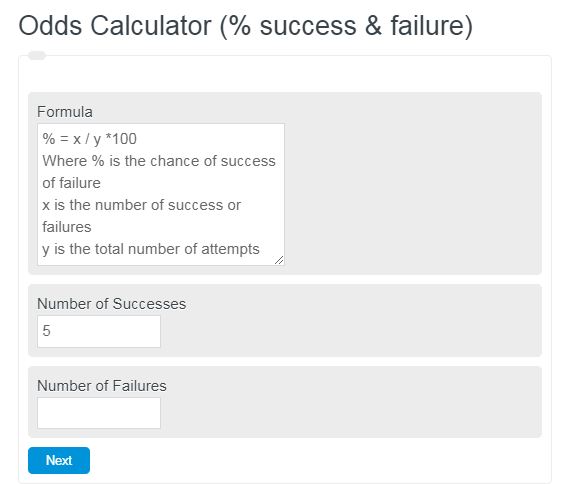
Convert success and failure percentages, odds in favor or against, and observed counts, then estimate expected outcomes and repeated-event probabilities.
- All Statistics Calculators
- Z-score calculator
- Winning Percentage Calculator
- Overlapping Probability Calculator
How the Odds Calculator for Success and Failure Works
This calculator converts observed counts of successes and failures into percentage chances for a two-outcome event. It is best used when every trial ends in exactly one of two results: success or failure. In that setting, the two percentages always add up to 100%.
It is also helpful to think of this as an empirical probability calculator. The output is based on real counts you enter, not a theoretical model. That makes it useful for test results, sales conversions, quality checks, pass/fail counts, and any other binary outcome process.
Core Variables
- S = number of successes
- F = number of failures
- T = total number of trials
- Cs = percent chance of success
- Cf = percent chance of failure
- Of = odds in favor of success
- Oa = odds against success
Main Formulas
If you know the number of successes and failures, these equations give you the complete picture immediately. The success percentage tells you how often the desired outcome occurred, while the failure percentage shows how often it did not.
How to Use the Calculator
- Enter the number of successful outcomes.
- Enter the number of failed outcomes.
- Read the calculated success percentage and failure percentage.
If your version of the calculator allows one count and one percentage, it can also solve for the remaining values. That is useful when you know, for example, how many successes occurred and what share of the total they represent.
Reverse Calculations
When one count and its matching percentage are known, you can recover the total first and then the missing count.
If the recovered totals are not whole numbers, the percentage you entered is probably rounded.
Probability vs. Odds
This page reports percentage chance, which is a form of probability. In everyday conversation people often say “odds,” but mathematically odds are usually expressed as a ratio of success to failure, not as a percent.
For example, if there are 8 successes and 2 failures, the probability of success is 80%, while the odds in favor of success are 4:1. Those numbers describe the same data in different formats.
Examples
| Successes | Failures | Total Trials | Success % | Failure % | Odds in Favor |
|---|---|---|---|---|---|
| 8 | 2 | 10 | 80% | 20% | 4:1 |
| 12 | 12 | 24 | 50% | 50% | 1:1 |
| 3 | 9 | 12 | 25% | 75% | 1:3 |
How to Interpret the Results
- Higher success percentage means the desired outcome occurred more often.
- Higher failure percentage means the undesired outcome occurred more often.
- Balanced outcomes occur when successes and failures are equal, producing 50% success and 50% failure.
- Very small sample sizes can produce extreme percentages that are not yet stable.
For example, 1 success out of 1 trial gives a success rate of 100%, but that does not carry the same weight as 100 successes out of 100 trials. The calculator gives the correct percentage in both cases, but sample size still matters when you interpret the result.
Common Mistakes to Avoid
- Confusing probability with odds. A success rate of 75% is not the same as odds of 75:25; the simplified odds would be 3:1.
- Using the wrong total. The denominator should include all relevant successes and failures.
- Entering values outside the binary setup. This calculator assumes every outcome belongs to one of only two categories.
- Using negative or non-count values. Successes and failures are usually whole-number counts.
Edge Cases
- If S = 0, the success percentage is 0% and the failure percentage is 100%.
- If F = 0, the success percentage is 100% and the failure percentage is 0%.
- If S = 0 and F = 0, no valid percentage can be calculated because there are no trials.
Where This Calculator Is Useful
- Pass/fail test summaries
- Sales win/loss tracking
- Quality control inspections
- Sports make/miss outcomes
- Customer support resolution rates
- Manufacturing success/failure counts
- Binary experiment and trial outcomes
Quick FAQ
Is this theoretical probability?
Not necessarily. The calculator uses observed counts, so it gives empirical probability based on your data.
Why do the percentages sometimes look slightly off after rounding?
Before rounding, the two percentages sum to exactly 100. Small display differences can happen when decimals are rounded.
Can I use this for more than two outcomes?
No. This calculator is designed for binary events only. If your data has three or more categories, each category must be analyzed separately or with a different probability tool.
What is the fastest way to check my inputs?
Make sure your success count plus failure count equals the total number of trials you intended to analyze. If that total is wrong, every percentage will be wrong too.