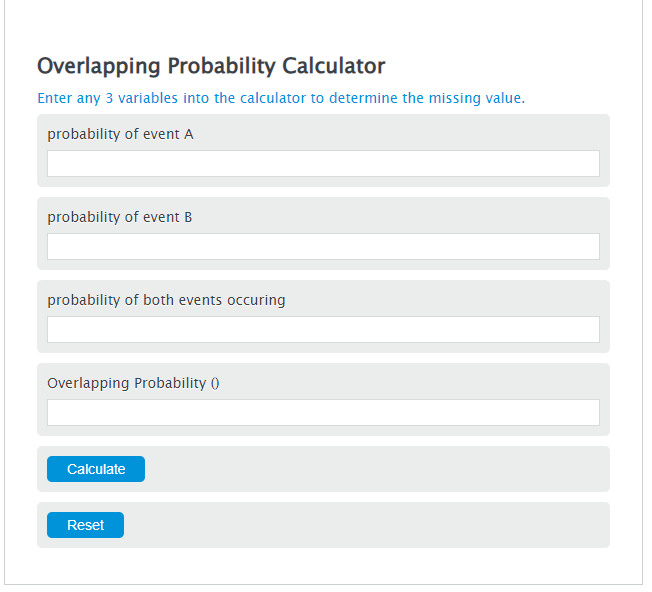
Calculate overlapping probabilities for two events, including union, intersection, conditional probabilities, and results from counts.
Related Calculators
- Posterior Probability Calculator
- Failure Probability Calculator
- Defective Probability Calculator
- Chances Of Winning Calculator
- All Statistics Calculators
Overlapping Probability Formula
Variables:
- OP is the overlapping probability, i.e., P(A ∪ B) (the probability that A or B or both occur; 0 to 1, or 0% to 100%)
- P(A) is the probability of event A
- P(B) is the probability of event B
- P(A ∩ B) is the probability that both events occur (the overlap / intersection)
To calculate Overlapping Probability (the probability that at least one of the two events occurs), add the probability of event A to that of event B, then subtract the probability of both events occurring (the overlap) from the result.
How to Calculate Overlapping Probability?
The following steps outline how to calculate the Overlapping Probability.
- First, determine the probability of event A.
- Next, determine the probability of event B.
- Next, determine the probability of both events occurring (the intersection, P(A ∩ B)).
- Next, gather the formula from above = OP = P(A) + P(B) – P(A ∩ B).
- Finally, calculate the Overlapping Probability.
- After inserting the variables and calculating the result, check your answer with the calculator above.
Example Problem :
Use the following variables as an example problem to test your knowledge.
Probability of event A = 3%
Probability of event B = 5%
Probability of A and B = 2%
Overlapping Probability (P(A ∪ B)) = 3% + 5% − 2% = 6%
Frequently Asked Questions
What is the difference between Overlapping Probability and Independent Events?
In this context, Overlapping Probability refers to the probability that at least one of two events occurs (P(A ∪ B)) when the events may overlap (i.e., they are not mutually exclusive). Independent events are those whose outcomes do not affect each other, meaning P(A∩B)=P(A)P(B) (and equivalently, knowing one event occurred does not change the probability of the other).
How can Conditional Probability be applied in calculating Overlapping Probability?
Conditional probability can be used to find the overlap (intersection). For example, P(A∩B)=P(A|B)\,P(B) (or P(A∩B)=P(B|A)\,P(A)). Once you have P(A∩B), you can compute P(A∪B)=P(A)+P(B)-P(A∩B).
What is Compound Probability and how does it relate to Overlapping Probability?
Compound probability involves calculating the probability of events in combination (such as unions and intersections). Overlapping Probability here is the union of two events (P(A∪B)), which explicitly accounts for overlap by subtracting the intersection term P(A∩B).
Can Overlapping Probability exceed 1 or be negative?
No. Probabilities range from 0 to 1 (or 0% to 100%). If calculations result in values outside this range, it typically indicates invalid inputs (for example, an intersection value that is too large or inconsistent with the union formula).