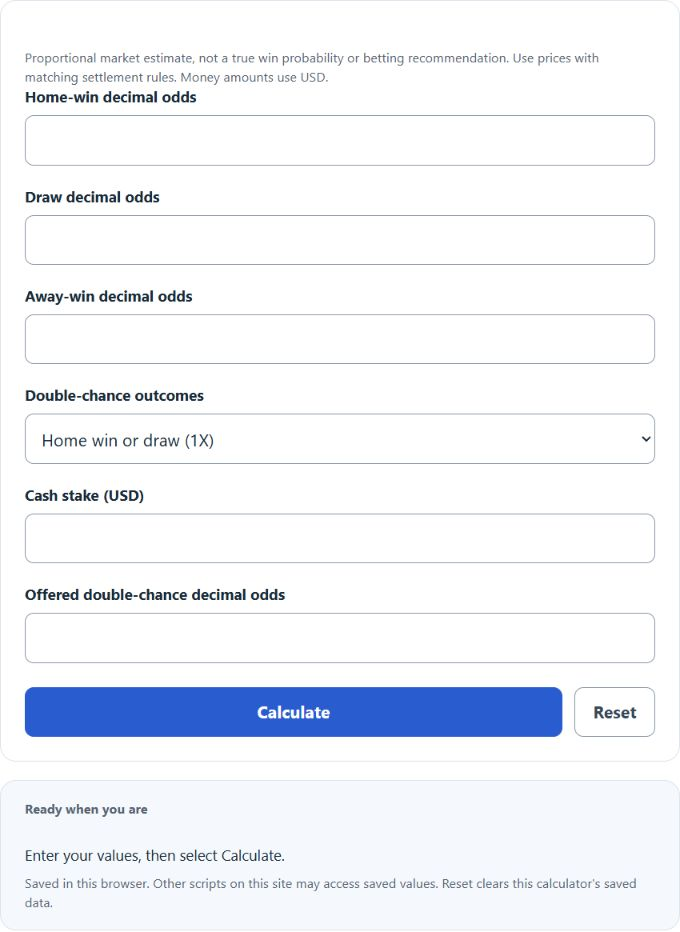
Calculate double chance bet from your inputs, with a result breakdown and worked steps.
Double Chance Bet Formula and Method
Normalize each 1X2 implied probability by their total
Enter the home, draw and away prices for the same three-way market. The tool normalizes their reciprocal probabilities to remove the total margin proportionally, then adds the two outcomes included in 1X, X2 or 12. This gives a market-derived estimate for the combination.
How to Use This Calculator
Enter all three decimal prices from the same three-way market, choose 1X, X2 or 12, then enter the USD cash stake and the offered double-chance price. Review the primary result and its breakdown, then open the calculation steps to see how the inputs were used.
Worked Example
With the example inputs in the table, the result is 66.611%. The estimate comes from proportional normalization of the entered three-way market.
Add the probabilities of the two included outcomes.
Input and Example Guide
| Input or category | Example or weight | Entry guidance |
|---|---|---|
| Money convention | U.S. dollars (USD) | All cash amounts use USD; no currency conversion is performed. |
| Cash stake (USD) | 100 | Use the stated unit; retain available precision. |
| Home-win price (decimal odds) | 2.5 | Use the stated unit; retain available precision. |
| Draw price (decimal odds) | 3.2 | Use the stated unit; retain available precision. |
| Away-win price (decimal odds) | 2.8 | Use the stated unit; retain available precision. |
| Double-chance outcomes | Home win or draw (1X) | Choose the convention that applies to your record. |
| Offered double-chance price (decimal odds) | 1.5 | Use the stated unit; retain available precision. |
Interpreting the Result
The actual double-chance quote determines winning cash profit, so it is entered separately. The normalized estimate and offered implied probability answer different questions. Regulation-time, overtime and void treatment must match across the prices; the arithmetic does not identify a true probability or settlement rule.
A 1X2-derived estimate is not a measured true probability. Use matching regulation-time settlement and the actual double-chance quote for the payout.
Assumptions and Common Input Errors
The estimate comes from proportional normalization of the entered three-way market. Keep the same currency and settlement conditions throughout a scenario. Cash stakes accept two decimals and decimal odds up to six. Winning returns use exact decimal arithmetic and round half cents up; actual operator fees and settlement rules are excluded.
Saving and Revising a Scenario
A successful calculation is saved in this browser and can be restored on the next visit. Editing an input retains the answer as Previous result until Calculate is selected again. Reset empties user-specific values and clears this calculator’s saved state.
Sources
Betfair Help, Decimal Odds and Stake-Inclusive Returns, reviewed 2026. Arithmetic and scenario assumptions are specified above.