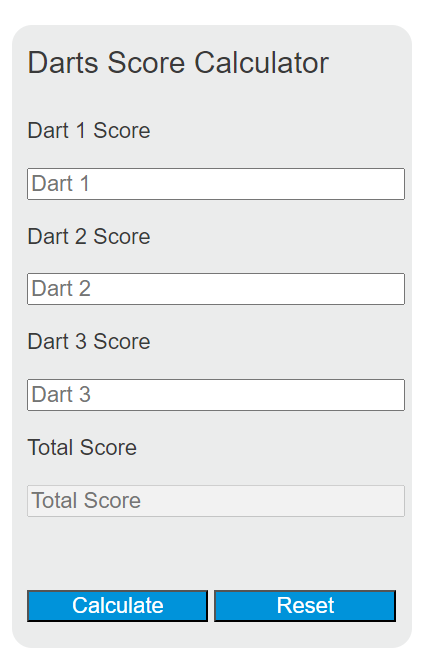
Add the scores of three darts or find one missing dart value while checking that every score is possible on a standard board.
Three-Dart Score Formula
Turn total = dart 1 + dart 2 + dart 3. Missing dart = turn total − the other two dart scores.
Select the Missing Value
Choose the turn total when all three hit values are known. Choose a particular dart when you know the total and the other two values. Enter a point value, not a segment number: treble 20 is entered as 60 and double 16 as 32. The requested output is omitted from the input fields so an earlier answer cannot accidentally become another source value.
Possible Single-Dart Values
The supported board has singles one through 20, their doubles and trebles, a 25-point outer bull, and a 50-point inner bull. A miss is zero. These values do not cover every integer from zero to 60: 23 and 59, for example, are not single-dart scores. The calculator validates both entered and reconstructed dart values against the board’s actual possibilities.
Worked Total Example
For hits worth 60, 20, and 20, the sum is 100 points. The supporting mean is 100 ÷ 3 = 33.33 points per dart. Three trebles of 20 give 180, the maximum three-dart hit total. Three misses give zero and are valid inputs; a blank field is not assumed to mean a miss.
Worked Missing-Dart Example
Suppose the turn total is 121 and the two known darts scored 60 and 25. Subtracting gives 121 − 60 − 25 = 36. That value is possible as double 18 or treble 12, so the missing score is accepted. If the same two darts were paired with a claimed total of 108, the missing 23 would be rejected even though it lies within zero to 60.
A Score Does Not Identify the Segment
Some point values have more than one explanation. Twenty can be single 20 or double 10, and 36 can be double 18 or treble 12. Recovering a missing number therefore does not prove which segment was hit. A total of 40 does not, by itself, establish that the last dart was double 20. Use the actual hit record when a finishing rule matters.
Hit Totals and Credited Visits
This calculator totals the three values you provide. In a double-out leg, a bust can cause the entire visit to be credited as zero even though the darts struck scoring segments. It does not ask for the starting remainder or finish type, and therefore does not adjudicate busts, double-in, or checkout legality. For an average, use the credited score from the scoring record rather than an unadjusted hit total.
Practical Entry Checks
Scores must be whole numbers, each dart must be a valid board value, and the total must lie between zero and 180. A reconstructed negative dart indicates that the known hits already exceed the claimed total. A reconstructed value above 60 is also impossible. The result breakdown lets you compare all three entries with the original record before carrying the total into another calculation.
Reference Table
| Hit | Point value | Entry |
|---|---|---|
| Single 20 | 20 | 20 |
| Double 16 | 32 | 32 |
| Treble 20 | 60 | 60 |
| Outer bull | 25 | 25 |
| Inner bull | 50 | 50 |
| Miss | 0 | 0 |
Sources
Darts Regulation Authority, DRA Rules, 2019, sections 5.3–5.4. Calculator Academy, standard-board value validation and arithmetic examples, 2026.