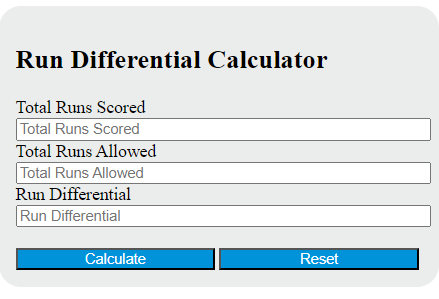
Calculate baseball run differential from runs scored and allowed, solve for a missing total, or estimate Pythagorean win percentage and record.
Related Calculators
- ERA Calculator (Earned Run Average)
- Closing Line Value Calculator
- Goal Assist Ratio Calculator
- Points Per Minute Calculator
- All Sports and Fitness Calculators
Run Differential Formula
The following formula is used to calculate the run differential in a baseball game.
Variables:
- RD is the run differential
- RS is the total runs scored by a team
- RA is the total runs allowed by a team
To calculate the run differential, subtract the total runs allowed by a team from the total runs scored by the team. The result is the run differential, which can be a positive or negative number. A positive run differential indicates that a team has scored more runs than it has allowed, while a negative run differential indicates the opposite.
What is a Run Differential?
Run differential in baseball is the difference between the total number of runs a team has scored and the total number of runs its opponents have scored. It is used as a performance metric to evaluate a team’s overall performance. A positive run differential indicates that a team has scored more runs than it has allowed, suggesting strong offensive and defensive performance, while a negative run differential suggests the opposite.
How to Calculate Run Differential?
The following steps outline how to calculate the Run Differential.
- First, determine the total runs scored by a team (RS).
- Next, determine the total runs allowed by a team (RA).
- Next, gather the formula from above = RD = RS – RA.
- Finally, calculate the Run Differential.
- After inserting the variables and calculating the result, check your answer with the calculator above.
Example Problem :
Use the following variables as an example problem to test your knowledge.
total runs scored by a team (RS) = 250
total runs allowed by a team (RA) = 200