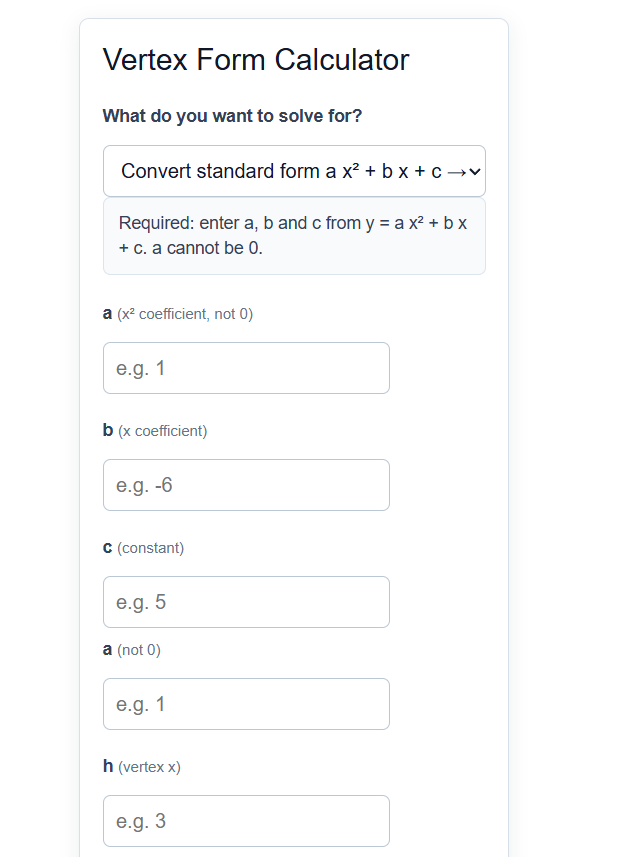
Calculate the vertex form of any quadratic, convert between standard and vertex form, and find the vertex (h, k), axis of symmetry, and intercepts of a parabola.
Vertex Form Formula
The vertex form of a quadratic describes a parabola using its vertex (h, k):
y = a(x - h)^2 + k
When you start from standard form, you convert using these relationships:
y = ax^2 + bx + c, h = -b/(2a), k = c - b^2/(4a)
When you have a vertex and one other point on the parabola, you solve for a:
a = (y - k) / (x - h)^2
- y = the output value of the quadratic for a given x
- a = the leading coefficient; it sets how wide the parabola is and which way it opens
- h = the x coordinate of the vertex
- k = the y coordinate of the vertex
- b = the coefficient of x in standard form
- c = the constant term in standard form, equal to the y intercept
The calculator works in three directions. In standard-to-vertex mode it takes a, b, and c, computes h from -b/(2a) and k from c - b^2/(4a), and writes the result as a(x - h)^2 + k. In vertex-to-standard mode it takes a, h, and k and expands the square back into ax^2 + bx + c, using b = -2ah and c = ah^2 + k. In the vertex-and-point mode it takes a known vertex (h, k) plus any second point (x, y) and solves a = (y - k)/(x - h)^2 so it can report both forms. In every mode it can also return the axis of symmetry x = h, the direction of opening, the minimum or maximum value, the y intercept, and the x intercepts when they are real.
Reading the Sign of a
The leading coefficient a controls the shape and orientation of the parabola, so its sign tells you what the vertex represents before you do any other work.
| Value of a | Opens | Vertex is | Width vs y = x² |
|---|---|---|---|
| a > 1 | Up | Minimum | Narrower |
| 0 < a < 1 | Up | Minimum | Wider |
| a = 1 | Up | Minimum | Same |
| a < 0 | Down | Maximum | Depends on |a| |
The table below summarizes how each quantity maps between the two forms, which is useful when you want to check the calculator by hand.
| Quantity | From standard form | From vertex form |
|---|---|---|
| Vertex x (h) | -b/(2a) | h (given) |
| Vertex y (k) | c - b²/(4a) | k (given) |
| b | b (given) | -2ah |
| c (y intercept) | c (given) | ah² + k |
| Axis of symmetry | x = -b/(2a) | x = h |
Example Problems
Example 1. Convert y = 2x² + 8x + 5 to vertex form. Here a = 2, b = 8, c = 5. The vertex x is h = -b/(2a) = -8/4 = -2. The vertex y is k = c - b²/(4a) = 5 - 64/8 = 5 - 8 = -3. So the vertex form is y = 2(x + 2)² - 3, the vertex is (-2, -3), and because a is positive that point is a minimum.
Example 2. Find the equation from the vertex (1, 4) passing through the point (3, 0). Use a = (y - k)/(x - h)² = (0 - 4)/(3 - 1)² = -4/4 = -1. The vertex form is y = -(x - 1)² + 4. Expanding gives the standard form y = -x² + 2x + 3, and since a is negative the vertex (1, 4) is a maximum.
Frequently Asked Questions
What is the difference between standard form and vertex form? Standard form is y = ax² + bx + c and is convenient for reading off the y intercept c and for applying the quadratic formula. Vertex form is y = a(x - h)² + k and shows the vertex (h, k) and the axis of symmetry directly. Both describe the same parabola, so you can convert between them without changing the graph.
How do I find h and k from a, b, and c? Compute h = -b/(2a), then plug that x back into the equation or use k = c - b²/(4a) to get the vertex y value. The leading coefficient a stays the same in both forms, so once you have h and k you can write y = a(x - h)² + k immediately.
Can a be zero? No. If a = 0 the x² term disappears and the equation becomes linear, so there is no parabola and no vertex form. The calculator requires a nonzero value of a and will flag an entry of zero in any mode that uses it.