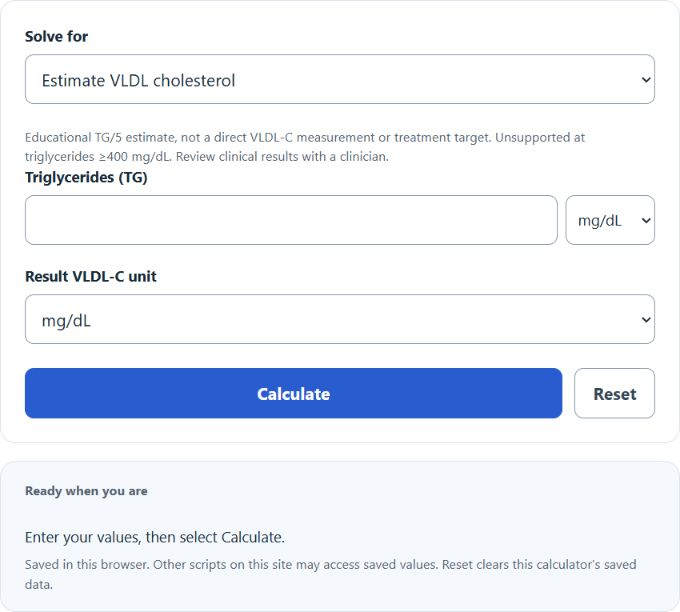
Calculate estimated VLDL cholesterol from triglycerides using TG divided by 5, or back-calculate triglycerides from VLDL, in mg/dL or mmol/L.
Educational use only. This tool estimates VLDL using a rule-of-thumb (VLDL ≈ TG/5 in mg/dL) and may be inaccurate, especially when triglycerides are high (e.g., ≥400 mg/dL / 4.5 mmol/L), with non-fasting samples, or in certain medical conditions. Not medical advice; discuss results with a licensed clinician.
VLDL Estimate Formula
Very-low-density lipoprotein cholesterol (VLDL-C) has historically been approximated from triglycerides as the VLDL component of the Friedewald equation. This calculator provides that legacy estimate; it is not a direct VLDL measurement, and current guidance prefers Martin/Hopkins or Sampson/NIH LDL-C estimation.
In SI units, a commonly rounded form is shown below. This calculator uses TG conversion 88.57 mg/dL per mmol/L and cholesterol conversion 38.67, giving a consistent divisor of 5 × 38.67 / 88.57 ≈ 2.183019 rather than rounding it to 2.2.
If you know an estimated VLDL value and want the corresponding triglyceride value, the relationship can be rearranged as follows:
Variable Definitions
| Variable | Meaning | Typical Unit |
|---|---|---|
| VLDL | Estimated very-low-density lipoprotein cholesterol | mg/dL or mmol/L |
| TG | Triglyceride concentration from a lipid panel | mg/dL or mmol/L |
How to Use the Calculator
- Choose the VLDL estimate task and enter triglycerides, or choose reverse mode for algebra using a known legacy VLDL estimate.
- Select the correct unit system: mg/dL or mmol/L.
- Choose the result unit and select Calculate. No estimate is reported at or effectively at TG 400 mg/dL or above.
- Interpret the result together with total cholesterol, LDL, HDL, non-HDL cholesterol, and your overall clinical picture.
Example
If triglycerides are 150 mg/dL, the estimated VLDL is:
If triglycerides are 1.7 mmol/L, the estimated VLDL is:
What VLDL Is
VLDL is a lipoprotein made by the liver to transport triglycerides through the bloodstream. It carries a large triglyceride load and a smaller amount of cholesterol. As triglycerides are removed from the particle, VLDL is gradually remodeled into smaller remnants and then into other lipoprotein fractions. Because of this, a higher estimated VLDL value usually reflects higher circulating triglycerides and may be part of a more atherogenic lipid pattern.
How VLDL Fits Into a Lipid Panel
Estimated VLDL is commonly used as one piece of a broader lipid calculation. One common relationship is:
This matters because if the VLDL estimate is less accurate, any downstream LDL calculation that depends on it can also become less accurate.
When the Estimate Is Most Useful
- For illustrating the legacy Friedewald VLDL component when TG is below 400 mg/dL; this is not a screening diagnosis.
- For understanding how triglycerides influence the lipid panel.
- For educational use when comparing changes over time in the same unit system.
- For estimating VLDL when a report does not list it directly.
When the Estimate Can Be Less Reliable
- Triglycerides are very high, especially at or above 400 mg/dL.
- The blood sample was non-fasting and triglycerides were temporarily elevated after a meal.
- There are unusual lipoprotein disorders or remnant abnormalities.
- Recent alcohol intake, acute illness, pregnancy, poorly controlled diabetes, or major metabolic changes are affecting triglycerides.
- Clinical assessment needs the full lipid panel and context. The 2026 ACC/AHA guideline prefers Martin/Hopkins or Sampson/NIH for LDL-C estimation; this legacy VLDL component does not implement those methods.
Important Interpretation Notes
- This calculator estimates VLDL cholesterol, not VLDL particle number or particle size.
- A higher estimate does not diagnose disease by itself; it should be read alongside the rest of the lipid panel and your medical history.
- If your triglycerides are significantly elevated, discuss the result with a licensed clinician instead of relying only on a rule-of-thumb estimate.
- Select each input and output unit carefully. The calculator converts TG and cholesterol using their different factors.
Common Questions
Is VLDL the same as LDL?
No. VLDL primarily carries triglycerides, while LDL carries a higher proportion of cholesterol and is a different lipoprotein fraction.
Can I use a non-fasting triglyceride value?
You can calculate an estimate, but the result may be less stable because triglycerides often rise after eating.
Why does the divisor change between mg/dL and mmol/L?
Triglycerides and cholesterol have different mass-to-molar conversion factors: 88.57 and 38.67 mg/dL per mmol/L respectively. The SI divisor consistent with TG/5 is about 2.183019, often rounded to 2.2.
Is estimated VLDL enough to judge cardiovascular risk?
No. Cardiovascular risk assessment is broader and usually considers LDL, HDL, non-HDL cholesterol, blood pressure, diabetes status, smoking history, age, family history, and other clinical factors.