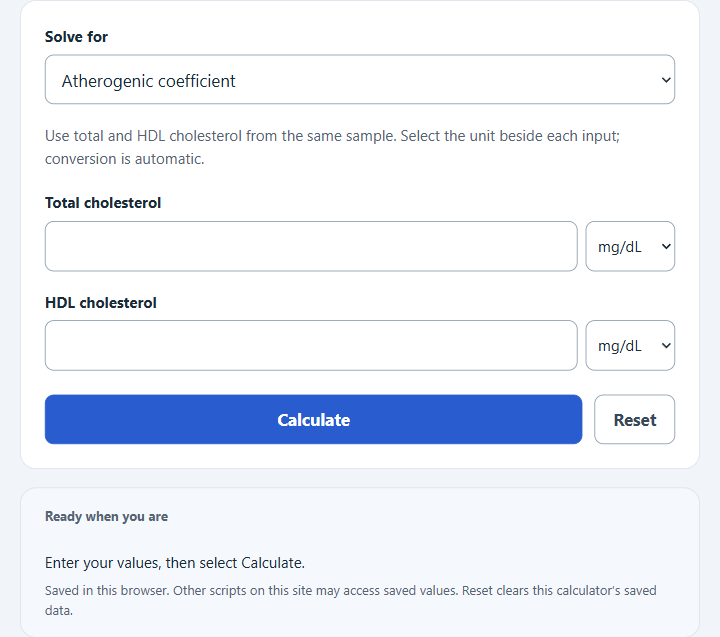
Choose Solve for to calculate atherogenic coefficient, total cholesterol, or HDL-C from the other two values. Cholesterol inputs accept mg/dL or mmol/L; reverse results show both units.
Medical note: This calculator is for educational use only and is not medical advice or a diagnosis. The atherogenic coefficient is only one lipid ratio and should be interpreted with other risk factors (for example blood pressure, diabetes, smoking, and LDL/non-HDL cholesterol) using guideline-based tools such as the ASCVD risk estimator; discuss results with a licensed clinician and refer to reputable guidance (e.g., CDC/NIH/AHA/ACC).
Atherogenic Coefficient Formula
The atherogenic coefficient compares non-HDL cholesterol to HDL cholesterol. It is unitless because the cholesterol units cancel out. Use the same unit system for total cholesterol and HDL-C, or convert both values to the same unit before applying the formula.
- AC = atherogenic coefficient, unitless
- TC = total cholesterol
- HDL = HDL-C, or HDL cholesterol
If you know HDL-C and the atherogenic coefficient, the calculator can rearrange the formula to estimate total cholesterol:
If you know total cholesterol and the atherogenic coefficient, the calculator can rearrange the formula to estimate HDL-C:
The calculator accepts total cholesterol and HDL-C in either mg/dL or mmol/L. For cholesterol values, it uses this conversion:
To use the calculator, choose the value to solve for, enter the two displayed inputs, and select Calculate. The matching rearranged formula is shown in Calculation details. HDL-C must be positive and cannot exceed total cholesterol. The coefficient is nonnegative.
Atherogenic Coefficient Context and Cholesterol Unit Conversions
The atherogenic coefficient is a descriptive non-HDL-to-HDL ratio. The former favorable/moderate/high cutoffs were removed because they are not current ACC/AHA treatment targets. Interpret the underlying LDL-C, non-HDL-C, triglyceride, ApoB, and overall cardiovascular-risk information with a clinician.
| Conversion | Formula | Example |
|---|---|---|
| mmol/L to mg/dL | Multiply by 38.67 | 5.2 mmol/L ≈ 201.08 mg/dL |
| mg/dL to mmol/L | Divide by 38.67 | 200 mg/dL ≈ 5.17 mmol/L |
Atherogenic Coefficient Examples
Example 1: Calculate atherogenic coefficient.
Suppose total cholesterol is 200 mg/dL and HDL-C is 50 mg/dL.
The atherogenic coefficient is 3.0.
Example 2: Calculate HDL-C.
Suppose total cholesterol is 180 mg/dL and the atherogenic coefficient is 2.0.
The HDL-C value is 60 mg/dL.
Atherogenic Coefficient FAQ
What does the atherogenic coefficient measure?
The atherogenic coefficient measures the relationship between non-HDL cholesterol and HDL cholesterol. Since non-HDL cholesterol is calculated as total cholesterol minus HDL-C, the coefficient shows how much cholesterol outside the HDL fraction exists compared with HDL-C.
Is the atherogenic coefficient the same as the total cholesterol to HDL ratio?
No. They are closely related, but they are not identical. The total cholesterol to HDL ratio is calculated as total cholesterol divided by HDL-C. The atherogenic coefficient subtracts HDL-C first, then divides by HDL-C.
For the same cholesterol values, the atherogenic coefficient is 1 less than the total cholesterol to HDL ratio.
How does the calculator handle different cholesterol units?
The formula divides one cholesterol value by another, so total cholesterol and HDL-C must be expressed in compatible units. If one value is in mg/dL and the other is in mmol/L, the result will be wrong unless one value is converted first. The calculator converts cholesterol values internally so the formula is applied consistently.