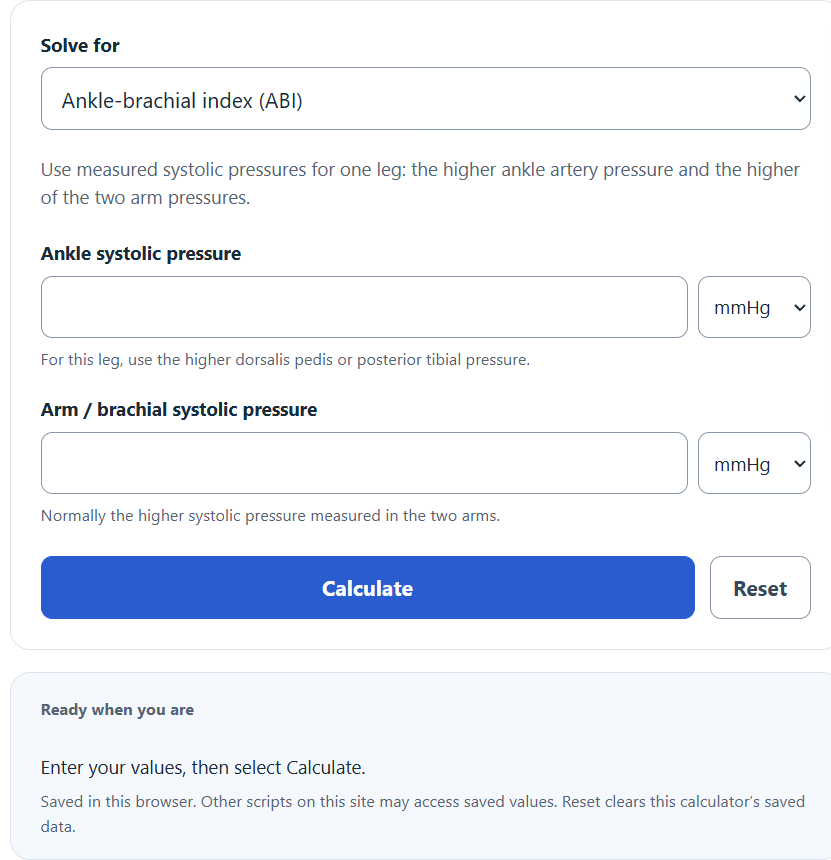
Calculate ankle-brachial index from ankle and arm systolic pressures, or find the missing SBP and convert between mmHg and kPa as needed. Choose the result under Solve for; reverse-calculated pressures are algebraic estimates, not measurements.
Measurement note: For each leg, clinical ABI is commonly the higher dorsalis pedis or posterior tibial systolic pressure divided by the higher of the right and left brachial systolic pressures; this calculator uses the values supplied and does not perform the measurements.
- Rest quietly for about 5–10 minutes before measuring.
- Measure systolic pressures (SBP). If you are using kPa, confirm your device reports kPa (not mmHg).
- For clinical measurement, ABI is often calculated separately for each leg using the higher ankle artery SBP and the higher brachial SBP (method may differ by clinic/guideline).
ABI Interpretation (informational)
- ≤ 0.90: abnormal
- 0.91–0.99: borderline
- 1.00–1.40: normal
- > 1.40: noncompressible
Medical disclaimer: For informational purposes only and not a diagnosis. If you have leg pain with walking, non-healing wounds, cool/numb feet, or sudden leg pain/weakness, seek medical care. For official interpretation and testing guidance, review consumer resources from organizations such as Mayo Clinic, MedlinePlus/NIH, or major heart/vascular societies and talk with a clinician.
ABI Formula
The ankle-brachial index, or ABI, compares systolic blood pressure at the ankle with systolic blood pressure at the arm. The calculator uses the same pressure unit for both values internally, converting kPa to mmHg when needed.
- ABI = ankle-brachial index, a unitless ratio
- BPankle = ankle systolic blood pressure
- BParm = arm or brachial systolic blood pressure
- BPmmHg = blood pressure in millimeters of mercury
- BPkPa = blood pressure in kilopascals
If you enter ankle systolic pressure and arm systolic pressure, the calculator divides ankle pressure by arm pressure to find ABI. If you enter ABI and arm pressure, it multiplies them to estimate ankle pressure. If you enter ABI and ankle pressure, it divides ankle pressure by ABI to estimate arm pressure. When kPa is selected, the pressure is converted to mmHg before the ratio is calculated, because ABI requires both pressures to be in the same unit.
ABI Result Ranges
Common resting-ABI reporting categories are: ≤0.90 abnormal; 0.91–0.99 borderline; 1.00–1.40 normal; and >1.40 noncompressible. Measurement technique, symptoms, and clinical context still matter, and noncompressible arteries may require another test.
Blood Pressure Unit Conversion
ABI is a ratio, so the unit cancels out only after both pressures are in the same unit.
| Conversion | Formula |
|---|---|
| kPa to mmHg | mmHg = kPa × 7.50062 |
| mmHg to kPa | kPa = mmHg ÷ 7.50062 |
Example
Example 1: Calculate ABI
You measure an ankle systolic pressure of 110 mmHg and an arm systolic pressure of 130 mmHg.
Rounded to two decimals, the ABI is 0.85.
Example 2: Calculate ankle systolic pressure
You have an ABI of 0.92 and an arm systolic pressure of 125 mmHg.
The ankle systolic pressure is 115 mmHg.
FAQ
Which arm pressure should be used for ABI?
Standard ABI measurement usually uses the higher brachial systolic pressure when both arms are measured. A low arm pressure on one side can make the ABI appear falsely high and potentially understate arterial disease; using the higher arm pressure reduces that distortion.
Does ABI have a unit?
No. ABI is a ratio, so it has no unit. The ankle and arm pressures must still be in the same unit before dividing. For example, you should not divide an ankle pressure in mmHg by an arm pressure in kPa without converting one of them first.
Can an ABI result diagnose peripheral artery disease by itself?
An ABI result can support the evaluation of peripheral artery disease, but it is not the only factor. Symptoms, medical history, pulse exam, testing conditions, and clinician interpretation all matter. Very high ABI values may also need different testing because stiff arteries can make the pressure reading less reliable.