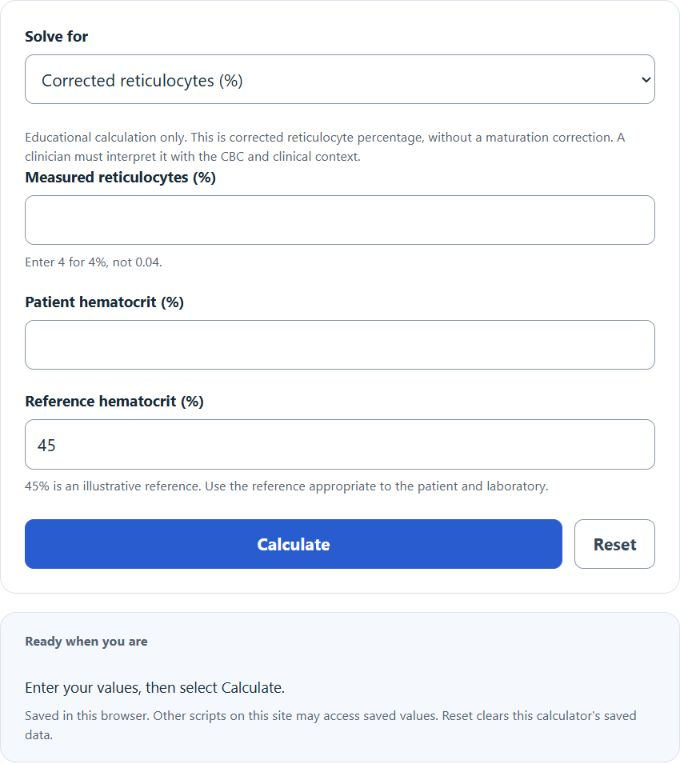
Calculate reticulocyte index from reticulocyte percentage, hematocrit, and normal hematocrit, or solve any missing value in the RI formula.
- Average Blood Pressure Calculator
- MAP Calculator (Mean Arterial Blood Pressure)
- All Health and Medical Calculators
- Absolute Lymphocyte Count
Retic Index Formula
The retic index adjusts the measured reticulocyte percentage for the patient’s hematocrit so the result better reflects marrow response relative to the degree of anemia. In this calculator, the retic index is the corrected reticulocyte percentage.
Definitions:
- RI = reticulocyte index
- Retic% = measured reticulocyte percentage
- Hct = patient hematocrit
- Hctnormal = normal or reference hematocrit used for correction
Use the same basis for both hematocrit values. For example, if the patient hematocrit is entered as 30, the normal hematocrit should be entered as 45, not 0.45. The reticulocyte value should be entered as a percentage, such as 4 for 4%.
Rearranged Forms
Select the value to solve for and enter the other three values. These rearrangements are useful:
What Each Input Means
| Field | Description | Entry Tip |
|---|---|---|
| Reticulocyte Percentage | The proportion of circulating red cells that are immature reticulocytes. | Enter as a percent value, such as 2.5 or 4. |
| Hematocrit | The patient’s measured packed red cell fraction. | Use the same format as the normal hematocrit. |
| Normal Hematocrit | The reference hematocrit chosen for comparison. | Keep this in the same units and style as the patient hematocrit. |
| Retic Index | The corrected reticulocyte percentage after adjusting for anemia severity. | This is the calculator output when the other three values are known. |
How to Calculate the Retic Index
- Select the value to solve for, then enter the measured reticulocyte percentage when requested.
- Enter the patient’s hematocrit.
- Enter the normal or reference hematocrit.
- Multiply the reticulocyte percentage by the patient hematocrit.
- Divide that result by the normal hematocrit.
This correction matters because a raw reticulocyte percentage can appear misleadingly high when the hematocrit is low. Adjusting for hematocrit gives a better sense of whether the marrow response is proportionate.
Example
If the reticulocyte percentage is 4, the patient hematocrit is 30, and the normal hematocrit is 45, then:
Even though the measured reticulocyte percentage is 4%, the corrected value is lower after accounting for the reduced hematocrit.
How to Interpret the Result
The retic index is used to judge whether red cell production is adequately increased for the patient’s level of anemia.
- Higher retic index: usually reflects a stronger regenerative marrow response.
- Lower retic index: may suggest that red cell production is not keeping pace with the clinical need.
- Equal patient and normal hematocrit: the correction factor becomes neutral, so the index matches the measured reticulocyte percentage.
Interpretation should always be paired with the rest of the CBC, clinical history, bleeding or hemolysis concerns, and the laboratory context.
Retic Index vs. Reticulocyte Production Index
The term “retic index” is sometimes used loosely. This calculator computes the corrected reticulocyte percentage. Some clinical workflows go one step further and estimate the reticulocyte production index by adding a maturation correction.
If you specifically need the reticulocyte production index, you would apply the appropriate maturation correction after finding the retic index.
Common Entry Mistakes
- Entering reticulocytes as 0.04 instead of 4.
- Mixing hematocrit formats, such as 30 for the patient and 0.45 for normal.
- Using a reference hematocrit that does not match the intended patient context.
- Confusing the corrected reticulocyte percentage with the reticulocyte production index.
Quick Practical Notes
- The calculator is most helpful when you want to correct a raw reticulocyte percentage for anemia severity.
- A normal-looking reticulocyte percentage can still represent a weak marrow response after correction.
- A high raw reticulocyte percentage does not automatically mean the response is adequate until hematocrit is considered.