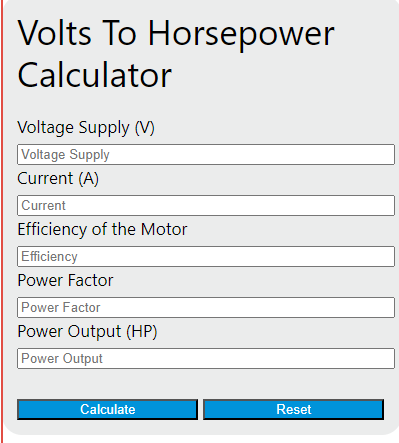
Calculate motor horsepower, current, or voltage for DC, single-phase, and three-phase power using amps, efficiency, power factor, HP, kW, V, and kV.
- All Unit Converters
- Electricity, Magnetism, & Electronics Unit Converters
- Volts To Hz Calculator
- Volts To Lumens Calculator
- Volts To Megawatts Calculator
Volts To Horsepower Formula
The following formula is used to calculate the horsepower from volts.
Variables:
- HP is the power output (horsepower)
- V is the voltage supply (volts)
- I is the current (amperes)
- E is the efficiency of the motor (decimal)
- PF is the power factor (decimal)
To calculate the horsepower, multiply the voltage supply by the current, then multiply the result by the efficiency of the motor and the power factor. Divide the result by 746 (since one horsepower is equivalent to approximately 746 watts).
| Voltage (V) | Horsepower (HP) |
|---|---|
| 12 | 0.123 |
| 24 | 0.246 |
| 48 | 0.492 |
| 60 | 0.615 |
| 90 | 0.923 |
| 110 | 1.128 |
| 120 | 1.231 |
| 208 | 2.133 |
| 220 | 2.256 |
| 230 | 2.359 |
| 240 | 2.461 |
| 277 | 2.841 |
| 300 | 3.076 |
| 380 | 3.897 |
| 400 | 4.102 |
| 415 | 4.256 |
| 440 | 4.512 |
| 460 | 4.717 |
| 480 | 4.922 |
| 600 | 6.153 |
| * Rounded to 3 decimals. HP = V x A x n x pf / 746. Assumes I=10A, n=90%, pf=0.85. | |
Three-Phase and DC Motor Formulas
The single-phase formula above applies to standard household and light commercial motors. For industrial three-phase motors, the formula includes the square root of 3 (approximately 1.732) to account for the phase relationship between the three power lines:
Where V_LL is the line-to-line voltage (e.g. 208V, 230V, 460V, or 575V). If using line-to-neutral voltage instead, multiply by 3 rather than 1.732.
For DC motors, there is no power factor or phase angle to consider, so the formula simplifies to:
DC motors are common in battery-powered vehicles, traction drives, and variable-speed industrial applications where precise torque control is required.
Why 746 Watts Equals One Horsepower
The 746 constant in the formula traces back to James Watt’s experiments in the 1780s measuring the sustained output of draft horses turning a mill wheel. Watt determined that a strong horse could perform roughly 33,000 foot-pounds of work per minute. Converting that figure into SI units yields 745.69987 watts, which rounds to the standard 746 W/hp used in electrical engineering today. This mechanical origin is why the conversion factor is not a clean number and why it appears in every electrical-to-mechanical power calculation.
Understanding Efficiency and Power Factor
Motor efficiency (E) represents the percentage of electrical input power that becomes useful mechanical shaft output. The remainder is lost as heat through copper losses in the windings, iron losses in the core laminations, friction in the bearings, and windage from the cooling fan. NEMA Premium efficiency standards require minimum efficiencies of 85.5% for a 1 HP motor up to 95.8% for a 200 HP motor at full load. Efficiency peaks near 75% of rated load and degrades significantly below 50% load, which is a common cause of wasted energy in oversized installations.
Power factor (PF) measures how effectively current is converted into real working power in an AC circuit. A power factor of 1.0 means all supplied current does useful work. Induction motors typically operate between 0.80 and 0.95 power factor at full load. At light loads, the power factor drops sharply because the magnetizing current stays roughly constant while the working current decreases. Low power factor increases the apparent current drawn from the supply, oversizes conductors and transformers, and may trigger utility power factor penalties. Capacitor banks or variable frequency drives are common corrections.
Typical Motor Efficiency and Power Factor by Size
| Motor Size (HP) | NEMA Premium Min. Efficiency (%) | Typical Power Factor |
|---|---|---|
| 1 | 85.5 | 0.75 – 0.82 |
| 3 | 89.5 | 0.80 – 0.86 |
| 5 | 89.5 | 0.82 – 0.87 |
| 10 | 91.7 | 0.84 – 0.89 |
| 25 | 93.0 | 0.86 – 0.91 |
| 50 | 94.1 | 0.88 – 0.92 |
| 100 | 95.4 | 0.89 – 0.93 |
| 200 | 95.8 | 0.90 – 0.95 |
| * NEMA Premium efficiency values per NEMA MG 1-2016, Table 12-12 for 4-pole, 460V, ODP motors. | ||
NEC Full-Load Ampere Reference
The National Electrical Code (NEC) Tables 430.248 and 430.250 provide standard full-load current values used for conductor sizing, overcurrent protection, and branch circuit design. These values assume standard-speed, normal-torque motors. Always use the actual nameplate current for motor protection calculations, as individual motors may differ from table values.
| HP | 115V | 200V | 208V | 230V |
|---|---|---|---|---|
| 1/6 | 4.4 | 2.5 | 2.4 | 2.2 |
| 1/4 | 5.8 | 3.3 | 3.2 | 2.9 |
| 1/3 | 7.2 | 4.1 | 4.0 | 3.6 |
| 1/2 | 9.8 | 5.6 | 5.4 | 4.9 |
| 3/4 | 13.8 | 7.9 | 7.6 | 6.9 |
| 1 | 16.0 | 9.2 | 8.8 | 8.0 |
| 1.5 | 20.0 | 11.5 | 11.0 | 10.0 |
| 2 | 24.0 | 13.8 | 13.2 | 12.0 |
| 3 | 34.0 | 19.6 | 18.7 | 17.0 |
| 5 | 56.0 | 32.2 | 30.8 | 28.0 |
| 7.5 | 80.0 | 46.0 | 44.0 | 40.0 |
| 10 | 100.0 | 57.5 | 55.0 | 50.0 |
| * Values from NEC Table 430.248. Use nameplate amps for actual motor protection sizing. | ||||
| HP | 115V | 200V | 208V | 230V | 460V | 575V |
|---|---|---|---|---|---|---|
| 1/2 | 4.4 | 2.5 | 2.4 | 2.2 | 1.1 | 0.9 |
| 3/4 | 6.4 | 3.7 | 3.5 | 3.2 | 1.6 | 1.3 |
| 1 | 8.4 | 4.8 | 4.6 | 4.2 | 2.1 | 1.7 |
| 1.5 | 12.0 | 6.9 | 6.6 | 6.0 | 3.0 | 2.4 |
| 2 | 13.6 | 7.8 | 7.5 | 6.8 | 3.4 | 2.7 |
| 3 | — | 11.0 | 10.6 | 9.6 | 4.8 | 3.9 |
| 5 | — | 17.5 | 16.7 | 15.2 | 7.6 | 6.1 |
| 7.5 | — | 25.3 | 24.2 | 22.0 | 11.0 | 9.0 |
| 10 | — | 32.2 | 30.8 | 28.0 | 14.0 | 11.0 |
| 15 | — | 48.3 | 46.2 | 42.0 | 21.0 | 17.0 |
| 20 | — | 62.1 | 59.4 | 54.0 | 27.0 | 22.0 |
| 25 | — | 78.2 | 74.8 | 68.0 | 34.0 | 27.0 |
| 30 | — | 92.0 | 88.0 | 80.0 | 40.0 | 32.0 |
| 40 | — | 120.0 | 114.0 | 104.0 | 52.0 | 41.0 |
| 50 | — | 150.0 | 143.0 | 130.0 | 65.0 | 52.0 |
| * Values from NEC Table 430.250 for squirrel-cage induction motors. | ||||||
Where This Conversion Applies
Converting volts to horsepower is necessary whenever you need to determine or verify the mechanical output of an electric motor from its electrical supply characteristics. HVAC technicians use it to confirm that a replacement blower or compressor motor matches the original equipment rating. Electricians size branch circuits, contactors, and overload relays based on the expected horsepower and corresponding full-load amps. Industrial maintenance teams use it to audit whether existing motors are appropriately loaded or oversized, since motors running below 50% load waste energy through poor efficiency and low power factor. In automotive and marine applications, this conversion helps compare electric drive systems with traditional combustion ratings, particularly as EV motor specifications are often listed in kilowatts while legacy benchmarks remain in horsepower.
Common Voltage Standards by Application
Residential circuits in North America supply 120V single-phase for small appliances and 240V single-phase for larger loads like well pumps and air compressors. Light commercial buildings commonly use 208V three-phase derived from a wye transformer. Industrial facilities operate at 460V or 575V three-phase to reduce conductor size and I2R losses in long cable runs. Motors above 200 HP in heavy industry may use medium-voltage supplies of 2,300V or 4,160V. Each voltage level changes the current draw for a given horsepower rating, which directly affects wire gauge selection, breaker sizing, and overall installation cost. The NEC tables above reflect these standard voltage tiers.